The best illustrated language flash cards make new words, signs, and phrases easier to understand and remember. Clear images, readable text, and useful organization can turn short practice sessions into engaging lessons for children, beginners, travelers, and learners who benefit from visual support.
This roundup compares 10 options across American Sign Language, Spanish, idioms, social communication, and foundational vocabulary. Use the guide below to match a deck’s content, format, and difficulty level to the learner and teaching setting.
Best 10 Illustrated Language Flash Cards Picks for 2026
Best ASL Starter Set
American Sign Language Flash Cards

- 105 cards covering 122 signs
- Includes alphabet, numbers, feelings, and animals
- Rounded corners and a resource card
Best For: Preschool and kindergarten ASL practice
Best Spanish Vocabulary Set

- 56 bilingual cards with illustrations
- Includes example sentences and pronunciation guide
- Sturdy, travel-friendly storage box
Best For: Foundational Spanish practice for ages 4+
Best Portable ASL Practice

- 101 cards across four everyday topics
- Explains each sign and how to perform it
- Includes a felt storage bag
Best For: Beginner ASL practice at home or in class
Best Social Conversation Cards

- 80 illustrated real-life situations
- 480+ prompts using who, what, where, why, and how
- Supports language and social-emotional skills
Best For: Speech therapy and guided social-skills conversations
Travel-Ready Spanish Practice
Spanish Conversational Phrase Flash Cards

- 100 cards cover vocabulary and daily phrases
- Bilingual text includes pronunciation and illustrations
- Portable, wipeable cards with storage box
Best For: Spanish beginners, travel practice, and classroom review
Early ASL Skills Builder
160 American Sign Language Flash Cards

- 160 cards introduce core ASL signs
- Includes signing illustrations and written descriptions
- Covers alphabet, numbers, phrases, emotions, and more
Best For: Young children, classrooms, homeschool, and therapy games
Figurative Language Practice
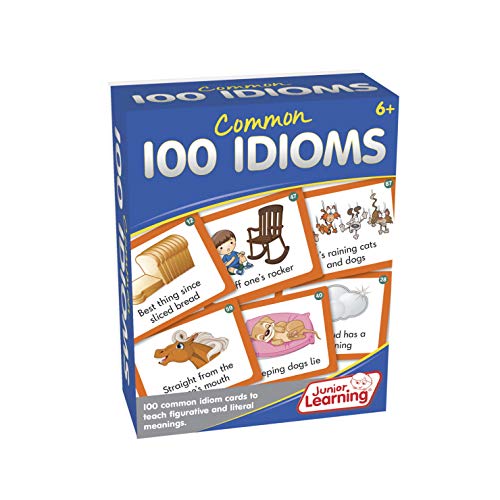
- 100 cards focus on common idioms
- Illustrations support memorable learning
- Example sentences show usage in context
Best For: Children practicing reading and figurative language
Best Large-Format Starter Set

- 240 cards across five color-coded themes
- Large laminated cards with visual sign guides
- Includes rings and a storage box
Best For: Beginners, classrooms, homeschool, and speech therapy
Best Real-Photo Vocabulary Aid
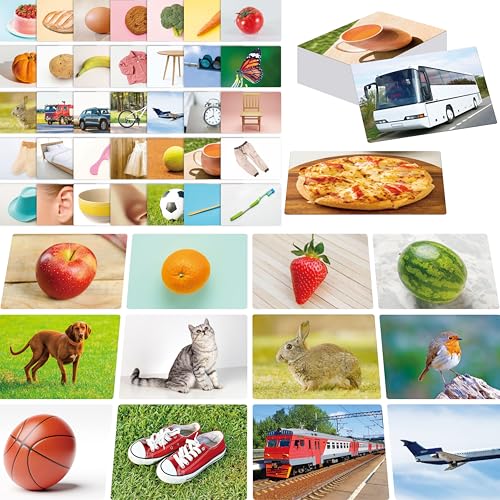
- 50 double-sided noun cards
- Real-life photos paired with printed words
- Supports matching and sentence activities
Best For: Foundational vocabulary, ESL, speech therapy, and autism support
Best Comprehensive ASL Vocabulary Set

- 500 cards in ten themed packs
- Self-checking backs and color-coded sorting
- Laminated cards with ten rings and storage box
Best For: Broad ASL study, classrooms, homeschool, and therapy
Best ASL Starter Set – American Sign Language Flash Cards
For families introducing sign language, these illustrated language flash cards combine colorful signing illustrations with corresponding words. The double-sided set covers 122 signs across foundational topics, including letters, numbers, animals, feelings, people, and sight words.
Best For: Preschool and kindergarten learners practicing everyday ASL with a parent, teacher, or caregiver.
Pros:
- Includes 105 cards covering 122 signs.
- Features alphabet letters, numbers 1–20, animals, feelings, people, and more.
- Rounded corners make cards easier to sort and flip.
- Resource card lists the included signs and words.
Cons:
- The set is focused on introductory signs rather than advanced ASL instruction.
- Cards are made from cardstock, so repeated handling may require care.
Its broad beginner vocabulary and simple illustration-to-word format make this a flexible choice for early ASL practice at home or in preschool settings.
Best Spanish Vocabulary Set – Spanish Vocabulary Flashcards
These illustrated language flash cards introduce basic Spanish vocabulary through colorful artwork, English and Spanish words, and example sentences. The set organizes 56 cards into seven categories and includes pronunciation guidance for beginner practice.
Best For: Children ages 4 and up learning foundational Spanish vocabulary at home, in class, or with family members.
Pros:
- Each card combines an illustration, bilingual vocabulary, and a sentence.
- Includes directions and a pronunciation guide.
- Sturdy box supports travel and storage.
- Uses recycled and FSC-certified materials with vegetable-based ink.
Cons:
- The set focuses on eight basic vocabulary words in seven categories.
- It is intended for foundational practice rather than comprehensive language study.
The bilingual sentence format adds context beyond simple word memorization, while the compact box makes this set practical for individual or classroom activities.
Best Portable ASL Practice – CHEFAN ASL Flash Cards
CHEFAN’s illustrated language flash cards provide beginner-friendly ASL practice with 101 double-sided cards. One side shows the gesture, while the reverse explains the sign and how to perform it, organized around four everyday topics.
Best For: Children, teens, and adults learning practical ASL at home, in classrooms, during homeschooling, or in therapeutic play.
Pros:
- Covers family and relationships, home activities, food and drink, and feelings and communication.
- Explanations and performance instructions support beginners.
- Durable 5 x 3.4-inch cards include a corner arch for organization.
- Includes a felt storage bag for portability.
Cons:
- The set emphasizes everyday beginner signs rather than a complete ASL curriculum.
- The supplied details describe the cards as paper, which may be less rugged than plastic cards.
The combination of instructional backs, practical categories, and a storage bag makes this a convenient option for repeated family or classroom practice.
Best Social Conversation Cards – 80 Scene Conversation Cards
These illustrated language flash cards use everyday scenes to prompt conversation, observation, and reasoning. Each of the 80 cards pairs a colorful situation with questions covering who, what, where, why, and how.
Best For: Speech therapy, social-emotional learning, group activities, and parent-child conversations for children ages 3 and up.
Pros:
- Includes 80 illustrated scenes from settings such as school, family life, playgrounds, and public places.
- Each card provides multiple prompts for extended discussion.
- Supports language expression, listening, observation, empathy, and critical thinking.
- Laminated cardstock is designed for repeated use.
Cons:
- These are discussion and social-skills cards, not conventional vocabulary flash cards.
- The open-ended prompts may work best with an adult facilitator.
Choose this set when the goal is expressive language and social understanding rather than memorizing isolated words. The scene-based format gives adults a clear starting point for meaningful discussion.
Travel-Ready Spanish Practice – Spanish Conversational Phrase Flash Cards
For learners seeking illustrated language flash cards for practical Spanish study, this 100-card set combines vocabulary, daily phrases, pronunciation, and cartoon illustrations. The bilingual format and portable storage box make it convenient for quick practice at home, in class, or while traveling.
Best For: Spanish beginners, travelers, homeschoolers, and classroom or self-study practice.
Pros:
- Includes 50 vocabulary cards and 50 daily-language cards.
- English and Spanish sides include pronunciation and cartoon illustrations.
- Thick, rounded, wipeable cards come in a reusable storage box.
- Supports self-quizzing, pair work, and language games.
Cons:
- Focuses specifically on Spanish rather than multiple languages.
- The compact card format may provide limited space for extended explanations.
This is a practical choice when portability and everyday conversational phrases matter most. Its visual design and multiple practice options make it approachable for beginners, while the durable construction suits repeated handling.
Early ASL Skills Builder – 160 American Sign Language Flash Cards
These illustrated language flash cards introduce children to American Sign Language through signing illustrations and written descriptions. The 160-card set covers foundational signs, from the alphabet and numbers to sight words, phrases, emotions, and greetings.
Best For: Children ages 4–8, preschool through second-grade learners, families, teachers, homeschoolers, and therapy games.
Pros:
- Includes 160 illustrated ASL cards with written sign descriptions.
- Covers finger names, hand positions, and fingerspelling examples.
- Introduces signs for alphabet, numbers, sight words, emotions, greetings, and parts of speech.
- Can support classroom, homeschool, and therapy-based learning activities.
Cons:
- Designed primarily for younger learners, with a listed reading age of 4–8.
- The set is focused on ASL rather than spoken-language vocabulary.
Families and educators looking for a broad introductory ASL resource may find this set especially useful. Its range of topics supports structured review and interactive practice as children build signing confidence.
Figurative Language Practice – 100 Common Idiom Flash Cards
For children building reading and vocabulary skills, these illustrated language flash cards make common idioms easier to understand and remember. Each card pairs an engaging illustration with an example sentence, while the double-sided design supports quizzing and review.
Best For: Children ages 6–10 practicing idioms, figurative language, reading, and vocabulary.
Pros:
- Includes 100 common idioms for focused vocabulary practice.
- Engaging illustrations help make each expression memorable.
- Example sentences show how idioms are used in context.
- Double-sided cards can be used to quiz or test understanding.
Cons:
- Concentrates on idioms rather than general conversational language.
- Recommended for children ages 6–10, so it may not suit very young learners.
This set is a targeted supplement for literacy instruction rather than a general language course. The combination of visuals, highlighted idioms, and usage examples gives children several ways to connect figurative expressions with meaning.
Best Large-Format Starter Set – ASL Flash Cards for Beginners
If you want illustrated language flash cards for learning American Sign Language, this 240-card set emphasizes large visuals, written guidance, and practical vocabulary. The five color-coded packs cover topics including alphabets, numbers, food, emotions, seasons, and greetings, making it easy to organize lessons by theme.
Best For: Kids, adults, teachers, parents, and therapists who want a large-format ASL set for homeschool, classroom, special education, speech therapy, or home learning.
Pros:
- Includes 240 cards covering everyday ASL vocabulary across five themed packs.
- Large 5.71-by-3.94-inch format is designed for children’s hands and classroom use.
- Visual guides and written descriptions explain handshape, location, and movement.
- Laminated 350gsm cardstock, five metal rings, and a storage box support repeated use and organization.
Cons:
- Contains fewer cards and themed packs than the 500-card ASL alternative.
- The cards focus on visual and written instruction rather than an included interactive or digital component.
This is a practical choice when readability and straightforward organization matter more than maximum vocabulary volume. Its large cards and step-by-step sign guidance should be especially useful for beginners and group instruction.
Best Real-Photo Vocabulary Aid – Noun Picture and Word Cards
These illustrated language flash cards use real-life photos to connect 50 everyday nouns with written vocabulary. The double-sided format shows the image on one side and the corresponding word on the other, supporting matching, recognition, sentence practice, and simple storytelling.
Best For: Children and adults building foundational noun vocabulary in general education, kindergarten, homeschooling, speech therapy, ESL instruction, autism support, or dementia-related learning.
Pros:
- Includes 50 double-sided cards focused on practical everyday nouns.
- Real-life photos help learners connect words with familiar objects.
- Large 4-by-5.8-inch cards offer readable text and visible images.
- Can be used for matching games, acting activities, sentence building, and short stories.
Cons:
- Limited to nouns, so it does not provide verbs, phrases, or broader themed vocabulary.
- Offers one 50-card pack rather than multiple color-coded sets or sorting rings.
- The notes do not specify laminated or tear-resistant construction.
Choose this set when concrete vocabulary and photo-based learning are the priority. It is less comprehensive than a full language curriculum, but its simple format makes it flexible for one-on-one practice, travel, and classroom activities.
Best Comprehensive ASL Vocabulary Set – 500-Card ASL Bundle
For shoppers seeking illustrated language flash cards with broad American Sign Language coverage, this 500-card bundle offers ten color-coded themed packs. It includes basics, early vocabulary, calendar terms, mealtime, animals, nouns, verbs, sight words, and other practical categories, with self-checking answers on the card backs.
Best For: Toddlers, kids, teens, adults, ASL students, teachers, parents, and therapists who need a large vocabulary resource for classrooms, homeschool, speech therapy, or home learning.
Pros:
- Provides 500 cards covering alphabets, numbers, food, emotions, nouns, verbs, sight words, and daily themes.
- Ten color-coded packs and ten rings allow targeted study and custom sorting.
- Double-sided cards include inclusive illustrations on the front and answers on the back for self-checking.
- 350gsm laminated cardstock is described as waterproof, tear-resistant, and long-lasting, with a storage box included.
Cons:
- The extensive number of cards may feel less manageable for learners who need a small introductory set.
- Its listed weight of 3.7 pounds may make it less convenient for carrying than a smaller pack.
- The cards are smaller than the large-format ASL set, measuring 2.8 by 4.3 inches.
This is the strongest option for buyers who want the widest ASL vocabulary range and a structured way to divide study. The color system, self-checking backs, and rings make the large collection easier to use, while the smaller card size keeps the set practical for children and group activities.
How We Picked These Illustrated Language Flash Cards
We focused on decks with a clear connection between visual cues and language concepts, while considering subject coverage, card count, learner age, and intended use. The selection includes ASL sign references, Spanish vocabulary and phrases, idioms, conversation prompts, and picture-based noun cards. We also looked for practical details such as beginner-friendly wording, classroom usefulness, portability, and whether a set supports independent review or guided instruction.
Because “illustrated” can mean anything from simple line drawings to photographs, check the product images and listing details before buying. Visual style matters, especially for children or learners who need uncluttered, highly recognizable cues.
Quick Comparison
| Best for | Look for |
|---|---|
| ASL beginners | Large illustrations, labeled signs, and broad everyday coverage |
| Young children | Simple pictures, durable cards, and age-appropriate concepts |
| Spanish learners | Vocabulary or conversational phrases matched to the learner’s level |
| Social communication | Scene cards with prompts using who, what, where, when, why, or how |
| Classroom instruction | Generous card counts and categories that support lesson planning |
Key Buying Factors for Illustrated Language Flash Cards
Language and Learning Goal
Start with the skill you want to build. ASL decks should show signs clearly and, ideally, identify the associated word or phrase. Spanish sets may emphasize isolated vocabulary, travel phrases, or conversational practice. Picture cards can support nouns, receptive language, ESL instruction, or structured communication activities.
Visual Clarity and Readability
Choose images that are recognizable at a glance and text that remains readable from a teaching distance. For ASL, hand position, movement, and orientation are especially important. If a card relies on a single still image, learners may need demonstrations or supplemental video to understand motion-based signs.
Coverage and Organization
A larger deck is not automatically better. Broad sets offer more repetition and category options, while smaller decks can be less overwhelming for beginners. Look for alphabetical, thematic, or skill-based organization if you plan to build regular lessons.
Format and Durability
Consider card size, storage, finish, and how often the deck will be handled. Large cards can be easier for groups and young learners to see, while compact cards travel well. Frequent classroom use favors sturdy stock or cards that can be protected with sleeves.
Who Should Buy Which Illustrated Language Flash Cards?
Choose a dedicated ASL set for sign-language practice, particularly when learning common nouns, verbs, numbers, or alphabet signs. Families and educators working with preschool or early elementary learners should prioritize simple illustrations and age-matched vocabulary. Spanish beginners can choose vocabulary cards for foundational words or phrase cards for travel and practical conversation.
For speech-language, autism-support, or ESL settings, picture-and-word noun cards may be the most flexible starting point. Scene conversation cards are better suited to practicing questions, responses, social inference, and descriptive language. Learners expanding English vocabulary may benefit from an idiom-focused deck after mastering more literal everyday terms.
Whichever set you choose, use brief, repeated sessions: introduce a few cards, ask the learner to identify or demonstrate each item, then revisit missed cards later. Flash cards work best as a supplement to conversation, modeling, reading, and real-world practice—not as a replacement for them.