The best language flash cards for toddlers make early vocabulary practice simple, playful, and easy to repeat. This roundup compares traditional picture cards, talking sets, bilingual decks, and sign-language tools for different learning needs.
Whether you are building first words, supporting speech practice, introducing Spanish, or learning ASL together, the right deck should match your child’s age, interests, attention span, and communication goals.
Best 10 Language Flash Cards for Toddlers Picks for 2026
Best All-Around Starter Set

- 101 cards cover everyday first-word categories
- Reverse-side games add counting and observation practice
- Thick, wipe-clean cards suit toddler use
Best For: Screen-free first-word learning from toddlerhood through preschool
Best for Bilingual Learning
English-Spanish Talking Flash Cards

- Teaches 512 words in English and Spanish
- Audio reader provides clear spoken pronunciation
- Covers 31 themes from colors to transportation
Best For: Bilingual vocabulary exposure for toddlers and preschoolers
Best for Sign Language
American Sign Language Flash Cards

- Teaches 122 signs across 105 cards
- Covers alphabet, numbers, feelings, animals, and food
- Pairs signing illustrations with related words
Best For: Guided ASL communication practice for children
Best Audio Option for Younger Toddlers

- Introduces 510 English words across 31 themes
- Audio reader reinforces pronunciation and listening
- Designed for simple insert-and-use play
Best For: Audio-supported English vocabulary practice from age 1
Best Comprehensive Set
Early Learning Language Library

- 160 photographic vocabulary cards
- Includes guided questions and game ideas
- Bilingual Spanish text included
Best For: Preschool language practice, speech therapy, and special learners
Best First Words Pick

- 50 everyday first-word picture cards
- Thick, double-laminated construction
- Includes five games and a parent guide
Best For: Early first-word practice with babies and young toddlers
Best for Comfort
200 American Sign Language Cards

- 200 cards in four themed packs
- Illustrations and sign descriptions
- Matte-laminated, color-coded cards
Best For: Families and classrooms introducing ASL vocabulary
Everyday Vocabulary Pick

- 110 common words with double-sided cards
- Full-color photographs for visual learning
- Parent guide includes games and activities
Best For: Preschool vocabulary practice with adult-led activities
Early Communication Choice
My First Baby Sign Language Flash Cards

- More than 75 everyday ASL signs
- Includes alphabet and numbers 1–10
- 4-by-6-inch glossy cards with illustrations
Best For: Introducing signs to infants and toddlers ages 0–3
Broad Skills Set
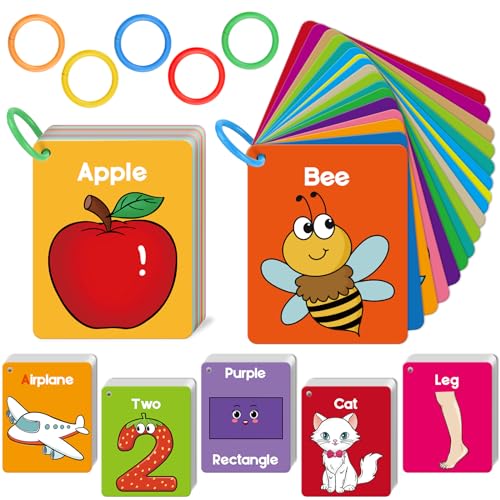
- 60 double-sided cards across early-learning topics
- Covers first words, letters, numbers, and more
- Five rings help sort and organize cards
Best For: Ages 3+ needing varied preschool learning practice
Best All-Around Starter Set – 101 First Words Flash Cards
For parents seeking language flash cards for toddlers, this 101-card set combines first-word vocabulary with simple games. The cards cover animals, food, household and outdoor objects, places, numbers, and more, making it a practical choice for early language practice.
Best For: Toddlers beginning first-word and object recognition practice from about 12 months through the preschool years.
Pros:
- Includes 101 cards covering familiar everyday categories.
- Reverse sides add games involving colors, counting, spelling, and observation.
- Large 3.7-by-5-inch cards use bright illustrations and rounded corners.
- Thick, wipe-clean cardboard is designed for messy toddler use.
Cons:
- The set is English-language only.
- Its traditional cards do not provide spoken audio.
This is a strong general-purpose option when you want screen-free vocabulary practice with extra activities built into each card. Its durable design and broad everyday vocabulary make it especially versatile for home or preschool routines.
Best for Bilingual Learning – English-Spanish Talking Flash Cards
These language flash cards for toddlers add audio and bilingual practice to vocabulary learning. The reader presents 512 English and Spanish words across themes such as animals, colors, shapes, transportation, food, and numbers.
Best For: Children ages 2 and up whose families want independent English-Spanish vocabulary exposure with spoken pronunciation.
Pros:
- Supports simultaneous English and Spanish learning.
- Includes 512 words across 31 themes.
- A clear standard American-accent voice reinforces auditory learning.
- Inserting cards into the reader is designed for simple independent use.
Cons:
- The electronic reader requires more setup than a traditional card set.
- The supplied age information varies between 2+ and 3+ recommendations.
This set stands out for households looking beyond single-language vocabulary. Parents can select cards suited to a child’s development while the audio reader adds a listening component to picture-and-word practice.
Best for Sign Language – American Sign Language Flash Cards
For families using American Sign Language, these language flash cards for toddlers and preschoolers pair colorful signing illustrations with associated words. The set covers 122 signs, including alphabet letters, numbers, feelings, animals, food, people, and sight words.
Best For: Guided ASL practice with preschoolers, kindergarteners, and older children learning foundational communication signs.
Pros:
- Provides 105 cards covering 122 ASL signs.
- Includes alphabet letters, numbers 1–20, sight words, animals, and more.
- Double-sided format shows a signing illustration and corresponding word.
- Rounded corners make cards easier to sort and flip.
Cons:
- The listed recommended age information spans a very broad range.
- It is intended for ASL practice rather than spoken bilingual vocabulary.
This is a useful supplement for households, classrooms, or caregivers incorporating ASL into early communication. Because the cards are designed for practice alongside an adult, they work best as an interactive teaching tool rather than a fully independent activity.
Best Audio Option for Younger Toddlers – English Talking Flash Cards
These English language flash cards for toddlers use a card reader to introduce 510 words across 31 everyday themes. The set combines pictures, spoken words, and simple insert-and-listen play for children starting around age 1.
Best For: Younger toddlers who benefit from audio-supported English vocabulary practice involving familiar objects, foods, animals, colors, and numbers.
Pros:
- Offers 510 English words across 31 themes.
- Includes common toddler topics such as food, animals, shapes, colors, and transportation.
- A clear standard American-accent voice supports listening and vocabulary development.
- The reusable box and simple card insertion support convenient storage and use.
Cons:
- It requires the electronic reader rather than functioning as cards alone.
- The supplied age details vary between 1–3 and 1–6 years.
This option is a good fit when spoken reinforcement is more engaging than static cards. Its extensive theme coverage gives families room to progress from basic object recognition toward broader vocabulary practice.
Best Comprehensive Set – Early Learning Language Library
For parents, teachers, and therapists seeking language flash cards for toddlers ages 3 and up, this set offers broad vocabulary coverage with photographic images and guided activities. It includes words for food, colors, animals, transportation, emotions, actions, and school activities.
Best For: Preschoolers, kindergarten learners, special learners, and speech or language practice at home or in the classroom.
Pros:
- Includes 160 large photographic vocabulary cards.
- Supports expressive and receptive language development.
- Includes a resource guide with word lists and game ideas.
- Features guided questions and bilingual Spanish text.
Cons:
- The recommended age starts at 36 months, so it may not suit younger toddlers.
- The larger set may be more than families need for simple first-word practice.
This is the most extensive option of the three for structured vocabulary building. Its wide topic range and included teaching guidance make it particularly practical for speech therapy, preschool instruction, and repeated practice at home.
Best First Words Pick – 50 First Words Noun Cards
These compact language flash cards for toddlers focus on 50 familiar first words, including everyday objects, animals, food, and body parts. Their thick, laminated construction and small format make them convenient for little hands, short practice sessions, and travel.
Best For: Babies and young toddlers beginning first-word learning, requesting practice, and simple language activities at home or in ABA sessions.
Pros:
- Focuses on 50 high-frequency words used in daily life.
- Thick, double-laminated cards are designed for repeated handling.
- Includes a parent guide, five educational games, and a vocabulary checklist.
- Real-life images on uncluttered white backgrounds support recognition.
Cons:
- The set is limited to 50 cards and is English-only.
- The listed age information varies between 12 months–2 years and ages 2–3.
- Interactive video features require access to the related videos.
Choose this set when you want a focused introduction rather than a large vocabulary library. The practical word selection, parent activities, and durable 3.5-inch cards suit brief, repeatable learning sessions.
Best for Comfort – 200 American Sign Language Cards
ASL Kids Flash Cards - 200 American Sign Language Cards for Children, Toddlers and Beginners
Check Price On AmazonFamilies looking for language flash cards for toddlers that introduce American Sign Language can use this 200-card set to practice signs through colorful illustrations and written instructions. The cards cover basics, early vocabulary, familiar signs, and day-to-day topics.
Best For: Families, preschool classrooms, and beginners learning ASL vocabulary through visual repetition and games.
Pros:
- Includes 200 cards across four themed packs.
- Covers alphabet, numbers, people, animals, emotions, colors, greetings, and more.
- Double-sided cards provide an illustration and a sign description.
- Color-coded category tabs help with sorting and organization.
Cons:
- The recommended age begins at 3 years and up.
- This set teaches ASL rather than spoken first-word vocabulary.
- Its broad coverage may be more advanced than needed for a toddler starting with a few signs.
This is the clear choice for introducing sign language alongside early communication. The substantial card count, category organization, and performance descriptions support both guided family practice and classroom activities.
Everyday Vocabulary Pick – First Words Flash Cards
For shoppers comparing language flash cards for toddlers, this Scholastic set focuses on building vocabulary through 110 common words. Double-sided cards use full-color photographs, while the included parent guide adds games and activities for more interactive practice.
Best For: Families seeking a photo-based first-words deck with guided activities.
Pros:
- Includes 110 common vocabulary words.
- Full-color photographs offer clear visual prompts.
- Parent guide includes games and activities.
Cons:
- The listed reading age starts at 4 years and up, so it may not suit younger toddlers.
- The set is in English only.
This is a straightforward choice for preschool vocabulary practice, particularly when adults want more structure than simple card review. Its age guidance is worth checking before buying for a very young child.
Early Communication Choice – My First Baby Sign Language Flash Cards
My First Baby Sign Language Flash Cards: Essential ASL Signs to Learn and Practice
Check Price On AmazonAmong language flash cards for toddlers, this set takes a communication-first approach by teaching more than 75 everyday ASL signs. Cards cover routines, emotions, play, the ASL alphabet, and numbers 1–10, with signing instructions and vibrant illustrations for parent-and-child practice.
Best For: Infants and toddlers ages 0–3 whose families want to introduce everyday baby signs.
Pros:
- Includes more than 75 everyday signs.
- Covers the ASL alphabet and numbers 1–10.
- Large 4-by-6-inch cards pair instructions with illustrations.
- Glossy cards are described as resistant to wear and drool.
Cons:
- This is an ASL-focused set rather than a traditional spoken first-words deck.
- Signing practice requires an adult to model and reinforce the gestures.
This set is a strong fit when the goal is early expression before spoken language develops. Its broad everyday vocabulary and durable design also make it practical for home, daycare, or travel.
Broad Skills Set – Torlam Toddler Flash Cards
For buyers wanting language flash cards for toddlers alongside wider early-learning practice, this Torlam set covers first words plus letters, numbers, shapes, colors, animals, body parts, and foods. It includes 60 double-sided cards and five colored rings for sorting and organization.
Best For: Children ages 3 and up who benefit from varied preschool and kindergarten-readiness topics.
Pros:
- Covers multiple foundational subjects in one 60-card set.
- Large 4-by-5-inch cards are designed for little hands.
- Rounded edges and five rings support handling and categorization.
- Illustrations, vibrant colors, and readable fonts encourage visual engagement.
Cons:
- The manufacturer-recommended age is 3 years and up.
- Its broad subject mix may provide less depth in first-word vocabulary than a dedicated language deck.
This is a versatile option for families or classrooms that want one compact set for several early-learning themes. Choose it for variety and sorting flexibility rather than a language-only curriculum.
How We Picked the Best Language Flash Cards for Toddlers
We compared these Language Flash Cards for Toddlers by looking at vocabulary coverage, age suitability, card durability, visual clarity, learning format, and ease of use for parents, caregivers, and educators. We also considered whether each set supports a specific goal, such as first words, speech therapy, bilingual learning, early concepts, or American Sign Language.
Because toddlers learn through repetition and interaction, we favored products that make it easy to practice a small number of words at a time. Talking cards can add audio feedback, while traditional cards encourage naming, pointing, imitation, and open-ended conversation.
Quick Comparison
| Best For | Recommended Type | What to Look For |
|---|---|---|
| First vocabulary | First-word picture cards | Clear images and familiar nouns |
| Independent audio practice | Talking flash cards | Simple controls and understandable pronunciation |
| Spanish-English learning | Bilingual talking cards | Accurate audio in both languages |
| ASL introduction | Sign-language cards | Readable illustrations and word associations |
| Speech support | Therapy-oriented vocabulary cards | Organized categories and repeatable activities |
| Early concepts | Multi-topic toddler cards | Alphabet, numbers, colors, shapes, and animals |
Key Buying Factors for Language Flash Cards for Toddlers
Vocabulary and Learning Objective
Choose a deck based on the words your child is ready to learn. First-word sets usually focus on people, objects, food, animals, and body parts. Broader decks may add letters, numbers, colors, and shapes, while specialized sets focus on ASL or speech practice.
Card Quality and Toddler Safety
Look for thick cards with rounded corners, easy-to-clean surfaces, and printing that remains readable after frequent handling. Always supervise young children with flash cards and follow the manufacturer’s age guidance, especially if cards or accessories could be mouthed.
Audio, Language, and Interaction
Talking cards can help demonstrate pronunciation, but they work best when adults repeat the word, ask the child to point, and connect it to a real object. For bilingual sets, check that both languages are clearly labeled and that the audio format suits your family.
Visual Design and Organization
Simple, uncluttered pictures are generally easier for toddlers to identify. Categories, color coding, storage rings, or numbered cards can make short practice sessions easier to manage.
Who Should Buy Which Language Flash Cards for Toddlers?
Parents seeking a gentle start should choose a compact first-words deck with familiar nouns. Families wanting Spanish exposure should consider bilingual talking cards, while caregivers introducing ASL should select a set with clear sign illustrations and matching word labels. For speech therapy or structured home practice, an organized language-focused deck is usually more useful than a broad preschool concept set.
Choose a larger multi-topic pack when your toddler already enjoys cards and is ready to explore alphabet, numbers, shapes, colors, and animals. Whichever format you buy, keep sessions short, follow your child’s interest, and treat the cards as conversation starters rather than a test.