The right chess puzzle book can turn passive study into focused practice. These selections cover everything from beginner-friendly mate-in-two problems to demanding advanced combinations and tactical exercises.
Use the guide below to match puzzle difficulty, format, and training goals with your current playing level.
Best 10 Tactical Chess Puzzle Books Picks for 2026
Massive Tactics Collection
5334 Problems, Combinations and Games

- More than 5,000 varied chess situations
- Includes mates, endgames, and combinations
- Over 6,000 illustrations for visual study
Best For: Players wanting an extensive all-in-one practice collection
Step-by-Step Training
Chess Puzzles & Tactics Blueprint

- More than 2,000 tactical exercises
- Organized by theme and difficulty
- Uses positions from actual games
Best For: Players seeking structured pattern-recognition practice
Grandmaster Challenge
The Ultimate Chess Puzzle Book

- Ranges from novice to extremely difficult
- Includes themed and clue-free tests
- Offers occasional positional solutions
Best For: Solvers wanting a broad, graduated challenge
Calculation Practice
Intermediate Chess Tactics Workbook

- 500 puzzles in guided and mixed formats
- Emphasizes calculation through resistance
- Includes logs and a retest plan
Best For: Intermediate players building disciplined tactical calculation
Structured Progression Pick
The Ultimate Chess Puzzle Book: Intermediate
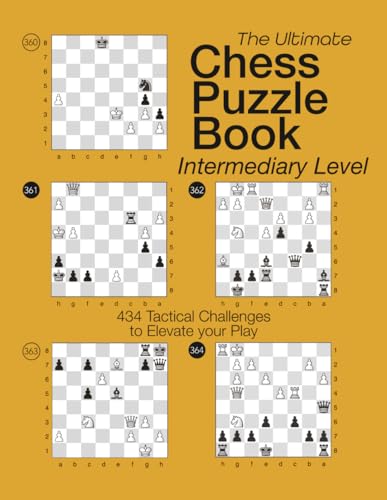
- 434 progressively harder intermediate puzzles
- Broad coverage of tactical and positional themes
- Explained solutions with clear diagrams
Best For: Players building calculation and pattern-recognition skills
Comprehensive Workout Pick

- 500 intermediate practice exercises
- Mixed workout sections test motif recognition
- Detailed answers and clear board diagrams
Best For: Practiced players wanting substantial offline training
Advanced Checkmate Drill Pick

- 500 progressive mate-in-four problems
- Focused practice for advanced tactical play
- Large-format diagrams and included solutions
Best For: Confirmed players sharpening multi-move mating attacks
Beginner Tactics Pick

- 500 progressive mate-in-2 problems with solutions
- Large format for diagram-based practice
- Designed for beginners and children
Best For: Beginners, children, and players progressing from mate-in-1 puzzles
Advanced Challenge
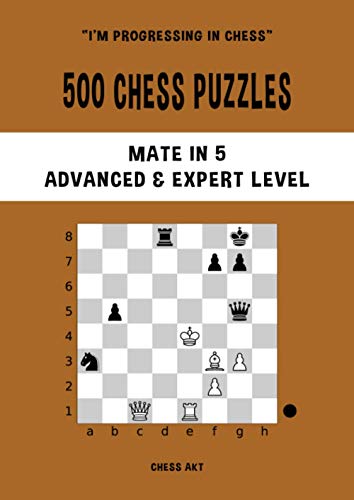
- 500 progressive mate-in-5 problems
- Solutions included for self-checking
- Aimed at advanced and expert players
Best For: Advanced players practicing longer checkmate combinations
Steady Improvement Choice
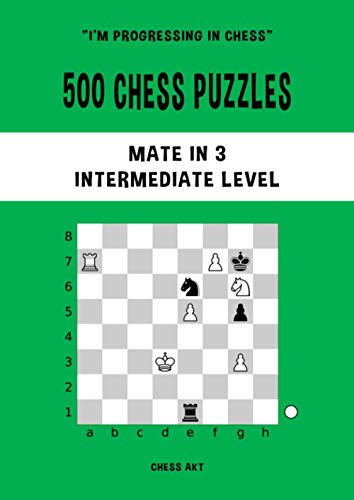
- 500 progressive mate-in-3 exercises
- Solutions support independent practice
- Built for regular and intermediate players
Best For: Intermediate players seeking a structured step up in calculation
Massive Tactics Collection – 5334 Problems, Combinations and Games
For shoppers seeking tactical chess puzzle books with exceptional volume, Chess: 5334 Problems, Combinations and Games is a substantial reference-style collection. Its positions cover checkmates, endgames, combinations, and games, with diagrams and solutions organized by problem type.
Best For: Enthusiastic beginners and improving competitors who want thousands of varied exercises in one large volume.
Pros:
- Includes more than 5,000 instructional situations.
- Covers 306 mate-in-one, 3,412 mate-in-two, and 744 mate-in-three problems.
- Also includes 144 simple endgames and 128 tournament game combinations.
- More than 6,000 illustrations support visual study.
Cons:
- At 1,104 pages and 2.7 pounds, it is less portable than shorter workbooks.
- The broad mix may feel less targeted than a book focused solely on tactical themes.
This is the strongest choice when quantity and range matter most. It can serve as a long-term practice library, though readers wanting a tightly graded training path may prefer a more structured workbook.
Step-by-Step Training – Chess Puzzles & Tactics Blueprint
The Chess Puzzles & Tactics Blueprint is a practical option among tactical chess puzzle books for players who want a large, theme-based progression. It offers more than 2,000 exercises covering common tactical ideas, with positions drawn from actual games and arranged by theme and difficulty.
Best For: Casual, online, or returning players who want structured practice aimed at spotting tactical patterns more quickly.
Pros:
- Provides more than 2,000 puzzles across multiple skill levels.
- Covers forks, pins, sacrifices, traps, and other tactical patterns.
- Organizes exercises by theme and difficulty for progressive study.
- Uses positions from actual games for practical application.
Cons:
- Its promotional description gives limited detail about the exact solution format.
- At 273 pages, it has fewer total pages than the largest collection in this roundup.
This book is a sensible middle ground for buyers who want substantial puzzle volume without committing to a thousand-page reference. Its graded, practical approach should appeal to players building a repeatable tactics routine.
Grandmaster Challenge – The Ultimate Chess Puzzle Book
The Ultimate Chess Puzzle Book stands out among tactical chess puzzle books for its broad difficulty range and carefully selected positions. The collection begins with accessible exercises, progresses to very difficult challenges, and includes themed puzzles, clue-free tests, and occasional positions where the best move is positional rather than tactical.
Best For: Players who want a graduated challenge, from novice-friendly problems to demanding tests suitable for advanced solvers.
Pros:
- Includes 100 relatively easy and 100 extremely difficult positions.
- Features tactical themes, graded tests, and positions without clues.
- Puzzles were selected from games and checked for sound solutions.
- Written by grandmaster John Emms, an experienced trainer and chess author.
Cons:
- Published in 2001, so it is an older title than some newer workbooks.
- At 240 pages, it offers less total material than the largest puzzle collections.
This is a strong pick for readers who value variety and increasing difficulty over sheer puzzle count. The clue-free tests and occasional positional answers add useful challenge beyond routine pattern drills.
Calculation Practice – Intermediate Chess Tactics Workbook
Chess Tactics Workbook for Intermediate is one of the more deliberately structured tactical chess puzzle books in this selection. Its 500 puzzles move from guided, theme-based exercises to mixed challenges, while prompts to record moves and continuations emphasize calculation rather than quick pattern recognition alone.
Best For: Club-level players who already know basic motifs and want to improve candidate-move selection, calculation, and resistance checking.
Pros:
- Includes 300 guided puzzles and 200 mixed challenges.
- Covers advanced motifs such as deflection, clearance, interference, and removing the defender.
- Provides space to record moves and calculated continuations.
- Adds a pattern tracker, mistake log, review, and retest plan.
Cons:
- It assumes the reader is already familiar with basic tactical patterns.
- With 500 puzzles, it offers less volume than the 2,000- and 5,000-plus-puzzle options.
Choose this workbook when your priority is disciplined calculation and measurable review. Its guided-to-mixed progression makes it especially suitable for focused independent study, coaching, or club-level training.
Structured Progression Pick – The Ultimate Chess Puzzle Book: Intermediate
The Ultimate Chess Puzzle Book – Intermediary Level: 434 Tactical Challenges to Elevate Your Play
Check Price On AmazonFor players moving beyond beginner tactics, this structured option is a strong entry in tactical chess puzzle books. Its 434 positions progress from solid intermediate challenges to harder calculations, with themes spanning attacks, combinations, endgames, quiet play, and opening tactics.
Best For: Intermediate players who want a gradual, explanation-focused training path.
Pros:
- 434 puzzles arranged in increasing difficulty
- Covers tactical, endgame, positional, and opening themes
- Solutions include full move sequences and explanations
- Large, high-contrast diagrams with clear coordinates
Cons:
- At 122 pages, the format is relatively compact
- Its intermediary focus may not suit complete beginners or expert-level players
This is a practical choice for players seeking consistent improvement rather than random puzzle practice. The structured progression and explained solutions make it especially useful for building pattern recognition and calculation habits.
Comprehensive Workout Pick – Intermediate Chess Puzzles
Among tactical chess puzzle books, this 500-exercise collection stands out for its workout-style format. It introduces key motifs, then mixes them in practice sections so players must identify the right tactical ideas without being told which one to use.
Best For: Practiced players who want extensive offline training with detailed answers.
Pros:
- Includes 500 intermediate exercises
- Progresses through increasingly complex motifs
- Workout sections simulate the need to recognize tactics independently
- Clear diagrams and a detailed answer key
Cons:
- Designed for skilled players rather than beginners
- Its 256-page length may feel more demanding for casual practice
The mix of guided chapters and unsignposted workout sections gives this book a useful balance of instruction and testing. It is a strong pick when you want a larger practice volume and a format suitable for self-study away from a board.
Advanced Checkmate Drill Pick – 500 Chess Puzzles, Mate in 4
This focused choice in tactical chess puzzle books is built around 500 progressive mate-in-four problems. It targets confirmed players who want repeated practice with tactical patterns such as forks, pins, deflections, overloads, and sacrifices.
Best For: Advanced players concentrating on multi-move checkmate calculation.
Pros:
- 500 mate-in-four problems with solutions
- Progressive difficulty supports regular practice
- Focuses directly on tactical checkmate skills
- Large 8.27-by-11.69-inch format
Cons:
- Its narrow mate-in-four focus offers less variety than broader puzzle books
- The 58-page booklet provides less surrounding instruction
- Advanced level may be unsuitable for beginners
Choose this booklet when your priority is concentrated checkmate training rather than a broad curriculum. Its progressive problem set and large diagrams make it well suited to short, repeatable tactical sessions.
Beginner Tactics Pick – 500 Mate-in-2 Chess Puzzles
This beginner-friendly volume is a practical entry point for anyone building skill with tactical chess puzzle books. It includes 500 progressive mate-in-2 problems with solutions, giving new players and children a structured way to practice pattern recognition and checkmating ideas.
Best For: Beginners, children, and players moving beyond mate-in-1 exercises.
Pros:
- Includes 500 problems with solutions.
- Uses progressive difficulty for a guided practice path.
- Large 8.27-by-11.69-inch format is suitable for working through diagrams.
- Introduces tactical themes such as forks, pins, deflection, overload, and sacrifices.
Cons:
- At 54 pages, the book is focused narrowly on mate-in-2 exercises.
- Players seeking advanced or expert challenges will need a later volume in the series.
This is a straightforward practice workbook rather than a broad strategy guide. Its progressive mate-in-2 format makes it a sensible choice for building a regular tactical training habit.
Advanced Challenge – 500 Mate-in-5 Chess Puzzles
For experienced players comparing tactical chess puzzle books, this volume concentrates on 500 progressive mate-in-5 problems. The longer combinations are intended for advanced and expert-level practice, with solutions included for checking your calculation.
Best For: Advanced players, expert players, and serious amateurs who want extended checkmate calculations.
Pros:
- Provides 500 mate-in-5 problems with solutions.
- Progressive difficulty supports systematic training.
- Focuses on advanced tactical patterns including forks, pins, deflection, overload, and sacrifices.
- Large 8.27-by-11.69-inch format gives diagrams room for practice.
Cons:
- The mate-in-5 focus may be too difficult for beginners and casual players.
- Its 58-page format is dedicated to one specialized puzzle type rather than varied instruction.
This is the most demanding of the three featured books. Choose it when your main goal is testing deeper calculation and checkmating technique, not learning basic tactical motifs.
Steady Improvement Choice – 500 Mate-in-3 Chess Puzzles
This intermediate volume offers a balanced step up for players who have outgrown simpler mates. Among tactical chess puzzle books, it stands out for its 500 progressive mate-in-3 exercises, solutions, and focus on regular practice.
Best For: Regular players and intermediate learners developing calculation and tactical pattern recognition.
Pros:
- Includes 500 mate-in-3 problems with solutions.
- Progressive difficulty creates a clear training sequence.
- Covers practical motifs such as forks, pins, deflection, overload, and sacrifices.
- Large 8.27-by-11.69-inch format is convenient for solving diagrams.
Cons:
- Players new to chess tactics may find mate-in-3 problems challenging.
- The 56-page book focuses on checkmate exercises rather than general strategy.
Mate-in-3 problems offer more calculation than beginner exercises without reaching the difficulty of mate-in-5 challenges. This makes the book a practical middle-stage training option for consistent players.
How We Picked the Best Tactical Chess Puzzle Books
We focused on books that offer substantial puzzle collections, clearly defined difficulty levels, and practical tactical themes. The selection includes broad problem anthologies, structured workbooks, and mate-in-two through mate-in-five collections, so readers can choose a format that fits their experience and study habits.
We also considered whether each title supports repeatable training. Books with hundreds or thousands of exercises can provide long-term value, while level-specific collections make it easier to avoid puzzles that are either too simple or unnecessarily frustrating.
Quick Comparison
- Best for maximum variety: A large anthology such as Chess: 5334 Problems, Combinations and Games.
- Best for structured tactical training: A workbook or blueprint organized around calculation, patterns, and finding forcing moves.
- Best for beginners: Mate-in-two exercises and introductory puzzle books.
- Best for intermediate players: Intermediate workbooks and collections with forcing lines, tactical vision, and mixed challenges.
- Best for advanced solvers: Mate-in-four and mate-in-five books or demanding combination-focused collections.
Key Buying Factors for Tactical Chess Puzzle Books
Difficulty and Progression
Choose problems that are challenging but solvable. Beginners generally benefit from short mating patterns and straightforward tactical motifs. Intermediate players should look for exercises requiring several candidate moves or forcing variations. Advanced players can gain more from longer combinations and less obvious defensive resources.
Puzzle Type
Mate-in-two books are useful for learning pattern recognition, while mate-in-three, mate-in-four, and mate-in-five collections demand increasingly accurate calculation. Mixed tactical books may cover forks, pins, skewers, discovered attacks, sacrifices, and combinations, making them better for broad tactical development.
Volume and Organization
A large collection offers excellent long-term practice, but a smaller, well-structured workbook may be easier to use consistently. Look for clear solutions and a format that lets you track progress without immediately seeing the answer.
Study Purpose
For daily practice, select a book with manageable sets of exercises. For intensive improvement, choose a substantial collection and solve positions without moving the pieces. Writing down your candidate moves and checking the solution afterward can make each session more instructive.
Who Should Buy Which Tactical Chess Puzzle Books?
New players should start with beginner or beginner-to-intermediate mate-in-two collections. These reinforce basic checkmate patterns and teach the habit of looking for forcing moves.
Improving club players will usually benefit most from intermediate workbooks and broad tactical collections. These provide enough variety to build pattern recognition while also developing calculation and visualization.
Experienced and advanced players should consider high-difficulty mate-in-four or mate-in-five books, along with large anthologies that include complex combinations. These are best for players who already recognize common motifs and want to test deeper calculation.
Whichever book you choose, consistent solving matters more than rushing through a large number of positions. Spend time identifying checks, captures, and threats before reviewing the solution, then revisit missed puzzles until the underlying pattern becomes familiar.