The right chess puzzle book can turn missed forks, pins, mating patterns, and in-between moves into familiar tactical opportunities. This roundup compares 10 options for intermediate players, from broad exercise collections to focused mate-in-three and middlegame workbooks.
Use the guide below to match a book’s difficulty, puzzle volume, and solution style with your current rating, study habits, and goals.
Best 10 Chess Puzzle Books for Intermediate Players Picks for 2026
Deep Practice Library
Chess: 5334 Problems, Combinations and Games

- More than 5,000 instructional positions
- Includes mates, endgames, and combinations
- Large 1,104-page illustrated volume
Best For: Players wanting an extensive all-in-one practice collection
Structured Tactics Training
The Chess Puzzles & Tactics Blueprint

- More than 2,000 tactical exercises
- Arranged by theme and difficulty
- Uses positions from actual games
Best For: Players seeking guided, practical tactics training
Progressive Grandmaster Challenge
The Ultimate Chess Puzzle Book

- Ranges from easy to extremely tough
- Includes themed and clue-free tests
- Written by grandmaster John Emms
Best For: Players wanting graded challenges that grow with their skills
Focused Checkmate Practice
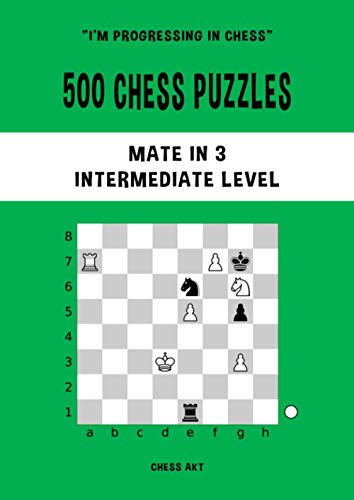
- 500 progressive mate-in-three problems
- Includes solutions and large diagrams
- Targets core tactical patterns
Best For: Players focused on improving mate-in-three calculation
Structured Tactics Workbook
Tactical Vision: 150 Chess Puzzles

- 150 puzzles across 15 tactical themes
- Designed for roughly 1250–1500 Elo
- Includes trackers and full move-by-move solutions
Best For: Intermediate and club players seeking organized tactical training
High-Volume Practice Pick

- Contains 500 progressive mate-in-two problems
- Includes solutions for every exercise
- Large-format workbook aimed at beginners and children
Best For: Developing players focused on repeated checkmate practice
Broad Skills Builder
Chess Puzzles: 1300–1700 Intermediate

- Aims at players rated about 1300–1700
- Includes 201 explained puzzles and solutions
- Adds rules, terminology, and strategy guidance
Best For: Learners wanting fundamentals and tactical practice in one book
Best Middlegame Tactics Book

- 100 puzzles from real games
- Targets 1200–1500 players
- Solutions follow each puzzle
Best For: Focused middlegame tactics practice
Best Checkmate Practice Book

- 100 mate-in-three puzzles
- Real-game positions
- Screen-reader supported ebook
Best For: Three-move checkmate calculation
Best In-Between Move Book

- 100 in-between move puzzles
- Real-game tactical positions
- 132-page Kindle edition
Best For: Spotting zwischenzug opportunities
Deep Practice Library – Chess: 5334 Problems, Combinations and Games
For shoppers seeking chess puzzle books for intermediate players, this is a massive reference-style collection with more than 5,000 instructional positions. Its broad mix of checkmates, endgames, combinations, and game examples makes it useful for players who want extensive practice in one volume.
Best For: Intermediate players who want a large, varied puzzle library and do not mind a substantial book.
Pros:
- Includes more than 5,000 problems, combinations, and games.
- Covers mate-in-one, mate-in-two, mate-in-three, simple endgames, and tournament combinations.
- Organized by problem type with solutions at the back.
- More than 6,000 illustrations support visual study.
Cons:
- At 1,104 pages and 2.7 pounds, it is less portable than a compact workbook.
- The collection also includes basic rules and novice-oriented material, which may not suit readers seeking only advanced puzzles.
This is the strongest choice for sheer volume and variety. It works particularly well as a long-term study companion, though its size favors home practice over casual carrying.
Structured Tactics Training – The Chess Puzzles & Tactics Blueprint
Among chess puzzle books for intermediate players, this recent workbook emphasizes practical tactical improvement through more than 2,000 exercises. The puzzles are presented by theme and difficulty, giving players a more guided path from basic patterns to stronger combinations.
Best For: Casual, returning, or online players who want organized tactics practice aimed at spotting winning moves faster.
Pros:
- Offers more than 2,000 chess puzzles and exercises.
- Covers tactical themes such as forks, pins, and sacrifices.
- Organized by theme and difficulty for step-by-step practice.
- Uses positions drawn from actual games, according to the description.
Cons:
- The marketing description focuses heavily on rating improvement, so readers seeking deep positional instruction may need another book.
- At 273 pages, it provides fewer total positions than the largest collections in this roundup.
This is a practical, focused option for players who prefer a clearly sequenced tactics workbook rather than an enormous reference volume. Its thematic structure should make regular training easier to plan.
Progressive Grandmaster Challenge – The Ultimate Chess Puzzle Book
This is one of the more balanced chess puzzle books for intermediate players, moving from relatively easy positions to extremely difficult challenges. It combines themed exercises, graded tests without clues, and occasional positional solutions, making it suitable for players who want to measure progress as well as practice tactics.
Best For: Intermediate players who want a graded collection that can continue challenging them as their calculation skills improve.
Pros:
- Progresses from 100 relatively easy puzzles to 100 very difficult ones.
- Includes tactical themes, graded tests, and positions requiring positional moves.
- Puzzles were selected from games and checked for sound solutions, according to the description.
- Written by grandmaster and experienced trainer John Emms.
Cons:
- The book dates from 2001, so it is an older selection compared with newer workbooks.
- Its hardest puzzles may be demanding for players still building basic tactical pattern recognition.
With 240 pages and a deliberately wide difficulty range, this is a strong pick for structured progression. It is especially appealing to solvers who enjoy tests without hints and want occasional positional surprises.
Focused Checkmate Practice – 500 Chess Puzzles, Mate in 3
For intermediate players comparing chess puzzle books for intermediate players, this workbook offers a focused set of 500 mate-in-three problems with progressive difficulty. Its large-format diagrams and solutions make it a straightforward choice for regular checkmate-pattern practice.
Best For: Regular players who want concentrated mate-in-three training in a large, lightweight workbook.
Pros:
- Provides 500 mate-in-three puzzles with solutions.
- Uses progressive difficulty to support continued practice.
- Large 8.27-by-11.69-inch format should make diagrams easy to view.
- Targets tactical ideas including forks, pins, deflection, overload, and sacrifice.
Cons:
- Its narrow mate-in-three focus offers less variety than broad tactics collections.
- At 56 pages, it has a shorter overall study scope.
- The independently published softcover may feel less substantial than a large reference book.
This is the most specialized option here. Choose it if mate-in-three problems are your priority; choose a broader collection if you want endgames, mixed tactics, or varied game situations in the same book.
Structured Tactics Workbook – Tactical Vision: 150 Chess Puzzles
For shoppers comparing chess puzzle books for intermediate players, this workbook stands out for its structured approach. It includes 150 curated puzzles for players rated approximately 1250–1500 Elo, arranged across 15 tactical themes with full move-by-move solutions.
Best For: Intermediate and club-level players who want systematic tactical training, calculation habits, and pattern recognition practice.
Pros:
- Organizes exercises by themes such as forks, pins, skewers, king attacks, and positional tactics.
- Introduces calculation guidance, including the Checks, Captures, Threats principle.
- Includes a progress tracker and complete solutions with defensive lines.
- Covers both fundamental motifs and more complex combinations.
Cons:
- Its 150-puzzle format offers fewer exercises than larger puzzle collections.
- The stated rating range may make it less suitable for complete beginners or advanced tournament players.
- At 105 pages, the workbook is relatively compact.
This is a strong choice if you prefer guided, thematic study instead of an unstructured set of positions. The included roadmap and detailed solutions make it especially practical for self-directed training.
High-Volume Practice Pick – 500 Chess Puzzles: Mate in 2
Among chess puzzle books for intermediate players, this volume is a straightforward option for repeated checkmate practice. It provides 500 progressive mate-in-two problems with solutions, while also being positioned for beginners and children.
Best For: Beginners and developing intermediate players who want a large volume of progressively harder mating exercises.
Pros:
- Offers 500 problems, giving readers substantial practice material.
- Uses progressive difficulty to support gradual improvement.
- Focuses on mate-in-two positions and includes solutions.
- Large 8.27 x 11.69-inch format may be convenient for viewing diagrams.
Cons:
- The description primarily presents it as a beginner and children’s book.
- Its narrow mate-in-two focus may provide less variety in broader tactical motifs.
- At 54 pages, solutions and exercises may be presented in a compact layout.
Choose this book if quantity and focused mating practice matter more than thematic variety. Players seeking forks, pins, sacrifices, and broader combinations may want a more comprehensive tactical workbook.
Broad Skills Builder – Chess Puzzles: 1300–1700 Intermediate
Chess Puzzles : 1300-1700 Intermediate: Chess Book (Chess Book : Chess puzzles 0-2000)
Check Price On AmazonThis option for readers browsing chess puzzle books for intermediate players combines chess fundamentals with practical puzzle solving. It targets the 1300–1700 range and includes 201 puzzles with explanations, along with rules, terminology, and strategy material.
Best For: Learners who want a combined reference and exercise book covering basic knowledge, strategic concepts, and tactical puzzles.
Pros:
- Targets an intermediate rating range of approximately 1300–1700.
- Includes 201 puzzles with explanations and solutions.
- Combines rules, chess language, strategies, and tactical patterns.
- Covers motifs such as blocks, decoys, mating patterns, and checkmate.
Cons:
- The description also emphasizes beginners, so advanced players may find the introductory material basic.
- It offers fewer puzzles than the 500-problem collection in this roundup.
- The compact 5.06 x 7.81-inch format may provide a smaller reading area.
This is a versatile pick for players who want instruction alongside exercises rather than a puzzle-only workbook. It may be particularly useful when tactical practice needs to reinforce broader chess vocabulary and fundamentals.
Best Middlegame Tactics Book – 100 Middlegame Chess Puzzles
If you want chess puzzle books for intermediate players that focus on practical middlegame decisions, this compact workbook offers 100 positions drawn from real games. It targets players rated 1200–1500 and emphasizes tactics such as forks, skewers, decoys, double attacks, and mating patterns.
Best For: Intermediate players who want focused middlegame tactics practice after the opening.
Pros:
- Includes 100 real-life chess positions.
- Designed specifically for the 1200–1500 rating range.
- Solutions appear on the following page for self-directed practice.
- Short 60-page format is easy to work through in brief sessions.
Cons:
- Its narrow middlegame focus may not cover broader strategy or endgames.
- The print edition is relatively brief.
This is a straightforward choice for players who want to build tactical pattern recognition in the middlegame without committing to a lengthy textbook. Its real-game positions and immediate solutions make it suitable for regular, structured practice.
Best Checkmate Practice Book – 100 Mate in 3 Chess Puzzles
Among chess puzzle books for intermediate players, this digital title is a focused option for practicing forced checkmates. It contains 100 real-game puzzles for players rated 1200–1500, each centered on finding a mate in three moves.
Best For: Intermediate players who want to improve calculation and recognize three-move checkmate patterns.
Pros:
- Provides 100 mate-in-three challenges.
- Uses positions taken from real-life games.
- Solutions are placed on the following page.
- Supports screen readers and enhanced typesetting.
Cons:
- Its exclusive mate-in-three format is narrower than a general tactics collection.
- It is listed as a Kindle edition rather than a print book.
This book suits players who want a clearly defined tactical objective in every exercise. If your priority is checkmate calculation rather than a broad mix of middlegame themes, its focused format can make practice easier to organize.
Best In-Between Move Book – 100 Intermezzo Chess Puzzles
For chess puzzle books for intermediate players that teach a less obvious tactical idea, this collection concentrates on in-between moves, also called intermezzos. Its 100 real-game positions challenge 1200–1500 players to find an unexpected forcing move before making the expected capture or response.
Best For: Intermediate players who want to improve their ability to spot zwischenzug opportunities and decisive tactical threats.
Pros:
- Devotes all 100 puzzles to in-between moves.
- Explains the theme as an unexpected move that creates an immediate threat.
- Draws its positions from real-life games.
- Offers 132 pages of digital practice with solutions on the following page.
Cons:
- The specialized theme may be less useful for readers seeking varied tactics.
- It is presented as a Kindle edition.
This is a good pick for players who already know basic tactics and want to sharpen their ability to look for forcing alternatives. The dedicated intermezzo theme makes it especially useful as a targeted supplement to broader puzzle training.
How We Picked the Best Chess Puzzle Books for Intermediate Players
We looked for books that offer meaningful tactical practice rather than simple pattern recognition alone. The selection includes large collections for long-term training, structured workbooks focused on common motifs, and rating-targeted series for players roughly between 1200 and 1700. We also considered puzzle variety, stated difficulty, solution availability, and whether the format supports repeat study.
Because “intermediate” covers a wide range of playing strength, the list includes both accessible mate-in-two exercises and more demanding combinations, middlegame tactics, and in-between-move problems.
Quick Comparison
| Best for | Look for | Typical choice |
|---|---|---|
| Broad tactical training | Large, varied collections | Multi-thousand-problem books |
| Pattern building | Focused motifs and clear solutions | Fork, pin, skewer, and checkmate workbooks |
| Targeted practice | Specific puzzle types | Mate-in-two, mate-in-three, or in-between-move books |
| Rating-based study | Exercises matched to your level | Books with stated rating ranges |
Key Buying Factors for Chess Puzzle Books for Intermediate Players
Difficulty and Rating Range
Choose exercises that make you calculate, but do not turn every session into guesswork. A book aimed at 1200–1500 may suit developing players, while a 1300–1700 or broader advanced collection can provide a better challenge as your calculation improves.
Puzzle Variety
Books covering forks, pins, skewers, discovered attacks, mating patterns, defensive resources, and zwischenzugs build more transferable skills. Specialized books are useful when you know a particular weakness needs attention.
Volume and Study Format
A 100-puzzle book is easier to finish systematically; a 500- or 2,000-plus-puzzle collection offers more repetition and long-term value. Consider whether you prefer short daily sessions or a large reference-style workbook.
Solutions and Explanations
Solutions should show the principal variation and explain why the tactic works. This matters especially when several candidate moves look promising. If a book is sparse on explanations, plan to analyze missed solutions on a board or chess app.
Presentation and Portability
Clear diagrams, readable notation, and a layout that lets you hide the answer make solving more effective. A compact paperback may suit travel, while a larger workbook can be easier on the eyes during extended sessions.
Who Should Buy Which Chess Puzzle Books for Intermediate Players?
Choose a broad, high-volume collection if you want a substantial tactical library and are comfortable selecting puzzles independently. Pick a structured tactics workbook if you want guided practice around recurring motifs. Mate-in-two books are useful for building pattern speed, while mate-in-three collections demand deeper calculation. Middlegame puzzle books are a strong fit for players who often spot basic tactics but miss combinations in realistic positions. Finally, an in-between-move collection is ideal for improving candidate-move discipline and finding forcing resources between obvious checks and captures.