Finding the right reading support can make practice feel more manageable for a child who struggles with decoding, blending, or remembering sound patterns. The best phonics kits combine clear instruction with repetition and activities that fit a learner’s age, attention span, and current skill level.
We’ve gathered 10 options ranging from complete learn-to-read programs and teacher-friendly workbooks to flash cards, flip books, and playful phonics activities. Use the guide below to compare structure, practice style, and the features that matter most before choosing a kit.
Best 10 Phonics Learning Kits for Struggling Readers Picks for 2026
Complete Reading Program
Hooked on Phonics Learn to Read Kit
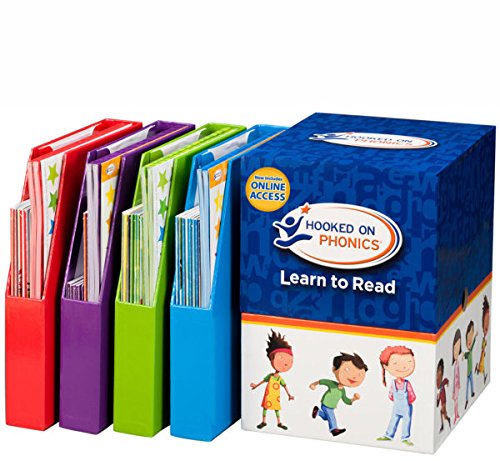
- Eight levels from Pre-K through 2nd Grade
- Includes books, workbooks, videos, and flashcards
- Supports phonics practice with stories and activities
Best For: Families wanting a full, multi-level reading curriculum
Intermediate Practice Pack
Extra Practice for Struggling Readers: Phonics

- Designed for grades 3–6
- Reviews tricky words and phonics elements
- Supports repeated, independent practice
Best For: Older struggling readers needing focused workbook practice
Spaced-Repetition Cards
Phonics Flash Cards Learning System

- Organized across 20 phonics stages
- Includes words, sentences, and learning games
- Thick cardboard cards for repeated use
Best For: Young learners who prefer short, interactive practice
Older-Student Word Study
Evan-Moor Phonics and Word Study

- Designed for grades 4–6+ struggling readers
- Includes pretests and sequenced skill lessons
- Connects phonics practice with stories and comprehension
Best For: Structured intervention for older readers needing targeted support
Structured Practice

- 30 independent practice packets
- Covers vowels, blends, digraphs, and more
- Printable format for home or classroom use
Best For: Paced worksheet practice and targeted phonics reinforcement
Portable Review

- 54 cards plus sound and parent cards
- Practices vowels, blends, and combinations
- Colorful, portable cards for ages 6+
Best For: Short, visual phonics practice at home or on the go
Interactive Listening
Reader Dog Phonics Learning Toy

- Tap-to-read audio across 148 pages
- Five levels include vowels and blends
- Includes 90 stickers and portable card rings
Best For: Hands-on early reading practice with audio feedback
Best Stepwise Practice

- Four progressive phonics levels
- 480 words, pictures, and 120 sentences
- Includes sorting rings for interactive practice
Best For: Ages 4–8 needing structured phonics progression
Best for Word-Family Games

- 40 flip books across five levels
- Covers 53 phonics patterns and 320+ words
- Adds rhyming and sight-word activities
Best For: Learners who enjoy hands-on word-building games
Best for Progress Tracking

- 40 books organized across 11 levels
- Systematic onset-changing word-family practice
- Includes six double-sided review pages
Best For: Guided early-reading intervention and progress monitoring
Complete Reading Program – Hooked on Phonics Learn to Read Kit
Hooked on Phonics Complete Learn to Read Kit (Pre-K through 2nd Grade | Ages 3-8)
Check Price On AmazonFor families seeking phonics learning kits for struggling readers, this complete program offers a structured path from early phonics through early fluency. Its eight levels combine workbooks, storybooks, flashcards, stickers, and video lessons for children ages 3–8.
Best For: Families wanting an all-in-one, multi-level reading program for Pre-K through 2nd Grade.
Pros:
- Covers eight levels from Pre-K to 2nd Grade.
- Includes 36 storybooks, eight workbooks, DVDs, flashcards, and stickers.
- Stories reinforce the skills introduced in the lessons.
- Video content is also available for streaming on devices.
Cons:
- The 17-pound kit is large and may require dedicated storage space.
- The broad age range may require parents to identify the appropriate starting level.
This is a comprehensive choice for caregivers who prefer a guided curriculum rather than a single practice book or flashcard set. Its large collection of materials can support regular practice, but the size of the kit may feel excessive for families seeking a compact solution.
Intermediate Practice Pack – Extra Practice for Struggling Readers: Phonics
Designed for older students, this practice pack is a focused option among phonics learning kits for struggling readers. It provides dozens of reproducible pages for reviewing tricky words, phonics elements, and word-study skills at grades 3–6.
Best For: Intermediate readers who need repeated, independent practice with decoding and word-study skills.
Pros:
- Targets common tricky words and essential phonics elements.
- Repeated practice is intended to build automaticity and fluency.
- Can be used for independent practice.
- Includes 80 pages in a compact workbook format.
Cons:
- It is primarily a practice workbook, not a complete multi-sensory kit.
- Its grade 3–6 focus may not suit beginning readers.
This resource makes sense when a student already has basic instruction but needs extra repetition to strengthen decoding and word recognition. Its straightforward workbook format is practical for tutoring, classroom reinforcement, or at-home independent work.
Spaced-Repetition Cards – Phonics Flash Cards Learning System
These flashcards offer a portable, game-oriented approach to phonics learning kits for struggling readers. The set organizes practice across 20 phonics stages and includes work with CVC words, digraphs, blends, long vowels, sentences, and phonogram families.
Best For: Children ages 4–8 who benefit from short, repeatable flashcard sessions and phonics games.
Pros:
- Uses a stated spaced-repetition learning sequence.
- Includes 1,300 words, 240 sentences, and more than 120 phonics elements according to the product notes.
- Covers four difficulty levels and 20 phonogram family groups.
- Thick cardboard construction is designed for durability.
Cons:
- The set contains 66 flashcards, so it may require repeated use to access the full range of listed practice content.
- Flashcards provide less lesson guidance than a complete workbook curriculum.
This set is a convenient supplement for families who want flexible practice without committing to a large curriculum. Its staged sequence and game format may help keep sessions brief and engaging, while adults may still need to provide instruction and track progress.
Older-Student Word Study – Evan-Moor Phonics and Word Study
For grades 4–6 and beyond, this resource provides targeted phonics and word-study lessons for struggling readers. It combines pretests, explicit skill instruction, practice activities, stories, high-frequency word lists, and comprehension work in a reproducible format.
Best For: Teachers, tutors, and families supporting older students who need differentiated phonics and decoding practice.
Pros:
- Covers advanced areas including r-controlled vowels, syllable patterns, affixes, and vowel combinations.
- Pretests help identify strengths and weaknesses.
- Lessons follow a Learn It, Practice It, Review It, Read It, and Apply It sequence.
- Includes 240 high-frequency words drawn from Dolch and Fry lists.
Cons:
- The material is aimed at grades 4–6+, not early beginners.
- Its reproducible lesson format may require more adult planning than a game-based card set.
- Age-appropriate themes do not eliminate the need to match lessons to each learner’s level.
This is the strongest fit for structured intervention with older readers because it links phonics instruction to reading in context, comprehension, and oral reading. Its assessment and teacher-support pages also make it useful when instruction needs to be differentiated.
Structured Practice – Week-By-Week Phonics Packets
For families and educators comparing phonics learning kits for struggling readers, Week-By-Week Phonics Packets offers printable, skill-focused practice that children can complete independently. Its 30 packets cover foundational phonics topics from letter-sound relationships through vowel patterns, blends, digraphs, and word structure.
Best For: Kindergarten through third-grade learners who benefit from paced worksheets, classroom practice, homework, or RTI instruction.
Pros:
- Covers a broad progression of core phonics skills.
- Independent, self-paced format is easy to manage.
- Activities include puzzles, rhymes, stories, and word searches.
- Can support classroom, homework, second-language, and RTI settings.
Cons:
- Requires printing or reproducing the packets.
- Worksheet-based practice may be less engaging for children seeking an interactive toy.
This is a practical choice when you want organized, repeatable phonics practice rather than an electronic learning experience. Its flexible packet format also makes it useful for targeted skill reinforcement.
Portable Review – Phonics Made Easy Flash Cards
School Zone Phonics Made Easy Flash Cards is a compact option among phonics learning kits for struggling readers. The set combines words with colorful pictures to practice letter sounds, short and long vowels, blends, and other letter combinations at home, school, or while traveling.
Best For: Children ages 6 and up, especially learners who respond well to brief, repeatable flash-card practice with visual cues.
Pros:
- Includes 54 flash cards, a word sounds card, and a parent card.
- Practices short vowels, long vowels, blends, and combinations.
- Large cards use colorful illustrations and rounded corners.
- Portable format supports quick practice sessions on the go.
Cons:
- Offers less extended reading practice than a packet or book-based program.
- Flash-card activities may require an adult or partner for the most effective practice.
This set works well as a supplemental tool for reinforcing sound-symbol connections and building practice speed. Its small, portable format makes it particularly convenient for short sessions outside the classroom.
Interactive Listening – Reader Dog Phonics Learning Toy
For children who need a more interactive introduction, this reader-dog kit adds tap-to-read audio to phonics learning kits for struggling readers. The sensor reads words and pictures aloud across five levels, while the included pages, flash cards, and stickers provide practice with sounds, word patterns, vocabulary, and simple sentences.
Best For: Children ages 3 to 8 who enjoy audio feedback, hands-on activities, and step-by-step early reading practice.
Pros:
- Includes 148 pages, 592 words, 148 sentences, flash cards, and 90 stickers.
- Reader dog provides tap-to-read pronunciation support.
- Five levels progress from the alphabet to vowels and consonant blends.
- Rechargeable USB-C design, card rings, and three volume settings support portability.
Cons:
- Requires charging and careful maintenance of the reading sensor.
- Its toy-based format may be less suitable for children who prefer quiet worksheets.
- The supplied details do not indicate that it replaces adult instruction or reading practice.
This kit is appealing when motivation and pronunciation modeling are priorities. The combination of audio, stickers, cards, and leveled content gives young learners multiple ways to revisit early phonics and vocabulary.
Best Stepwise Practice – Phonics Flash Cards
These phonics learning kits for struggling readers offer a structured way to practice sound blending, word families, and early reading skills. The 62-card set includes 480 words and pictures, 120 sentences, sorting rings, and four difficulty levels covering foundational phonics through silent letters.
Best For: Children ages 4–8 in preschool through third grade who benefit from progressive, hands-on phonics practice.
Pros:
- Four levels progress from CVC words to trigraphs and silent letters.
- Includes 20 phonogram family groups, 480 words and pictures, and 120 sentences.
- Sorting rings and colorful cards support interactive practice and phonemic awareness.
Cons:
- The compact card format may offer less writing practice than a workbook.
- The set is designed for English-language learning only.
Choose this set when you want one compact resource that can grow with a young learner. Its clearly staged levels make it practical for guided practice, review, and gradual skill building.
Best for Word-Family Games – Read and Rhyme Flip Books
For families seeking phonics learning kits for struggling readers, this 40-book flip set emphasizes word families, rhyming, and decoding through hands-on word building. It covers more than 53 phonics patterns and 320 words across five levels, including short and long vowels, Magic E, R-controlled vowels, digraphs, and beginning blends.
Best For: Preschool and elementary learners who stay engaged with flipping, matching, rhyming, and sight-word activities.
Pros:
- Five levels provide a broad progression from pre-K through third-grade skills.
- Interactive flip books let children build words by changing sounds and patterns.
- Combines phonics, rhyming word families, high-frequency words, and vocabulary practice.
Cons:
- The set may be more extensive than needed for learners working on one narrow skill.
- Its cardboard format may require careful handling by younger children.
This is a strong option when variety and active word play are priorities. The many levels and pattern groups make it useful for repeated practice, while the flip-book format can make decoding feel less worksheet-driven.
Best for Progress Tracking – Phonics Flip Books
These phonics learning kits for struggling readers use 40 flip books and 11 progressive levels to move from CVC words toward more complex word families. The onset-changing format reinforces shared patterns, while six double-sided review pages help parents and teachers check spelling progress and identify areas needing more practice.
Best For: Pre-K and kindergarten learners, homeschoolers, and small groups needing systematic word-family instruction with simple progress checks.
Pros:
- Eleven levels create a detailed path from emergent reading to more advanced decoding.
- Word-family books use a consistent “change the onset” approach to reinforce patterns.
- Six double-sided review pages support monitoring and targeted reinforcement.
Cons:
- The extensive level system may require adult guidance to select the right starting point.
- The set focuses on flip-book practice rather than broad sentence or story reading.
Consider this set if you want a highly structured resource with built-in review materials. Its tactile format supports repeated practice, while the progress pages make it easier to see which word families need additional attention.
How We Picked the Best Phonics Learning Kits for Struggling Readers
We selected these Phonics Learning Kits for Struggling Readers based on instructional coverage, practice variety, age range, and ease of use. The roundup includes structured programs for step-by-step learning, targeted packets for extra decoding practice, and compact card-based tools for short daily sessions.
We also considered whether each format supports essential early-reading skills such as letter-sound recognition, blending, short and long vowels, consonant digraphs, word families, and high-frequency words. No single kit suits every learner, so the best choice depends on the child’s specific gaps and how much adult guidance is available.
Quick Comparison
| Kit type | Best for | Typical advantage |
|---|---|---|
| Complete reading program | Families wanting a sequence | Progressive lessons and broader coverage |
| Practice packets and workbooks | Targeted reinforcement | Repeatable written decoding practice |
| Flash cards | Short daily reviews | Portable, focused repetition |
| Flip books and word-family tools | Hands-on word building | Visual and interactive practice |
| Learning toys and activity kits | Younger learners | Play-based engagement |
Key Buying Factors for Phonics Learning Kits for Struggling Readers
Match the Skill Level
Start with what the child can do independently, not only their grade or age. A learner who confuses individual letter sounds may need an introductory kit, while one who knows basic sounds but reads slowly may benefit more from CVC words, blends, digraphs, and vowel-pattern practice.
Look for a Clear Progression
Choose materials that move from sound recognition to blending, decoding, and increasingly complex words. A defined sequence helps prevent random practice and makes it easier to identify where the child needs more support.
Prioritize Controlled Repetition
Struggling readers often need frequent, successful review. Flash cards, word-family flip books, and short packets can work well when used consistently. Spaced review is particularly useful for retaining sound patterns without turning every session into a long drill.
Consider the Teaching Format
Workbooks suit children who can write and follow directions, while cards and manipulatives may be better for learners who need active, brief sessions. Check whether the kit includes instructions for adults, answer guidance, stickers, readers, or other materials needed to use it effectively.
Keep Sessions Manageable
Look for flexible activities that can be completed in roughly 10 to 20 minutes. A kit is more useful when it supports regular practice without causing fatigue or frustration. Praise accurate attempts and stop before attention drops sharply.
Who Should Buy Which Phonics Learning Kits for Struggling Readers?
Choose a complete learn-to-read kit if you want a ready-made sequence covering multiple early-reading skills. These are convenient for families who prefer one central program.
Choose practice packets or a structured workbook when a child needs additional repetition in phonics and word study, especially alongside classroom instruction or tutoring.
Choose flash cards for quick reviews, travel, or targeted work on vowels, digraphs, blends, and high-frequency patterns. Use them with oral blending rather than relying only on memorization.
Choose flip books or word-family activities for children who learn well through manipulating word parts and comparing similar words.
Choose a learning toy or sticker-based activity kit for younger children who need a playful introduction or have difficulty staying engaged with worksheet-heavy practice.
If reading difficulties persist despite regular practice, use these materials as supplemental support and consider speaking with the child’s teacher or a qualified reading specialist for a more individualized plan.