Finding the right paper folder can save hours in busy offices, schools, churches, and print shops. The best models balance speed, fold quality, ease of setup, and a price that stays within budget.
This roundup of the best paper folding machines under 500 focuses on practical options for everyday document handling, from compact desktop units to heavier-duty automatic feeders.
Best 10 Paper Folding Machines Under 500 Picks for 2026
Rapid Office Folder
Martin Yale P7500 Automatic Feed Tabletop Folder

- Up to 4,000 folded sheets per hour
- Loads up to 50 sheets in the feed tray
- Simple operation for office and mailroom use
Best For: Small offices and mailrooms needing quick, easy folding
High-Speed Desktop Folder
Formax FD 300 Desktop Folder with LCD Control

- Folds up to 7,400 sheets per hour
- Drop-in top-feed system loads up to 200 sheets
- LCD panel with counter and AutoBatch mode
Best For: Teams that need fast, orderly desktop folding
Manual Crease Helper
Rebound Handle Desktop Paper Creaser

- Spring-loaded handle eases repeated pressing
- Handles thick stock up to 450g
- Compact metal frame for desktop use
Best For: Thick-stock creasing for print shops and office craft jobs
Heavy-Duty Auto Folder
Martin Yale 1217A Automatic Paper Folder
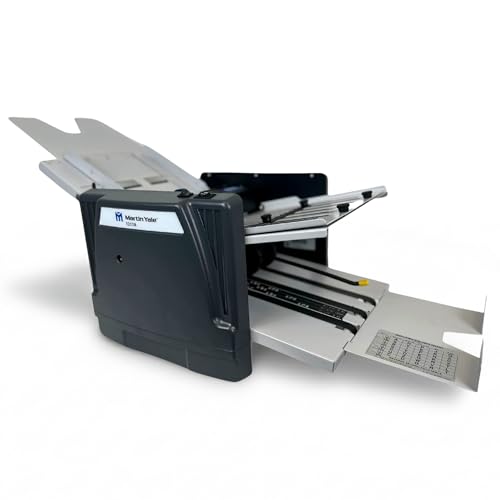
- Up to 10,300 sheets per hour
- Seven fold types with adjustable tables
- Feeds up to 250 sheets and handles sets
Best For: High-volume folding in offices, schools, and mailrooms
Manual Creaser
Portable Manual Folding for Cards & Photos

- Manual creasing for documents, cards, photos, and invitations.
- Handles paper up to 250g for varied projects.
- Metal body with scale, baffle, and magnet for better alignment.
Best For: Crafters and small offices needing precise manual creasing.
3-in-1 Electric Creaser
Adjustable-Speed Folding and Scoring Tool

- Creaser, perforator, and single-sheet cutter in one machine.
- Adjustable speed up to 100 rpm for workflow control.
- Compact desktop design with protective cover and detachable parts.
Best For: Small shops needing a versatile electric creasing and folding machine.
Desktop Folder
Compact Letter-Size Office Folders

- Manual feed with automatic tri fold or half fold output.
- Processes up to 1,800 sheets per hour.
- Compact desktop size for offices, schools, and mailrooms.
Best For: Office teams that fold standard letter-size documents regularly.
Editor’s Choice

- Adjustable speed up to 100 rpm
- Includes creaser, perforator, and cutter
- Safety cover and easy tool swaps
Best For: Small shops needing a multi-function creasing machine
Best Manual Pick

- Manual creaser with magnetic positioning
- All-metal body and steel blades
- Works on cards, covers, and invitations
Best For: Small-batch creasing and folding projects
Best for Batch Work

- Combines creasing, perforation, and cutting
- Runs up to 10 meters per minute
- All-metal build with guide rails
Best For: Batch finishing jobs that need multiple functions
Rapid Office Folder – Martin Yale P7500 Automatic Feed Tabletop Folder
If you’re comparing paper folding machines under 500 for a busy office, the Martin Yale P7500 is built for fast, straightforward production. It automatically feeds up to 50 sheets at a time and can produce up to 4,000 folded sheets per hour, with fold options for letter, half, Z-fold, and double parallel jobs.
Best For: Small offices, mailrooms, churches, and teams that need simple, everyday folding with minimal setup.
Pros:
- Automatic feed design helps speed up repetitive folding tasks.
- Handles letter, half, Z-fold, and double parallel folds.
- Simple operation means little to no training is needed.
- Compact tabletop format fits smaller work areas.
Cons:
- Feed tray capacity is limited to up to 50 sheets per load.
- Accepted paper sizes are limited to 8.5″ x 11″ and 8.5″ x 14″.
- Designed for 20lb bond paper in the supplied notes.
Overall, the P7500 is a practical pick when you want an easy-to-use folder that prioritizes speed and convenience over advanced controls. It suits routine office folding tasks well, especially where space and simplicity matter.
High-Speed Desktop Folder – Formax FD 300 Desktop Folder with LCD Control
For buyers searching paper folding machines under 500, the Formax FD 300 stands out as a high-speed desktop option with more control than a basic folder. It uses a drop-in top-feed system, accepts up to 200 sheets of 20# paper, and folds as many as 7,400 sheets per hour with four standard fold types.
Best For: Offices that want faster folding, organized output, and simple batch controls in a desktop machine.
Pros:
- Top-feed loading requires no paper fanning.
- LCD control panel includes a 3-digit resettable counter.
- AutoBatch function helps process set quantities with pauses.
- Output conveyor and adjustable stacker wheels support neat stacking.
Cons:
- Heavier and larger than simpler tabletop folders.
- Best suited to paper sizes up to 8.5″ x 14″.
- Priced positioning may be closer to the upper end of this roundup.
The FD 300 is a strong fit if you want speed plus better batch handling and output organization. Its control panel and conveyor-style exit make it especially useful when folded documents need to stay orderly after processing.
Manual Crease Helper – Rebound Handle Desktop Paper Creaser
Among paper folding machines under 500, this manual model is best viewed as a creasing tool for specialty print work rather than a high-volume office folder. It uses a rebound, labor-saving handle and a sturdy metal frame to help create clean crease lines on thick stock, cards, brochures, and similar materials.
Best For: Print shops and office craft work that need clean creases on thicker paper and card stock.
Pros:
- Spring-loaded rebound handle reduces hand fatigue during batch work.
- Handles up to 450g stock with a 350mm working length.
- Compact metal build saves space on the desktop.
- Produces defined crease lines for cards and brochures.
Cons:
- Manual operation is slower than automatic paper folders.
- Designed for creasing, not high-speed document folding.
- Details are focused on specialty materials rather than standard office stacks.
This is the niche choice in the group, especially if your priority is a clean fold line on thicker materials. It is a better fit for finishing tasks than for everyday office document folding.
Heavy-Duty Auto Folder – Martin Yale 1217A Automatic Paper Folder
If you’re shopping paper folding machines under 500 for heavier office workloads, the Martin Yale 1217A is the most capacity-focused option here. It automatically feeds, folds, and collects documents, handles a wide size range from 4″ x 4″ to 12″ x 18″, and can process up to 10,300 sheets per hour with seven fold types.
Best For: Offices, schools, mailrooms, and churches that need high-volume folding with flexible document handling.
Pros:
- Very high folding speed at up to 10,300 sheets per hour.
- Seven fold types and two adjustable fold tables add flexibility.
- Accepts stapled or unstapled sets through a manual bypass.
- Large feed capacity of up to 250 sheets supports bigger runs.
Cons:
- Weighs 59 pounds, so it is less portable than smaller tabletop models.
- Its footprint is larger than compact office folders.
- Best suited to letter-size workflows when using the standard supported setup.
The 1217A is the most robust choice in this list for busy environments that need speed, range, and set handling. It is a good fit when you want a dependable automatic folder that can manage more demanding day-to-day workloads.
Manual Creaser – Portable Manual Folding for Cards & Photos
If you’re comparing paper folding machines under 500 for small-batch finishing work, this manual creasing machine is a practical pick for cards, invitations, photos, and documents. It focuses on clean, precise folds rather than high-volume automation, which makes it a good fit when accuracy and material flexibility matter most.
Best For: Crafters, small offices, and anyone who needs precise manual creasing for mixed paper projects.
Pros:
- Manual creasing setup works with documents, cards, photos, invitations, and more.
- Supports materials up to 250g for a wider range of project types.
- Solid metal body with double-sided anti-oxidation paint for durability.
- Positioning baffle, high-precision scale, and strong magnet help improve alignment.
Cons:
- Manual operation is less suited to high-volume folding jobs.
- Best for creasing tasks rather than fully automated folding.
This model makes sense if you want a durable, accurate manual tool for occasional or creative folding work. It trades speed for control, which is often the right balance for specialty paper projects.
3-in-1 Electric Creaser – Adjustable-Speed Folding and Scoring Tool
For buyers comparing paper folding machines under 500 that can do more than basic folds, this 3-in-1 electric unit adds creasing, perforating, and single-sheet cutting in one compact setup. The adjustable speed and blade options make it a flexible choice for greeting cards, photocopies, menus, and bookbinding-style tasks.
Best For: Small shops and offices that need a multi-function electric creasing machine with adjustable output.
Pros:
- 3-in-1 blade setup includes adjustable width creaser, perforator, and single-sheet cutter.
- Adjustable speed up to 100 rpm helps match different workflows.
- Compact design with adjustable blade positioning for more precise results.
- Protective cover and detachable structure support safer use and maintenance.
Cons:
- At 24.2 pounds, it is not especially lightweight.
- Best suited to scoring and folding tasks rather than simple one-step automation.
This is a strong option if you want more versatility from a desktop machine without moving into a larger commercial setup. Its multi-tool design is the main reason to choose it over a basic folder.
Desktop Folder – Compact Letter-Size Office Folders
If you need one of the more practical paper folding machines under 500 for everyday office use, this Martin Yale desktop folder is built for simple letter-size folding. It manually feeds paper and automatically folds tri fold or half fold formats, making it a straightforward choice for mail prep, schools, and small office workflows.
Best For: Small offices, schools, and mailrooms that need fast, reliable folding for letter-size documents.
Pros:
- Automatic folding with manual feed keeps operation simple.
- Handles up to 1,800 sheets per hour for routine document folding.
- Supports tri fold and half fold formats for 8.5 x 11 paper.
- Desktop size fits compact workspaces and small mailrooms.
Cons:
- Designed for letter-size paper, so it is less flexible than multi-purpose machines.
- Best suited to standard office folding tasks rather than craft-style scoring.
This model is a good fit when you want speed and simplicity over extra features. It is the most office-focused option here, especially if your work centers on standard letter folds.
Editor’s Choice – 3-in-1 Electric Creaser
If you want paper folding machines under 500 that can do more than simple creasing, this 3-in-1 electric model is built for flexible small-shop work. It combines adjustable-speed operation with interchangeable creasing, perforating, and single-sheet cutting tools, making it practical for menus, covers, and other presentation pieces.
Best For: Small businesses and print shops that need one machine for creasing, perforating, and light cutting.
Pros:
- Adjustable speed up to 100 rpm for faster folding workflows
- Three tool options: creaser, perforator, and single-sheet cutter
- Adjustable height and blade position for sharper, more consistent creases
- Safety cover and easy disassembly help support safer operation
Cons:
- Heavier desktop unit at 24.2 pounds
- Designed for single-sheet scoring rather than high-volume automated folding
- Requires screw adjustments for some setup changes
This is the most versatile option in the group if you need a multi-function creasing setup. The electric drive and tool-swapping design make it a strong fit for recurring jobs, especially where clean creases and occasional perforation matter.
Best Manual Pick – Tabletop Metal Creaser
For buyers comparing paper folding machines under 500, this manual tabletop creasing machine is a simple, portable choice for crisp scoring. It is designed for clean crease lines on coated paper, cardboard, and copy paper, with magnetic positioning that helps keep folds neat and consistent.
Best For: Small-batch projects like cards, covers, menus, and invitations.
Pros:
- Manual design keeps operation simple and portable
- Magnetic positioning presets two standard book crease positions
- All-metal body and steel blades improve stability and durability
- Works with coated paper, cardboard, and copy paper
Cons:
- Manual operation is better for small batches than large runs
- Creasing width options are fixed at 350mm/450mm
- No electric folding or automated feed features
This model makes sense if your priority is accuracy over speed. It offers solid build quality and precise creasing in a compact format, which is ideal for occasional production work or shop tasks that need clean presentation folds.
Best for Batch Work – Electric Creaser and Cutter
This electric option stands out among paper folding machines under 500 if you need a workstation that handles multiple finishing steps in one pass. It combines creasing, perforation, and dot/line cutting, with a high-speed motor and adjustable hollow-groove blade setup for more controlled results.
Best For: Busy users who want one machine for creasing, perforating, and cutting cards or invitations.
Pros:
- Integrates creasing, perforation, and dot/line cutting in one unit
- Motor drive reaches 10 meters per minute for faster processing
- All-metal structure with steel knife holder for durability
- Double-side guide rail design helps simplify paper alignment
Cons:
- Large and heavy desktop machine at 24.2 pounds
- Setup may require hex wrench adjustments for depth and width changes
- Best suited to users who need multiple finishing steps rather than basic folding only
For higher-throughput finishing work, this machine offers the broadest toolset in the list. Its integrated design can reduce handling between steps, which is valuable when producing cards, tickets, or invitations in repeatable batches.
How We Picked These Paper Folding Machines Under 500
We focused on machines that offer the best mix of value, fold consistency, usable speed, and simple operation. Since buyers shopping for Paper Folding Machines Under 500 usually want reliable daily performance, we prioritized models with clear fold options, practical sheet handling, and features that reduce jams or setup time.
We also looked for a spread of use cases, including manual folders for lower-volume jobs and electric or automatic-feed machines for higher output environments.
Quick Comparison: What Matters Most
If you fold documents occasionally, a manual or compact desktop model may be enough. If you handle mailers, invoices, newsletters, or church bulletins in volume, an automatic-feed machine will save more time and effort. The fastest machine is not always the best choice; the right fit depends on paper size, monthly volume, and how many fold styles you need.
Key Buying Factors for Paper Folding Machines Under 500
Fold Types
Look for the fold styles you actually use most, such as letter, half, Z-fold, double parallel, or tri-fold. More fold options provide flexibility, but only if the machine handles them cleanly.
Feed Method
Manual-feed machines are better for small batches and occasional use. Automatic-feed models are more efficient for repetitive jobs and larger stacks of paper.
Paper Size and Compatibility
Check whether the machine supports letter, A4, or larger formats like A3, especially if your documents vary. Some Paper Folding Machines Under 500 are optimized for standard office paper, while others are better suited to specialty or oversized sheets.
Speed and Volume
Sheets-per-hour ratings help compare throughput, but real-world speed depends on paper thickness, fold type, and operator experience. Choose a machine that matches your workload rather than chasing the highest spec alone.
Setup and Maintenance
Simple controls, a clear scale, and an easy-to-empty output tray can make a big difference in day-to-day use. For frequent folding, models that are easier to calibrate and maintain usually offer better long-term value.
Who Should Buy Which Paper Folding Machines Under 500?
Small offices and home businesses should look at compact desktop folders or manual models for light workloads. Schools, churches, and mailrooms usually benefit from automatic-feed units with multiple fold styles and stronger output capacity. Print shops and document-heavy operations may prefer a more robust electric model with better speed and continuous handling. If you need occasional creasing, scoring, or card-related tasks, a multifunction unit may be the most practical choice.
In short, the best option is the one that matches your paper volume, paper size, and workflow without paying for features you will not use.