The best progressive chess puzzle books turn tactical training into a manageable routine, moving from simple patterns to harder combinations as your calculation improves.
We compared 10 options across difficulty, puzzle volume, solution quality, format, and suitability for different learners so you can choose a book that fits your current level and goals.
Best 10 Progressive Chess Puzzle Books Picks for 2026
Best Progressive Training
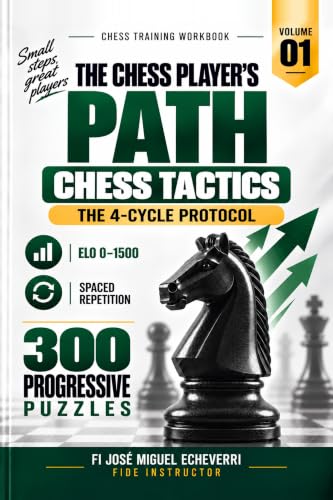
- 300 graded puzzles from Elo 0–1500
- Four-cycle spaced-repetition method
- Annotated solutions and error log
Best For: Beginners and club players wanting structured tactical progress
Best Comprehensive Collection

- More than 5,000 instructional situations
- Broad coverage of mates, endgames, and combinations
- Over 6,000 supporting illustrations
Best For: Players seeking a large traditional chess puzzle reference
Best Large Modern Workbook
The Chess Puzzles & Tactics Blueprint

- More than 2,000 tactical exercises
- Arranged by theme and difficulty
- Practical positions from actual games
Best For: Casual and online players building a broad tactics routine
Best Expert Challenge
The Ultimate Chess Puzzle Book

- Ranges from novice puzzles to extreme challenges
- Includes themed and clue-free graded tests
- Original game positions with computer-checked solutions
Best For: Players wanting an escalating, challenging puzzle collection
Deep Tactical Training

- 600 recent and unfamiliar tactical positions
- Explained solutions cover common wrong answers
- Includes no-clue tests and a theme index
Best For: Serious tactical practice and focused study
Beginner-Friendly Progression
The Ultimate Chess Puzzle Book for Beginners

- 439 puzzles increase gradually in difficulty
- Large, high-contrast diagrams aid visualization
- Covers mates, tactics, endgames, and game goals
Best For: New players and readable family practice
Structured Mate-in-2 Practice

- 500 problems with progressively harder positions
- Focused on mate-in-2 tactical patterns
- Large format with solutions for regular practice
Best For: Beginners and intermediates building mating skills
Kid-Friendly Pattern Builder

- 100 positions with graded difficulty
- Each puzzle follows an instructive example
- Includes warm-ups and advanced challenges
Best For: Children and developing players who want guided progression
Volume Practice Starter

- 500 beginner mate-in-one problems
- Progressive difficulty with solutions
- Large 8.27-by-11.69-inch format
Best For: Beginners and children practicing basic checkmates
Next-Step Checkmate Training

- 600 unique mate-in-two problems
- Increasing difficulty with solutions
- Large format for beginner-to-intermediate practice
Best For: Players ready to progress beyond mate-in-one puzzles
Best Progressive Training – Foundations & Tactical Vision
For players specifically seeking progressive chess puzzle books, this workbook offers a clearly staged path through 300 puzzles rated from Elo 0–1500. Its four-cycle spaced-repetition method, written solving space, and annotated solutions make it particularly structured for deliberate practice.
Best For: Beginners and improving club players who want graded tactics practice with a repeatable review system.
Pros:
- 300 puzzles organized across three increasing difficulty blocks.
- Four-cycle spaced-repetition framework supports repeated practice.
- Includes ruled solving lines, annotated solutions, and an error log.
- High-contrast diagrams are designed for print and Kindle viewing.
Cons:
- Its Elo range tops out at 1500, so advanced players may outgrow it.
- The publication date is September 2026, making it a newer release with limited track record in the supplied information.
This is the most explicitly progressive option in the group, combining graded puzzles with a built-in study routine rather than simply presenting a large collection of positions.
Best Comprehensive Collection – Chess: 5334 Problems
Among progressive chess puzzle books, this classic stands out for sheer breadth: more than 5,000 instructional situations arranged by problem type. It covers checkmates, endgames, and tournament combinations, making it a substantial reference for players who want a long supply of varied exercises.
Best For: Enthusiastic beginners and competitors who prefer a large, traditional puzzle collection with solutions.
Pros:
- Contains more than 5,000 problems, combinations, and games.
- Includes 306 mate-in-one, 3,412 mate-in-two, and 744 mate-in-three problems.
- Adds 144 simple endgames and 128 tournament game combinations.
- More than 6,000 illustrations support visual study.
Cons:
- At 1,104 pages and 2.7 pounds, it is less portable than shorter workbooks.
- The supplied description emphasizes organization by type rather than a modern spaced-repetition progression.
- Published in 2013, it is an older edition.
This is a strong choice when quantity and variety matter most. Buyers who want a guided, level-by-level curriculum may find its problem-type organization less focused than a purpose-built progressive workbook.
Best Large Modern Workbook – The Chess Puzzles & Tactics Blueprint
This modern entry among progressive chess puzzle books provides more than 2,000 exercises organized by theme and difficulty. The stated focus on practical positions from actual games makes it suitable for players who want a broad tactics workout with a step-by-step structure.
Best For: Casual, online, and returning players who want extensive, practical tactics training across multiple levels.
Pros:
- Offers more than 2,000 puzzles covering forks, pins, sacrifices, and other tactics.
- Organizes exercises by theme and difficulty for step-by-step practice.
- Uses positions described as coming from actual games.
- Provides a substantial 273-page workbook format.
Cons:
- The supplied details do not specify an Elo range or a named review system.
- The large exercise count may require readers to create their own revision schedule.
- Its promotional description makes improvement-oriented claims that are not independently quantified in the supplied information.
The Blueprint balances volume with thematic organization. It is a practical middle ground for buyers who want more material than a compact puzzle book but less bulk than a 5,000-plus-problem compendium.
Best Expert Challenge – The Ultimate Chess Puzzle Book
For shoppers comparing progressive chess puzzle books, The Ultimate Chess Puzzle Book offers a pronounced difficulty climb from 100 relatively easy positions to 100 extremely tough puzzles. It also mixes themed exercises, clue-free graded tests, and occasional positional solutions for a more varied challenge.
Best For: Players who want a broad difficulty range and increasingly demanding puzzles selected from original game positions.
Pros:
- Progresses from novice-level exercises to very difficult challenges.
- Includes tactical themes, graded tests, and positions without clues.
- Positions were selected from games rather than simply recycled from earlier puzzle books.
- Solutions were checked with computer assistance for soundness, according to the description.
Cons:
- At 240 pages, it contains fewer total positions than the largest collections here.
- The toughest puzzles may be unsuitable for complete beginners.
- Published in 2001, it is an older book.
This is a compelling pick for solvers who value originality and challenge escalation. Its difficulty range is progressive, though its format is less explicitly curriculum-based than the newer structured workbooks.
Deep Tactical Training – 600 Modern Chess Puzzles
For players seeking progressive chess puzzle books with serious tactical variety, 600 Modern Chess Puzzles offers a substantial workout. Its positions are mostly drawn from recent, obscure games or analysis, helping readers solve unfamiliar situations rather than rely on memorized examples.
Best For: Players who want challenging tactical practice, explained solutions, and a large set of modern positions.
Pros:
- Includes 600 puzzles selected for instructive training value.
- Solutions provide verbal explanations and address plausible wrong answers.
- Includes no-clue tests and a tactical-theme index useful for focused practice.
Cons:
- Its emphasis on tactical training may be less suitable for readers seeking broad strategic instruction.
- The mostly recent, obscure positions may be demanding for less experienced solvers.
Choose this book if you want depth, variety, and explanation-driven practice after learning basic tactical motifs. The 192-page format also makes it a substantial option for regular study or coaching use.
Beginner-Friendly Progression – The Ultimate Chess Puzzle Book for Beginners
THE ULTIMATE CHESS PUZZLE BOOK FOR BEGINNERS: 439 Tactics & Checkmates to Progress in Chess
Check Price On AmazonAmong progressive chess puzzle books, The Ultimate Chess Puzzle Book for Beginners stands out for its step-by-step structure and accessible presentation. It combines 439 gradually harder puzzles with large diagrams, thematic chapters, and simplified solutions for new learners.
Best For: Beginners, children, seniors, and anyone who prefers large-print diagrams and a guided learning path.
Pros:
- Moves from fundamental checkmates and tactics toward advanced play and endgames.
- Uses large, high-contrast diagrams with board coordinates.
- Includes simplified move sequences and short chess-history reading breaks.
Cons:
- Its beginner focus may feel too easy for experienced players.
- At 108 pages, it offers fewer puzzles than the larger-volume options.
This is a practical starting point for building pattern recognition without an intimidating layout. The large-print, 8.5-by-11-inch format is especially useful for younger readers or anyone who values readability.
Structured Mate-in-2 Practice – 500 Chess Puzzles, Mate in 2
If you are comparing progressive chess puzzle books for targeted checkmate practice, 500 Chess Puzzles, Mate in 2 provides a focused collection for beginners and intermediate players. The problems follow progressive difficulty and come with solutions, making the book suited to regular diagram-based training.
Best For: Beginners, children, and developing players who want repeated mate-in-2 exercises in a large-format workbook.
Pros:
- Offers 500 mate-in-2 problems with progressive difficulty.
- Designed for beginners and children while also addressing intermediate practice.
- Large 8.27-by-11.69-inch format supports diagram-based solving.
Cons:
- Its mate-in-2 focus is narrower than books covering many tactical themes.
- The 54-page length means the exercises are presented in a compact format.
This is a straightforward choice when your main goal is to improve tactical vision through repeated mating patterns. It also belongs to a six-book series that progresses from mate in 1 through mate in 6.
Kid-Friendly Pattern Builder – Chess Puzzles for Kids
For families seeking progressive chess puzzle books, Chess Puzzles for Kids offers 100 positions that move from approachable warm-ups to highly demanding challenges. Each puzzle begins with an instructive example, helping readers recognize the pattern before attempting the exercise.
Best For: Children ages 8–12, younger beginners, and developing players who want guided practice across several difficulty levels.
Pros:
- 100 puzzles span easy through extremely challenging positions.
- Instructive examples introduce the pattern behind each puzzle.
- Includes basic exercises, classic puzzles, and advanced “Mission Impossible” chapters.
Cons:
- Its child-focused presentation may feel less suitable for adults seeking a specialized tactical workbook.
- The most difficult final chapters may be too demanding for beginners.
This is the most guided option in the group, combining explanations with a broad difficulty range. Choose it when a young player benefits from learning a pattern before solving independently.
Volume Practice Starter – 500 Chess Puzzles, Mate in 1
Among progressive chess puzzle books, this beginner-level workbook emphasizes repetition: it provides 500 mate-in-one problems with solutions and a stated progressive difficulty. Its large page format and straightforward focus make it practical for regular short practice sessions.
Best For: Beginners and children building basic checkmating recognition and tactical habits.
Pros:
- Offers 500 mate-in-one exercises for extensive repetition.
- Problems are arranged with progressive difficulty.
- Solutions are included, and the large 8.27-by-11.69-inch format supports clear diagram work.
Cons:
- The scope is limited to mate-in-one problems.
- At 52 pages, the large puzzle count may require compact page layouts.
- Players seeking broader tactics or longer combinations will need another volume.
This is a focused first step rather than a general tactics manual. It is a sensible pick for learners who need a high volume of simple checkmate exercises before advancing to mate-in-two and later books in the series.
Next-Step Checkmate Training – Chess Puzzles 600 Mate In 2
For players ready to move beyond one-move finishes, Chess Puzzles 600 Mate In 2 is a dedicated progressive workbook with 600 unique mate-in-two problems. It includes solutions, clear diagrams, and increasing difficulty for beginners through intermediate players.
Best For: Beginners and intermediate players developing the ability to calculate a two-move mating sequence.
Pros:
- Provides 600 unique mate-in-two puzzles.
- Difficulty increases throughout the book.
- Includes solutions and uses a large 8.5-by-11-inch format.
Cons:
- Its exclusive mate-in-two focus may not cover broader tactical themes.
- The 58-page length may mean many problems appear in a compact layout.
- Beginners without mate-in-one experience may find the step up challenging.
This book fits a clear progression from basic checkmates toward short calculation. Choose it when mate-in-one exercises no longer provide enough challenge and the player wants a substantial mate-in-two set.
How We Picked the Best Progressive Chess Puzzle Books
We focused on books that provide enough practice to build pattern recognition and calculation rather than relying on a small collection of showcase problems. Key considerations included the stated rating or difficulty range, whether puzzles progress logically, the balance of mates and broader tactics, solution coverage, and usefulness for independent study.
We also considered different audiences. A beginner who needs one-move checkmates has different requirements from an intermediate player seeking modern positions, large exercise sets, or spaced-repetition practice. Puzzle quantity matters, but organization and appropriate difficulty are just as important.
Quick Comparison
| Best For | Look For | Why It Matters |
|---|---|---|
| New players | Mate-in-one and basic tactics | Builds confidence and pattern recognition |
| Improving beginners | Progressive difficulty and clear solutions | Creates a structured training path |
| Intermediate players | Mixed tactics and modern positions | Develops calculation beyond memorized patterns |
| High-volume practice | Hundreds or thousands of exercises | Supports regular, repeatable training |
| Children | Accessible presentation and short problems | Keeps practice engaging and manageable |
Key Buying Factors for Progressive Chess Puzzle Books
Difficulty and Progression
Choose a book that matches your current ability but leaves room to grow. A clearly labeled rating range or staged sequence is useful because consistently solving problems that are far too easy or difficult limits improvement.
Puzzle Type
Mate-in-one and mate-in-two books are excellent for learning threats, checks, and board awareness. Broader tactical collections may include forks, pins, skewers, discovered attacks, sacrifices, and combinations. Select the mix that matches the skill you want to develop.
Solutions and Explanations
Solutions should identify the principal move and explain why it works. If a book mainly supplies answer keys, it may be best for testing recognition, while annotated solutions are more helpful when you are learning calculation habits.
Practice Format
Look for features that support consistent study, such as numbered exercises, progressive sections, spaced repetition, notation that is easy to follow, and room to record answers. A portable paperback can work well for daily practice, while a very large collection suits longer training sessions.
Who Should Buy Which Progressive Chess Puzzle Books?
Absolute beginners should start with approachable mate-in-one or beginner-focused collections. Players who know basic tactics but want a guided path should prioritize progressive books with clearly staged difficulty. Intermediate players will generally benefit more from mixed tactical positions, modern examples, and larger challenge sets. Parents and coaches should favor children’s books or clearly organized beginner material with concise explanations.
Whichever title you choose, solve without moving the pieces when possible, write down your candidate move, and review every missed problem. Ten focused puzzles several times a week will usually produce more improvement than a rushed marathon followed by no analysis.