The right rhyming dictionary can turn a stalled line into a finished verse. These hardcover references range from broad, traditional listings to compact handbooks and creativity-focused guides designed to spark less predictable word choices.
We’ve selected 10 options for poets, songwriters, students, teachers, and anyone who wants a durable, easy-to-use offline writing tool. The guide below explains what separates them and how to choose with confidence.
Best 10 Hardcover Rhyming Dictionaries Picks for 2026
Best Overall

- More than 45,000 rhyming words
- Sound-based organization plus alphabetical index
- Includes usage notes and writing guidance
Best For: Poets and writers wanting a broad, easy-to-use reference
Best for Students
The Scholastic Rhyming Dictionary

- More than 15,000 words and phrases
- Entries arranged by syllable count
- Includes slang, idioms, and proper nouns
Best For: Grades 4–6 and introductory writing practice
Best Comprehensive Reference
The Complete Rhyming Dictionary Revised
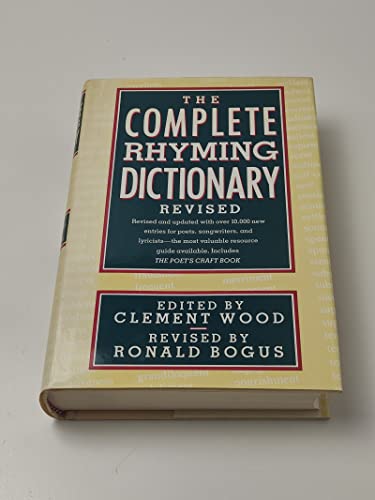
- More than 60,000 entries
- Covers several rhyme types and syllable lengths
- Includes the Poet’s Craft Book
Best For: Serious writers needing extensive rhyme coverage
Best for Original Lyrics

- More than 150,000 rhyming solutions
- Focuses on near, half, and false rhymes
- Designed to help avoid clichés
Best For: Songwriters and poets seeking unexpected rhyme options
Poet's Craft Pick
The Complete Rhyming Dictionary

- 624-page poetry reference
- Includes craft guidance
- Doubleday 1982 edition
Best For: Poets wanting rhyme help plus broader poetry guidance
Fast-Search Pick

- Built for quick rhyme searches
- Uses stress and vowel assonance
- Includes index and rhyme examples
Best For: Songwriters and poets seeking an accessible lookup tool
Classic Handbook Pick
New Rhyming Dictionary And Poets' Handbook

- Covers rhymes and rhythms
- Sixth edition from 1931
- Designed as a poet's writing aid
Best For: Writers and collectors seeking a traditional poetry handbook
Best with Extra Features

- Over 85,000 words
- Includes close and half rhymes
- Sound-based organization
Best For: Writers who need extensive rhyme coverage
Best Compact Choice
Hal Leonard Pocket Rhyming Dictionary

- Nearly 30,000 entries
- Alpha-phonetic organization
- Includes proper nouns and expressions
Best For: Writers wanting a concise rhyme reference
Best Classic Reference
Complete Rhyming Dictionary and Poet's Craft Book

- 607 pages of material
- Includes a poet's craft book
- 1936 first-edition listing
Best For: Collectors and readers seeking a vintage reference
Best Overall – New Oxford Rhyming Dictionary
For writers seeking one of the most versatile hardcover rhyming dictionaries, the New Oxford Rhyming Dictionary combines broad coverage with a clear, practical layout. It includes rhymes for more than 45,000 words, including proper names, place names, and foreign terms used in English.
Best For: Poets, lyricists, card writers, and anyone who wants an easy-to-navigate general-purpose rhyming reference.
Pros:
- Offers more than 45,000 rhyming words.
- Groups words by sound and includes a complete alphabetical index.
- Includes usage notes, literary examples, and creative-writing guidance.
- Adds more than 200 newer words, including “iPod” and “vuvuzela.”
Cons:
- Its 448-page format may be more reference book than casual users need.
- It focuses on conventional rhyming support rather than primarily unconventional rhymes.
This is the strongest all-around choice for buyers who value organization, substantial coverage, and helpful context alongside rhyme lists.
Best for Students – The Scholastic Rhyming Dictionary
The Scholastic Rhyming Dictionary is a compact option among hardcover rhyming dictionaries, with more than 15,000 rhyming words and phrases arranged to make syllable count easy to compare. Its inclusion of slang, idioms, and proper nouns adds useful variety for younger writers.
Best For: Students in grades 4–6, classroom writing activities, and buyers seeking a straightforward introductory reference.
Pros:
- Provides more than 15,000 rhyming words and phrases.
- Arranges entries by number of syllables.
- Includes slang, idioms, and proper nouns.
- Has a student-oriented grade range of 4–6.
Cons:
- Its coverage is smaller than the larger dictionaries in this roundup.
- The 1994 publication date means it may not reflect newer vocabulary.
With its syllable-based organization and accessible scope, this is a sensible pick for school-age users who do not need an expansive professional reference.
Best Comprehensive Reference – The Complete Rhyming Dictionary Revised
For shoppers comparing hardcover rhyming dictionaries by sheer breadth, The Complete Rhyming Dictionary Revised is a substantial reference with more than 60,000 entries. It covers sight, vowel, consonant, and one-, two-, and three-syllable rhymes, while also including the Poet’s Craft Book.
Best For: Serious poets, experienced lyricists, and writers who want extensive rhyme categories in one large volume.
Pros:
- Contains more than 60,000 entries.
- Includes sight, vowel, consonant, and multisyllabic rhymes.
- Adds more than 10,000 new entries in the revised edition.
- Includes the Poet’s Craft Book.
Cons:
- At 640 pages and 2.3 pounds, it is relatively large and heavy.
- The revised edition was published in 1991, so its vocabulary may be dated.
This is the volume to consider when maximum coverage and multiple rhyme types matter more than portability or modern publication date.
Best for Original Lyrics – Surprising Rhyming
Surprising Rhyming takes a different approach to hardcover rhyming dictionaries by emphasizing alternative, near, half, and false rhymes rather than only predictable perfect matches. With more than 150,000 rhyming solutions across about 1,400 rhyme sounds, it is designed as a brainstorming tool for adventurous songwriting and poetry.
Best For: Pop, rock, country, folk, and hip-hop lyricists, as well as poets trying to avoid clichés.
Pros:
- Provides more than 150,000 rhyming solutions.
- Offers alternatives beyond traditional perfect rhymes.
- Draws on unconventional rhyme practices associated with influential songwriters and lyricists.
- Includes newer words added to standard dictionaries.
Cons:
- Its alternative-rhyme focus may be less useful for writers seeking only exact rhymes.
- At 624 pages, it is a substantial reference to keep at hand.
Choose this book when originality and flexibility are the priority; its deliberately unexpected suggestions can help lyrics and poems sound less predictable.
Poet's Craft Pick – The Complete Rhyming Dictionary
The Complete Rhyming Dictionary: The Essential Handbook for Poets and Sungwriters
Check Price On AmazonFor shoppers comparing hardcover rhyming dictionaries, The Complete Rhyming Dictionary stands out as a substantial reference that goes beyond rhyme lookup. Published by Doubleday in 1982, it combines a 624-page rhyming dictionary with guidance on several elements of poetry.
Best For: Poets who want a broad rhyming reference with additional craft guidance.
Pros:
- 624 pages of reference material
- Explains several elements of poetry
- Presented as a poet’s craft book, not just a dictionary
Cons:
- Published in 1982, so it is an older edition
- Its expanded poetry focus may be more than shoppers seeking only quick rhyme lookups need
Choose this title if you want a traditional, full-length poetry companion rather than a narrowly focused rhyme finder. Its substantial page count and craft-oriented description make it a practical choice for sustained writing reference.
Fast-Search Pick – Collins Rhyming Dictionary
Among hardcover rhyming dictionaries, the Collins Rhyming Dictionary is designed around fast, practical word searches for songs and poems. Its system groups satisfactory rhymes by stress and vowel assonance, while an index and example panels help writers move quickly from an idea to a usable rhyme.
Best For: Songwriters and poets who prioritize accessible, efficient rhyme searches.
Pros:
- Groups rhymes using stress and vowel assonance
- Includes an index for direct word lookups
- Features examples of rhyme in action
- Designed to avoid obscure padding and complicated rhyme subdivisions
Cons:
- The supplied listing identifies it as a digital edition, not a confirmed hardcover
- Its 2014 publication date may matter to shoppers seeking a newer reference
This is the strongest fit for writers who want a straightforward workflow instead of a highly technical arrangement. Confirm the format before buying, since the supplied details describe a digital edition with a 2.2 MB file size.
Classic Handbook Pick – New Rhyming Dictionary And Poets' Handbook
For readers browsing hardcover rhyming dictionaries with a classic reference-book feel, New Rhyming Dictionary And Poets’ Handbook offers a compact storehouse of rhymes and rhythms. The supplied listing identifies this as the sixth edition, published by Harper&Bros. in 1931.
Best For: Writers and collectors who appreciate an older, traditional rhyming handbook.
Pros:
- Combines rhymes and rhythms in one reference
- Described as a handy tool comparable to a thesaurus
- Sixth edition provides a longstanding reference format
Cons:
- Published in 1931, making it an especially old edition
- The supplied notes do not provide page count or detailed search features
- Hardcover status is not explicitly confirmed in the supplied details
This title makes the most sense for shoppers drawn to established poetic reference works and historical editions. If you need modern organization or detailed specifications, verify the listing information before purchase.
Best with Extra Features – Oxford Rhyming Dictionary
For shoppers comparing hardcover rhyming dictionaries, the Oxford Rhyming Dictionary is a comprehensive reference designed for finding precise, close, and half rhymes. Its sound-based organization helps you match words as they are spoken rather than simply how they are spelled.
Best For: Songwriters, poets, copywriters, lyricists, students, and teachers who want extensive coverage.
Pros:
- Includes more than 85,000 words.
- Provides close rhymes and half rhymes alongside standard rhymes.
- Uses an index that directs readers to sound-based rhyme groups.
- Offers 672 pages of reference material.
Cons:
- Its 2.45-pound weight and larger format may be less convenient for portability.
- The publication date is 2004.
Choose this edition when breadth and nuanced rhyme matching matter more than a compact footprint. It is particularly well suited to a dedicated writing desk or classroom reference shelf.
Best Compact Choice – Hal Leonard Pocket Rhyming Dictionary
Among hardcover rhyming dictionaries, the Hal Leonard Pocket Rhyming Dictionary emphasizes quick access and manageable coverage. Its nearly 30,000 entries are organized alpha-phonetically to reduce cross-referencing while supporting songwriting, poetry, and general writing.
Best For: Singer-songwriters, poets, and recreational or professional writers seeking a concise resource.
Pros:
- Contains nearly 30,000 entries.
- Alpha-phonetic organization is intended to minimize cross-referencing.
- Covers standard vocabulary, proper nouns, and popular expressions.
- Includes a foreword by Nashville songwriter Buzz Cason.
Cons:
- Has substantially fewer entries than the Oxford Rhyming Dictionary.
- The supplied listing identifies it as a 240-page book, but does not provide physical dimensions or binding details.
- Publication date is 2003.
This is a practical pick for writers who value a concise, user-friendly format over maximum word count. Its focus on contemporary vocabulary and expressions may be helpful during songwriting sessions.
Best Classic Reference – Complete Rhyming Dictionary and Poet's Craft Book
For readers exploring hardcover rhyming dictionaries with historical character, The Complete Rhyming Dictionary and Poet’s Craft Book offers a substantial 607-page reference from Doubleday. The supplied copy is a 1936 first edition, so condition should be considered carefully before buying.
Best For: Collectors, writers interested in older reference books, and readers seeking a classic poet’s craft volume.
Pros:
- Provides 607 pages of material.
- Combines a rhyming dictionary with a poet’s craft book.
- The supplied copy is identified as a first edition.
Cons:
- The listing describes a loose front hinge.
- The copy is marked ex-library.
- As a 1936 edition, it may not reflect contemporary vocabulary.
This book is best approached as a vintage reference and collectible rather than a modern, up-to-date rhyming tool. Confirm the copy’s condition if durability and presentation are priorities.
How We Picked These Hardcover Rhyming Dictionaries
We focused on reference books that offer lasting value in a physical format, prioritizing rhyme coverage, organization, ease of lookup, and usefulness beyond a basic word list. We also considered whether each title supports different creative needs, including formal poetry, lyrics, classroom exercises, and experimental writing.
Edition details matter. Some titles emphasize comprehensive coverage, while others are designed for portability, unexpected associations, or a combination of rhymes and practical writing advice. Check the listing carefully for the exact edition, binding, and included features before buying.
Quick Comparison
| Best For | Look For |
|---|---|
| Broad everyday reference | Large word coverage and clear alphabetical organization |
| Poetry and songwriting | Perfect-rhyme listings plus usage or craft guidance |
| Fresh, less obvious ideas | Alternative groupings and prompts for unconventional rhymes |
| Students and younger writers | Simple navigation, approachable explanations, and manageable size |
| Travel or quick sessions | Compact dimensions and a lightweight binding |
Key Buying Factors for Hardcover Rhyming Dictionaries
Coverage and Rhyme Style
Decide whether you need common end rhymes, extensive multisyllabic coverage, or help with near and imperfect rhymes. A comprehensive dictionary is valuable for serious writing, while a more focused volume may be faster for casual use.
Organization and Lookup Speed
Check how words are indexed and grouped. Clear alphabetical entries, pronunciation guidance, and helpful cross-references reduce interruptions when you are drafting. Songwriters may also prefer a book that makes repeated or phrase-based searches convenient.
Craft Guidance and Extras
Some Hardcover Rhyming Dictionaries include advice on meter, poetic technique, lyric writing, or word choice. These additions can justify a larger book if you want instruction as well as lookup support; otherwise, a straightforward reference may be more efficient.
Size, Durability, and Edition
Hardcover construction suits frequent desk use and library shelves, but it can add weight. Confirm the trim size and page count if portability matters, and look for a current or revised edition when vocabulary, layout, or supplementary content has been updated.
Who Should Buy Which Hardcover Rhyming Dictionaries?
Choose a comprehensive Oxford, Collins, or complete-dictionary title if you want a dependable general reference for regular poetry or songwriting. A poet’s handbook edition is a better fit if you want technique advice alongside rhyme searches. Writers seeking unusual turns of phrase should consider an alternative rhyming approach rather than a conventional list alone.
Students, teachers, and younger writers may prefer the Scholastic option for its approachable format. If you write away from your desk, a pocket-sized reference is the practical choice, provided its smaller coverage matches your needs. Before purchasing, compare the physical dimensions, binding, edition, and stated word count so the book fits both your writing habits and workspace.