If you’re digitizing rare books, family histories, or office records, the right scanner can save hours and preserve more detail. The best options balance image quality, gentle handling, and dependable OCR.
This roundup of book scanners for archival projects focuses on practical tools that make scanning faster, cleaner, and easier to organize for long-term storage.
Best 10 Book Scanners for Archival Projects Picks for 2026
High-Resolution Overhead Pick
CZUR ET24 Pro Professional Book Scanner
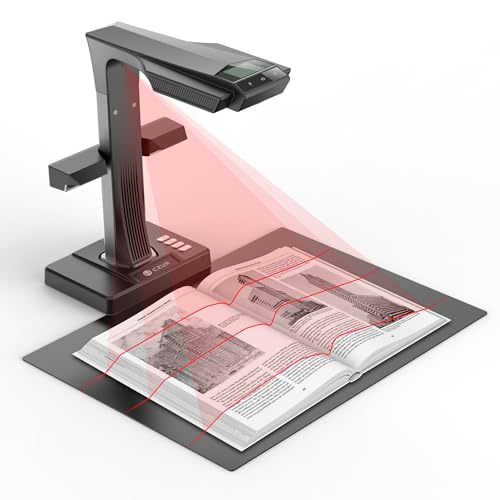
- 24MP overhead capture with A3 support
- Flattening tech helps with curved pages
- ABBYY OCR outputs editable files
Best For: Detailed archival scanning of books and large documents
Flatbed Organization Pick
Plustek OpticBook 4900 Flatbed Scanner

- BookMaker software helps organize archives
- OCR enables searchable, editable files
- Flatbed design supports careful book scanning
Best For: Organized, searchable archiving of books and reference documents
Fast Overhead Value Pick
CZUR Aura Pro Book & Document Scanner

- About 2 seconds per page scanning speed
- Flattening tech improves curved book pages
- Searchable PDF and Word output supported
Best For: Fast, easy archival scanning of books and mixed documents
Classic Overhead Scanner Pick
ScanSnap SV600 Overhead Book and Document Scanner

- Non-contact scanning preserves bound originals
- Auto Book Correction reduces curve distortion
- Page Turning Detection supports easy workflows
Best For: Fragile books, newspapers, and preservation-focused archival work
Portable Thin Book Scanner
CZUR Shine Ultra for Fast Flat Book Scans

- About 1-second-per-page scanning
- Patented flattening for thinner books
- Portable foldable design with OCR support
Best For: Thin books, flat paperwork, and quick archival batches
Refurbished A3 Flatbed
VIISAN 3120 for Large-Format Archiving

- A3 flatbed for books and oversized originals
- Up to 1200 DPI optical resolution
- Auto-scan workflow with Windows and Mac support
Best For: Libraries and archives handling large-format books and documents
High-Resolution Overhead Scanner
CZUR ET MAX for Serious Archival Work

- 38MP overhead capture with curve flattening
- Fast 1.5-second page scanning
- OCR to searchable PDFs and Office files
Best For: High-volume bound-book digitization and detailed archival capture
Desktop Archiving Scanner
JOYUSING V320pro 16MP Book & Document Scanner

- 16MP overhead scanning with LED auxiliary light
- Auto-flatten, deskew, finger removal, and smart paging
- Windows OCR to PDF, Word, Txt, and Excel
Best For: Fast everyday archival scanning on Windows
Large-Format Archive Scanner
VIISAN S21 A2/A3 Book & Document Scanner

- A2 overhead capture for oversized books and maps
- 26MP imaging with software-enhanced 600 DPI
- OCR exports to PDF, Word, Excel, EPUB, and TXT
Best For: Oversized archival materials and manuscript scanning
Library-Ready Archive Scanner
VIISAN DL16 A3 Overhead Document Scanner

- A3 overhead scanning for books and large documents
- 16MP capture with up to 300 DPI resolution
- Anti-glare LED lighting for cleaner page visibility
Best For: Libraries and home archiving with A3 originals
High-Resolution Overhead Pick – CZUR ET24 Pro Professional Book Scanner
For book scanners for archival projects, the CZUR ET24 Pro is built for speed and detail, especially when you need to digitize bound books, magazines, and oversized documents up to A3. Its upgraded flattening technology, 24MP camera, and ABBYY OCR make it a practical choice when the goal is clean, searchable archives rather than page-by-page flatbed handling.
Best For: Archivists and researchers who need high-resolution, overhead scanning for books and mixed paper collections.
Pros:
- 24MP camera with 5696 × 4272 resolution for detailed captures.
- Flattening technology helps reduce page curvature on books.
- ABBYY OCR supports editable PDF, Word, and Excel output with 180+ languages.
- Supports A3-size materials, plus HDMI and USB connectivity.
Cons:
- Very glare-heavy paper is not recommended.
- Arabic OCR is limited by operating system support; Thai and Hebrew are not supported.
- Larger desktop footprint than a compact document scanner.
Overall, the ET24 Pro is a strong fit if your archival workflow values speed, large-format support, and searchable output. It is more versatile than a basic book scanner, but it still works best with standard paper surfaces rather than highly reflective originals.
Flatbed Organization Pick – Plustek OpticBook 4900 Flatbed Scanner
If you want book scanners for archival projects that focus on organization as much as capture quality, the Plustek OpticBook 4900 stands out with bundled BookMaker software. Its flatbed design is better suited to careful digitizing of books, notes, magazines, and reference documents when file sorting, tagging, and searchable archives matter.
Best For: Users who want a flatbed scanner with document management tools for organizing archived books and reference material.
Pros:
- Includes BookMaker software for organizing books, PDFs, notes, and magazines.
- OCR supports searchable text and editable formats.
- File tagging and note-taking tools help sort archival content.
- Compatible with Windows and Mac systems.
Cons:
- Single-sheet capacity means slower manual scanning.
- Flatbed format is less suited to rapid batch scanning.
- Best suited to careful, one-at-a-time workflows rather than high-speed capture.
The OpticBook 4900 is less about speed and more about keeping an archive structured. For collections where classification and retrieval are as important as the scan itself, it offers a very practical workflow.
Fast Overhead Value Pick – CZUR Aura Pro Book & Document Scanner
For book scanners for archival projects where speed and simple operation matter, the CZUR Aura Pro offers a fast overhead workflow with flattening technology and searchable output. It scans in about 2 seconds per page and supports books, A3/A4 documents, and OCR conversion, making it a strong fit for building digital archives efficiently.
Best For: Users who want a fast overhead scanner for books and documents with easy setup and OCR.
Pros:
- Scans in about 2 seconds per page.
- Flattening technology helps replicate curved book pages.
- Outputs JPG, Word, PDF, and searchable PDF files.
- Built-in lighting is glare-free and controlled through the CZUR app.
Cons:
- Standard sheet capacity is limited to 3.
- Thai, Hebrew, and Arabic OCR are not supported.
- Best for overhead capture rather than flatbed-style page handling.
The Aura Pro is a compelling choice when you want to move quickly through archival scanning without giving up OCR support. It is especially useful for mixed document sets, though language support and capacity limits are worth noting.
Classic Overhead Scanner Pick – ScanSnap SV600 Overhead Book and Document Scanner
For book scanners for archival projects that need a non-contact overhead approach, the ScanSnap SV600 is designed to scan books, newspapers, magazines, and documents without cutting them apart. Its automatic book correction, multi-document detection, and page-turning detection make it a practical option for preserving fragile or bound materials while building digital archives.
Best For: Archiving bound books, newspapers, and fragile documents without damaging originals.
Pros:
- Scans books and newspapers directly without cutting them.
- Auto Book Correction helps flatten curve distortion.
- Multi Document Detection can crop and rotate multiple items in one scan.
- Page Turning Detection and Time Mode support hands-free workflows.
Cons:
- Lower 1200 resolution than some higher-end overhead scanners.
- Single-sheet capacity limits batch-style feeding.
- Best suited to overhead capture rather than high-volume production scanning.
The SV600 is a proven choice for preservation-minded scanning where avoiding physical damage matters most. It is especially useful for archived books and mixed paper items that are awkward to place on a flatbed.
Portable Thin Book Scanner – CZUR Shine Ultra for Fast Flat Book Scans
If you need book scanners for archival projects and want a quick, space-saving setup, the CZUR Shine Ultra is built for fast scanning of thinner bound materials and flat documents. Its curved-page flattening tech helps reduce distortion on book pages, while the A3-capable design and 1-second-per-page speed make it practical for smaller preservation batches.
Best For: Archiving thinner books, paper files, and mixed document stacks where speed matters more than heavy-duty book handling.
Pros:
- Patented page-flattening tech helps correct curved book pages.
- Fast scanning speed of about 1 second per page.
- Supports A3 and A4 documents, plus OCR in 180+ languages.
- Portable, foldable design with adjustable height and foot pedal control.
Cons:
- Only suitable for thinner books; thicker bindings are better handled by CZUR ET series models.
- Not compatible with Android or iOS.
- Thai, Hebrew, and Arabic OCR are not supported.
For archival work centered on thin books and paperwork, this model balances speed, portability, and text-recognition features well. If your collection includes heavy, tightly bound volumes, you’ll likely want a more robust book scanner instead.
Refurbished A3 Flatbed – VIISAN 3120 for Large-Format Archiving
For book scanners for archival projects that need a traditional flatbed approach, the VIISAN 3120 is designed for large documents, books, magazines, and other oversized materials. Its frameless A3 bed and auto-scan workflow make it a straightforward choice for libraries, schools, and office digitization tasks where consistent handling matters.
Best For: Large-format archival scanning of books, photo albums, newspapers, and oversized documents on a flatbed.
Pros:
- A3 flatbed supports materials up to 304 × 426 mm.
- Up to 1200 × 1200 DPI optical resolution for detailed scans.
- Auto-scan and LED lighting help speed up repeated jobs.
- Compatible with Windows and macOS drivers.
Cons:
- Refurbished condition may include minor cosmetic signs of prior use.
- 1200 DPI requires the supplied VIISAN scanning software.
- Bulkier than portable overhead-style scanners.
This is a solid option when your archive work favors a flatbed and you need room for larger originals. It’s especially appealing if you value resolution and reliability over ultra-fast overhead scanning.
High-Resolution Overhead Scanner – CZUR ET MAX for Serious Archival Work
If you’re comparing book scanners for archival projects, the CZUR ET MAX stands out as a high-resolution overhead model built for bound books and large documents. Its curve-flattening technology, 38MP sensor, and fast 1.5-second page capture make it a strong fit for higher-volume digitization where image detail and page correction are important.
Best For: Heavy-duty archival scanning of bound books, searchable documents, and A3-sized pages.
Pros:
- 38MP sensor delivers high-resolution captures at 7168 × 5376.
- Patented curve-flattening helps reduce distortion in bound books.
- OCR supports editable and searchable outputs, including Word, Excel, and PDFs.
- Works with Windows, macOS, and Ubuntu Linux 20.04 to 24.04.
Cons:
- Not recommended for glossy or highly reflective materials.
- Arabic OCR support is limited to ET Series scanners on Windows.
- Heavier and less portable than compact document scanners.
For archive projects that demand detail, speed, and strong bound-book handling, this is the most capable option in the group. It’s a better fit than a basic flatbed when your priority is efficient capture of pages you’d rather not unbind.
Desktop Archiving Scanner – JOYUSING V320pro 16MP Book & Document Scanner
If you’re comparing book scanners for archival projects, the JOYUSING V320pro is a practical desktop option for digitizing bound books and documents up to A3 and A4 sizes. It combines auto-flattening, deskew, OCR, and fast continuous capture, making it useful for turning paper collections into searchable files with less manual cleanup.
Best For: Home offices, small archives, and users who want fast book scanning with OCR on Windows or basic PDF capture on Mac.
Pros:
- 16MP imaging with LED auxiliary light for clearer capture in lower light.
- Auto-flatten and deskew tools, plus smart paging and finger removal.
- Supports PDF, Word, Txt, and Excel conversion on Windows.
- Fast continuous scanning up to 40 pages per minute.
Cons:
- Book thickness support is limited to 3 cm.
- Mac support is limited to PDF output based on the supplied notes.
- Requires software setup from Joyusing’s support download center.
For archival workflows that need speed more than heavy-duty production hardware, this scanner offers a solid mix of automation and file conversion. It is especially appealing if you want cleaner page capture without spending extra time correcting curved pages or manually removing fingers.
Large-Format Archive Scanner – VIISAN S21 A2/A3 Book & Document Scanner
When archival projects involve oversized books, journals, newspapers, or maps, this VIISAN book scanner is built to handle much larger originals than a typical desktop model. Its A2-capable overhead design, auto-flattening tools, and OCR support make it well suited to preserving bulky or wide-format materials in searchable digital form.
Best For: Libraries, manuscript work, and large-format archival digitization where A2 or A3 capture matters.
Pros:
- A2 large-format capture at 594 x 420 mm for oversized materials.
- Up to 26MP resolution with software-enhanced capture up to 600 DPI.
- Auto-flattening, finger removal, and double-page splitting.
- OCR can export to PDF, Word, Excel, EPUB, and TXT.
Cons:
- Bundled software supports only x64 and x86 systems, not ARM devices.
- Very glare-prone paper is not recommended in the supplied notes.
- Uses a desktop overhead setup, so it is less portable than simpler scanners.
If your archive includes oversized source material, the S21 stands out for flexibility and file output options. It is a strong choice when the priority is capturing large pages accurately and converting them into editable formats for later reference or processing.
Library-Ready Archive Scanner – VIISAN DL16 A3 Overhead Document Scanner
For book scanners for archival projects that focus on bound books and large documents, the VIISAN DL16 offers a straightforward A3 overhead setup with OCR and page-flattening tools. It is designed for cleaner capture of books, artwork, and oversized pages, which makes it a sensible fit for digitizing collections that need organized digital storage.
Best For: Libraries, educators, offices, and home archiving projects that need A3 overhead scanning.
Pros:
- A3 overhead design for bound books, artwork, and large-format pages.
- 16MP camera with up to 300 DPI resolution.
- Anti-glare LED lighting helps reduce shadows and reflections.
- Compatible with Windows and Mac for broader desktop use.
Cons:
- Resolution is listed at 300 DPI, which is lower than some higher-end overhead models.
- Notes do not mention PDF or editable-format conversion beyond OCR.
- Best suited to desktop workflows rather than portable scanning.
The DL16 is a balanced choice if you want a dependable overhead scanner without moving into more specialized large-format hardware. Its anti-glare lighting and A3 capture make it useful for archives where page visibility and ease of use matter more than maximum feature count.
How We Picked the Best Book Scanners for Archival Projects
For Book Scanners for Archival Projects, we prioritized scan quality, edge-to-edge capture, OCR accuracy, flattening tools, and ease of use. We also considered whether a model is better for bound books, oversized pages, or mixed documents, since archival work often involves all three.
Speed matters, but not at the expense of legibility or page preservation. That’s why overhead scanners, flatbeds, and large-format options all earned a place here depending on the use case.
Quick Comparison
Overhead book scanners are usually the fastest choice for bound volumes and fragile material. Flatbed scanners tend to produce the most consistent detail for photos, loose pages, and smaller items. Large-format scanners are the best fit when your archive includes maps, ledgers, or oversized spreads that standard devices can’t handle well.
Key Buying Factors for Book Scanners for Archival Projects
Image Quality and Resolution
Higher resolution helps capture fine print, paper texture, and marginal notes. For archival work, look for a scanner that produces sharp, distortion-free images rather than relying on headline megapixels alone.
Book Flattening and Edge Correction
Auto-flattening, deskew, and anti-glare lighting reduce curved-page distortion and shadowing near the spine. These features are especially useful when scanning older books that should not be pressed flat.
OCR and File Workflow
Good OCR turns scans into searchable files, which is essential for long-term retrieval. File-sorting software and export options like PDF, JPEG, and searchable PDF can make a big difference when building a digital archive.
Format Support
Check the maximum capture size before buying. A3 is enough for many books and documents, but A2 or larger support may be necessary for maps, newspapers, and oversized archival materials.
Handling and Preservation
For fragile bindings, choose a scanner that works from above and minimizes page contact. Flatbeds remain useful, but they are less ideal for delicate or tightly bound volumes.
Who Should Buy Which Book Scanners for Archival Projects?
If you need fast digitization of bound books, choose an overhead model with auto-flattening and OCR. If your archive includes photos or loose pages, a flatbed scanner is usually the safer, more detailed option. If you deal with oversized materials, look for an A2 or large-format scanner. For mixed home archives, a versatile overhead scanner often offers the best balance of speed, quality, and convenience.