The best chess puzzle books turn practice into a focused routine, helping you recognize checks, captures, mating patterns, forks, pins, and other tactical ideas faster.
This roundup covers 10 options for children, beginners, intermediate players, and serious improvers—from short mate-in-one exercises to large collections of thousands of problems.
Best 10 Illustrated Chess Puzzle Books Picks for 2026
Step-by-Step Tactics Training
The Chess Puzzles & Tactics Blueprint

- More than 2,000 tactical exercises
- Arranged by theme and difficulty
- Real-game positions for practical training
Best For: Players wanting a large, structured tactics workbook
The Comprehensive Illustrated Classic
Chess: 5334 Problems, Combinations and Games

- More than 5,000 instructional situations
- Over 6,000 clear illustrations
- Includes mates, endgames, and combinations
Best For: Readers wanting an expansive visual chess reference
Modern Tactical Vision Builder

- 600 mostly recent puzzle positions
- Explains key ideas and wrong answers
- Includes no-clues tests and a theme index
Best For: Players seeking fresh, instructive tactical challenges
Graded Challenge Collection
The Ultimate Chess Puzzle Book

- Moves from easy puzzles to expert challenges
- Includes themed and no-clue tests
- Adds occasional positional solutions
Best For: Players wanting a progressive, long-term puzzle challenge
Best All-Around Workbook
Winning Chess Exercises for Kids

- 350+ exercises with answers
- Annotated diagrams and step-by-step instruction
- Covers openings through endgames
Best For: Kids ages 8 to 12 building chess fundamentals
Best for Progressive Mate-in-Two Practice

- 500 problems with solutions
- Progressive difficulty for beginners
- Large format for puzzle practice
Best For: Beginners and children practicing mate in two
Best for Puzzle Variety

- 100 graded positions
- Examples precede every puzzle
- Ranges from warm-ups to hard challenges
Best For: Kids ages 8 to 12 seeking varied difficulty
Progressive Intermediate Practice
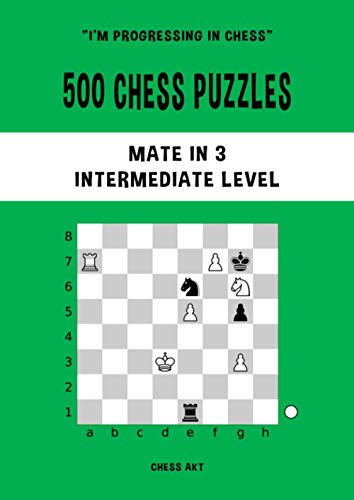
- 500 mate-in-3 problems with solutions
- Progressive difficulty for intermediate players
- Large 8.27-by-11.69-inch format
Best For: Intermediate players building tactical skill
Unique Two-Move Challenges

- 600 unique mate-in-two puzzles
- Solutions and increasing difficulty included
- Large 8.5-by-11-inch format
Best For: Beginners and intermediates practicing mating patterns
Beginner-Friendly Foundations

- 500 mate-in-one problems with solutions
- Progressive practice for beginners
- Suitable for children and new players
Best For: Beginners and children learning checkmate basics
Step-by-Step Tactics Training – The Chess Puzzles & Tactics Blueprint
For shoppers seeking illustrated chess puzzle books with a structured progression, The Chess Puzzles & Tactics Blueprint offers more than 2,000 exercises organized by theme and difficulty. Its focus on practical tactics, including forks, pins, and sacrifices, makes it a substantial training option for players who want targeted practice.
Best For: Casual, returning, and online players looking for a large, step-by-step tactics workbook.
Pros:
- Includes more than 2,000 puzzles covering a broad range of tactical themes.
- Organized by theme and difficulty for gradual skill development.
- Uses positions from actual games with an emphasis on practical application.
- Large 273-page format provides extensive practice.
Cons:
- Its sheer number of exercises may feel overwhelming to some beginners.
- The supplied description emphasizes tactics rather than broader chess instruction.
Choose this book if quantity, structure, and real-game tactical patterns matter most. It is particularly suited to readers who want a sizable practice routine rather than a short collection of puzzles.
The Comprehensive Illustrated Classic – Chess: 5334 Problems, Combinations and Games
If you want illustrated chess puzzle books with exceptional breadth, Chess: 5334 Problems, Combinations and Games is a substantial reference-style choice. It combines more than 5,000 instructional situations with over 6,000 illustrations, spanning checkmates, endgames, combinations, actual matches, and basic rules.
Best For: Enthusiastic novices and competitors who want a very extensive, diagram-rich chess resource.
Pros:
- Contains more than 5,000 problems, combinations, and game situations.
- Includes over 6,000 illustrations for visual study.
- Covers mates in one, two, and three, plus simple endgames and tournament combinations.
- Solutions are keyed to the back, and the book also includes basic rules and a bibliography.
Cons:
- At 1,104 pages, it is substantially larger and heavier than the other listed options.
- Its wide range of material may be less focused than a dedicated tactics workbook.
This is the strongest pick for buyers who value sheer volume and visual variety. Its extensive coverage makes it better suited to long-term browsing and reference than to a narrowly graded training plan.
Modern Tactical Vision Builder – 600 Modern Chess Puzzles
Among illustrated chess puzzle books, 600 Modern Chess Puzzles stands out for using mostly recent positions selected for instructive value. The collection includes detailed solutions, discussion of plausible wrong answers, a no-clues test section, and a theme index useful for focused practice.
Best For: Players who want modern, unfamiliar tactical positions and explanatory solutions.
Pros:
- Offers 600 puzzles, mostly drawn from the previous two years of its publication.
- Uses obscure games or analysis to reduce the chance of recognizing positions.
- Solutions explain key ideas and address many logical but incorrect answers.
- Includes no-clues tests and a tactical-theme index.
Cons:
- With 192 pages, it contains fewer exercises than the larger collections here.
- The modern, challenging positions may be less suitable for absolute beginners.
This is a focused option for readers who prefer solving fresh positions rather than repeating familiar classics. The explanatory solutions and theme index also make it useful for self-study or targeted coaching work.
Graded Challenge Collection – The Ultimate Chess Puzzle Book
The Ultimate Chess Puzzle Book is a strong choice for buyers comparing illustrated chess puzzle books by difficulty. It begins with 100 relatively easy positions, progresses through themed and graded tests, and ends with 100 extremely difficult puzzles, while also including occasional positions where the best move is positional rather than tactical.
Best For: Learners and experienced players who want a broad difficulty range and progressively tougher tests.
Pros:
- Provides 240 pages of puzzles ranging from novice-friendly to very difficult.
- Includes tactical themes, graded tests, and no-clue challenges.
- Positions were selected from new and old games rather than simply recycled from earlier puzzle books.
- Solutions were checked for soundness, including potential alternative solutions.
Cons:
- Published in 2001, so its positions are less contemporary than newer collections.
- Its toughest puzzles may be demanding for casual beginners.
This book works well when you want one collection that can remain challenging as your solving ability improves. Its graded structure and occasional positional solutions add variety beyond straightforward combination spotting.
Best All-Around Workbook – Winning Chess Exercises for Kids
Winning Chess Exercises for Kids: Tactics and Strategies to Outsmart Your Opponent
Check Price On AmazonFor parents seeking illustrated chess puzzle books with structured instruction, Winning Chess Exercises for Kids combines annotated diagrams, step-by-step guidance, and more than 350 exercises. It covers openings, middlegame tactics, endgames, checkmate patterns, and defensive ideas for developing players.
Best For: Kids ages 8 to 12 who want a guided workbook for building chess fundamentals and pattern recognition.
Pros:
- Includes more than 350 exercises with an answer key and explanations.
- Uses clear annotated diagrams to demonstrate concepts in action.
- Covers tactics and strategy across the opening, middlegame, and endgame.
- Offers instruction from Woman International Master Viktoria Ni.
Cons:
- The kid-focused format may feel basic to advanced players.
- Its 176-page workbook format is more instructional than purely puzzle-based.
This is the strongest choice for families wanting a comprehensive, approachable practice book rather than a collection of isolated positions. The explanations and broad topic coverage make it useful for regular study.
Best for Progressive Mate-in-Two Practice – 500 Chess Puzzles
This large-format option stands out among illustrated chess puzzle books for its focused collection of 500 progressive mate-in-two problems. It is designed for beginners and children who want repeated tactical practice, with solutions included for checking their work.
Best For: Beginners and kids developing tactical vision through regular mate-in-two exercises.
Pros:
- Provides 500 chess problems with solutions.
- Uses progressive difficulty to support ongoing practice.
- Large 8.27-by-11.69-inch format gives diagrams room to work.
- Focuses on a core tactical skill: finding checkmate in two moves.
Cons:
- At 54 pages, the solutions and puzzles may be densely arranged.
- Its narrow mate-in-two focus offers less coverage of broader strategy.
- The supplied description does not specify an age range beyond its beginner and children focus.
Choose this volume when quantity and repetition matter most. Its progressive format can provide a straightforward daily routine, though players wanting varied tactics or strategic lessons may prefer a broader workbook.
Best for Puzzle Variety – Chess Puzzles for Kids
Chess Puzzles for Kids is a strong pick among illustrated chess puzzle books for children who benefit from examples before solving. It presents 100 graded positions, each preceded by an instructive example, ranging from warm-ups to demanding “Mission Impossible” challenges.
Best For: Children ages 8 to 12 who want a varied challenge that grows from beginner exercises to advanced puzzles.
Pros:
- Every puzzle is introduced with an instructive example.
- Positions are graded across a wide range of abilities.
- Includes basic warm-ups, classic puzzles, and difficult final chapters.
- Introduces recurring tactical themes and patterns.
Cons:
- Contains 100 positions, fewer than the 500-puzzle option.
- The hardest “Mission Impossible” chapters may frustrate younger beginners.
- Published in 2012, so it is an older title than some alternatives.
This book works particularly well for mixed-ability households or readers who prefer learning by example. Its graded progression offers more variety than a single-motif puzzle book while still keeping the material kid-focused.
Progressive Intermediate Practice – Mate in 3 Puzzle Workbook
For players seeking illustrated chess puzzle books with a clear tactical focus, this workbook offers 500 mate-in-3 problems arranged by progressive difficulty. Its large 8.27-by-11.69-inch format and included solutions make it practical for regular solving sessions.
Best For: Intermediate players who want structured practice with three-move checkmate problems.
Pros:
- Includes 500 mate-in-3 problems with solutions.
- Progressive difficulty supports steady skill development.
- Large-format pages provide room for studying chess diagrams.
Cons:
- At 56 pages, the layout may be compact for 500 exercises.
- Its intermediate focus may be too challenging for beginners.
This is a focused tactical workbook rather than a broad chess instruction guide. Choose it if mate-in-three practice matches the player’s current level and goals.
Unique Two-Move Challenges – 600 Mate in 2 Chess Puzzles
This large-format option among illustrated chess puzzle books presents 600 unique mate-in-two puzzles with solutions. Increasing difficulty makes it suitable for beginners and intermediate players who want repeated practice in spotting short tactical finishes.
Best For: Beginners and intermediate players looking for a substantial collection of two-move checkmate exercises.
Pros:
- Offers 600 puzzles, providing extensive practice.
- Solutions are included for checking completed work.
- Increasing difficulty supports gradual progression.
- Large 8.5-by-11-inch size is convenient for viewing diagrams.
Cons:
- The focus is limited to mate-in-two positions.
- The 58-page length may result in a dense presentation.
Its combination of puzzle volume, solutions, and rising difficulty makes this a straightforward training choice. It is especially useful when the player wants to concentrate on recognizing immediate mating patterns.
Beginner-Friendly Foundations – Mate in 1 Puzzle Book
Designed for newcomers, this beginner-level entry in illustrated chess puzzle books contains 500 mate-in-one problems with solutions. The progressive format, large pages, and emphasis on basic tactical patterns make it approachable for children and starting players.
Best For: Beginners and children learning to identify simple checkmates and build regular solving habits.
Pros:
- Includes 500 mate-in-one exercises with solutions.
- Progressive difficulty helps introduce tactical concepts gradually.
- Specifically described as suitable for beginners and kids.
- Large 8.27-by-11.69-inch format supports diagram study.
Cons:
- Mate-in-one problems may be too easy for experienced players.
- The 52-page booklet may present many exercises in a compact layout.
This is the natural starting point in the six-book series for players who are still learning basic mating ideas. More advanced solvers may prefer the series’ mate-in-two or mate-in-three volumes.
How We Picked These Illustrated Chess Puzzle Books
We looked for books that provide meaningful tactical practice rather than collections of random positions. Our selection spans several difficulty levels, including beginner mate-in-one problems, mate-in-two and mate-in-three challenges, general tactics, modern positions, and broad exercise collections.
We also considered practical usability: clear diagrams, included solutions, progression from simpler to harder exercises, and suitability for different ages and study goals. A book does not need to be advanced to be valuable; a well-organized beginner collection can build pattern recognition more effectively than an intimidating expert-level volume.
Quick Comparison
- Best for a large variety of practice: broad collections with hundreds or thousands of problems.
- Best for beginners: mate-in-one books and clearly graded introductory exercises.
- Best for developing players: mate-in-two, mate-in-three, and general tactical puzzle books.
- Best for children: books with accessible language, approachable diagrams, and short exercises.
- Best for serious study: comprehensive collections that include combinations, games, and detailed solutions.
Key Buying Factors for Illustrated Chess Puzzle Books
Difficulty and Progression
Choose a level that is challenging without making every exercise feel impossible. Beginners often benefit from mate-in-one problems, while players with basic tactical confidence can move to mate-in-two, mate-in-three, forks, pins, discovered attacks, and longer combinations.
Number and Variety of Puzzles
A high puzzle count offers better value for regular practice, but variety matters more than volume alone. Look for books that cover multiple tactical themes and provide positions from realistic games rather than repeating one pattern exclusively.
Solutions and Explanations
Reliable solutions are essential for learning. Move-only answers let you check results quickly, while explanations help you understand why a tactic works and what defensive resource you may have missed.
Diagram Quality and Format
Readable board diagrams, clear notation, and comfortable page layouts make it easier to solve without a physical board. For younger players, large, uncluttered diagrams and straightforward instructions can make practice more enjoyable.
Practice Style
Decide whether you want a short daily routine, a structured course, or a large reference collection. A book with 500 focused puzzles may be more useful than a 2,000-problem volume if its difficulty and format match your available study time.
Who Should Buy Which Illustrated Chess Puzzle Books?
New players and children should start with beginner-focused exercises, especially mate-in-one problems and books designed for young learners. Improving club players may prefer mate-in-two or mate-in-three collections that demand deeper calculation. Players seeking broad tactical training should choose a varied collection with forks, pins, skewers, sacrifices, mating attacks, and combinations. Dedicated solvers will get the most from very large problem books that support months of regular practice.
Whichever of these Illustrated Chess Puzzle Books you choose, solve positions without moving the pieces first, write down your candidate moves, and review every missed puzzle. Consistent analysis—not simply completing the most pages—is what turns puzzle practice into stronger practical play.