Checkmate puzzles are one of the most direct ways to improve pattern recognition, calculation, and confidence at the board. The right book can turn short daily sessions into measurable tactical progress.
This roundup compares 10 checkmate chess puzzle books for beginners, children, and improving players, with options ranging from mate-in-one drills to deeper three-move exercises.
Best 10 Checkmate Chess Puzzle Books Picks for 2026
Structured Mate Progression

- 200 puzzles from mate in 1 through mate in 4
- Large diagrams with coordinates and turn indicators
- Complete solutions included
Best For: Players practicing progressively longer mating sequences
Large-Print Learning Path
Ultimate Chess Puzzle Book for Beginners
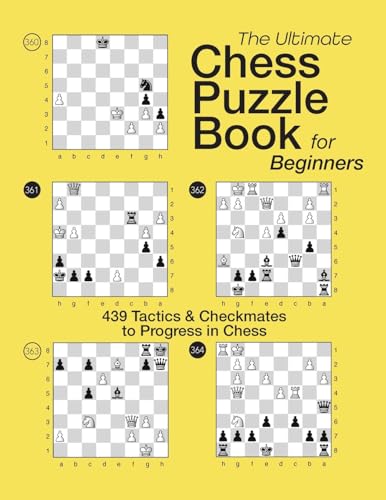
- 439 puzzles across tactics, checkmates, and endgames
- Large-print, high-contrast diagrams
- Simplified solutions and chess-history breaks
Best For: Beginners and readers who prioritize readability
High-Volume Novice Drills

- 500 mate-in-1 and mate-in-2 problems
- Progressively increasing novice-level difficulty
- Solutions and solving guidance included
Best For: Absolute beginners and children building mating patterns
Broad Tactical Training
Chess Puzzles & Tactics Blueprint

- 2,000-plus exercises across many tactical themes
- Progresses by theme and difficulty
- Uses positions from actual games
Best For: Players wanting broad tactical improvement beyond checkmates
Pattern Builder
The Chess Kid's Book of Checkmate
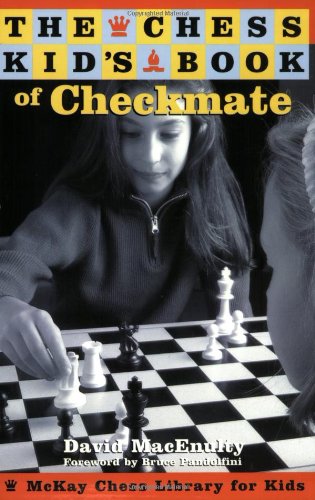
- Designed for ages 6 to 10
- Teaches recognizable mating patterns
- Includes more than 100 diagrams
Best For: Young beginners learning checkmate fundamentals
Structured Training
Chess Checkmate Workbook for Beginners

- Offers 250 progressive checkmate puzzles
- Covers multiple classic mating patterns
- Includes tracking and mistake-review tools
Best For: Beginners building calculation and mating-pattern skills
Deep Challenge
The Big Chess Puzzle Advent Calendar Book

- Contains 192 puzzles in 24 sections
- Emphasizes quiet moves and varied problem types
- Includes hints and explained, verified solutions
Best For: Intermediate to advanced solvers seeking demanding variety
Best for Young Learners

- 100 puzzles with step-by-step solutions
- Teaches mates in 1, 2, and 3 moves
- Includes progress tracker and parent checklist
Best For: Children ages 5–10 beginning structured checkmate practice
Best for Intermediate Practice

- 240 mates-in-three exercises
- Positions drawn from historical games
- Designed for intermediate players
Best For: Players ready for focused three-move checkmate training
Best for High-Volume Beginner Drills
1000+ Chess Puzzles: Mate in 1

- More than 1,000 mate-in-one puzzles
- Difficulty increases gradually
- Includes diagrams and answer key
Best For: Kids ages 6–9 building board vision through repetition
Structured Mate Progression – 200 Checkmate Puzzles
For shoppers comparing checkmate chess puzzle books, this 205-page collection offers a clearly staged workout: 200 positions progressing from mate in 1 through mate in 4. Large diagrams, board coordinates, and complete solutions make it practical for focused tactics practice.
Best For: Players who want a dedicated checkmate collection with gradually longer mating sequences.
Pros:
- Includes 200 puzzles spanning mate in 1 to mate in 4.
- Two large diagrams per page include board coordinates and a side-to-move indicator.
- Full solutions are provided at the back of the book.
Cons:
- Focuses specifically on checkmates rather than a broad range of tactical themes.
- The book is in English only.
This is a straightforward choice for building mating-pattern recognition in measured stages. Players seeking additional volume or harder positions may want to explore the other books in the series.
Large-Print Learning Path – Ultimate Chess Puzzle Book for Beginners
THE ULTIMATE CHESS PUZZLE BOOK FOR BEGINNERS: 439 Tactics & Checkmates to Progress in Chess
Check Price On AmazonAmong checkmate chess puzzle books, this large-print beginner title is designed as a broader learning resource rather than a mate-only workbook. Its 439 puzzles increase in difficulty and cover checkmates, tactics, endgames, and game goals, with large diagrams and simplified solutions.
Best For: Beginners, children, seniors, and teachers who want readable puzzles across fundamental chess themes.
Pros:
- Offers 439 gradually increasing puzzles across several thematic chapters.
- Large, high-contrast diagrams and an 8.5-by-11-inch format support readability.
- Includes full move-sequence solutions and short chess-history reading breaks.
Cons:
- Only part of the book is specifically devoted to checkmates.
- Its 108-page format provides less space than some larger puzzle collections.
This is a useful starter option when accessibility and broad fundamentals matter as much as checkmate practice. More advanced players may find its beginner orientation limiting.
High-Volume Novice Drills – 500 Chess Checkmate Puzzles
500 Chess Checkmate Puzzles: Novice Level (0 - 800), Mate in 1 and 2 (Checkmate Mastery)
Check Price On AmazonThis novice-level entry is one of the more focused checkmate chess puzzle books for absolute beginners and children. It supplies 500 mate-in-1 and mate-in-2 problems, progressively arranged and paired with solutions and introductory solving guidance.
Best For: New players rated or described at the 0–800 FIDE level who want extensive short-mate repetition.
Pros:
- Provides 500 checkmate problems in a compact 118-page book.
- Concentrates on approachable mate-in-1 and mate-in-2 positions.
- Includes solutions, solving methods, and guidance for getting started.
Cons:
- Does not cover longer mating sequences in this novice volume.
- The scope is intentionally limited to beginner-level checkmate training.
Choose this book when repetition and a manageable difficulty range are the priority. It is less suitable for players looking for mate-in-3-and-beyond challenges or varied tactical themes.
Broad Tactical Training – Chess Puzzles & Tactics Blueprint
For readers who want more than checkmate chess puzzle books can provide, this 273-page blueprint combines 2,000-plus exercises across a wide tactical range. It progresses from basic patterns to more advanced combinations and uses positions drawn from actual games, with organization by theme and difficulty.
Best For: Casual, online, or returning players seeking broad tactical practice alongside checkmate-related improvement.
Pros:
- Includes more than 2,000 puzzles covering forks, pins, sacrifices, and other tactics.
- Exercises are organized step by step by theme and difficulty.
- Positions are described as coming from actual games for practical application.
Cons:
- It is not a dedicated checkmate-only collection.
- The supplied description does not specify the number or format of included solutions.
- At 1.75 pounds, it is heavier than the smaller-format puzzle books listed here.
This is the broadest training choice in the group, particularly for players whose missed wins involve more than mating patterns. Pick a dedicated checkmate title instead if your goal is narrowly focused mate practice.
Pattern Builder – The Chess Kid's Book of Checkmate
For younger players searching for checkmate chess puzzle books, The Chess Kid’s Book of Checkmate offers a pattern-focused introduction. Written for ages 6 to 10, it uses more than 100 diagrams to explain how to recognize and create common mating patterns.
Best For: Children ages 6 and up who are learning the basic rules and patterns of checkmate.
Pros:
- Designed specifically for young chess learners.
- Explains common checkmate patterns step by step.
- Includes more than 100 diagrams and discusses one-piece mating situations.
Cons:
- Its child-focused approach may be too introductory for experienced players.
- Published in 2004, so it is not a recent training release.
This is a straightforward choice for building visual pattern recognition before moving on to more calculation-heavy puzzle work. Its age range and accessible presentation make it especially suitable for children beginning structured chess study.
Structured Training – Chess Checkmate Workbook for Beginners
Among checkmate chess puzzle books, this workbook stands out as a structured practice course for beginners who know the rules and basic notation. Its 250 puzzles progress from mate in one through longer forcing lines, with space for working out moves and verified notation-based solutions.
Best For: Beginners seeking progressive daily practice, coaching material, or chess-club training focused on mating patterns and calculation.
Pros:
- Provides 250 puzzles with increasing difficulty from mate in one to mate in three.
- Covers back-rank, smothered, Anastasia’s, Arabian, Boden’s, dovetail, and hook mates.
- Includes diagrams, solution lines, a pattern tracker, mistake log, and retest plan.
Cons:
- At 110 pages, the layout is focused on exercises rather than extended explanation.
- It is aimed at beginners, so advanced players may find the early sections basic.
This is the most practice-oriented option in the group. The progression, written calculation space, and review tools make it a practical pick for players who want to turn familiar mating ideas into faster, more accurate decisions.
Deep Challenge – The Big Chess Puzzle Advent Calendar Book
For experienced solvers comparing checkmate chess puzzle books, The Big Chess Puzzle Advent Calendar Book offers 192 puzzles arranged across 24 themed chapters. It emphasizes quiet key moves, defensive resources, endgame mates, stalemates, selfmates, and helpmates rather than relying only on obvious checks.
Best For: Players roughly rated 1600 to 2000 who enjoy demanding, varied problems and can read chess notation.
Pros:
- Includes 192 puzzles with difficulty increasing through 24 daily sections.
- Every solution explains the successful move, defenses, and tempting errors.
- Offers hints, five-star difficulty ratings, and computer-verified puzzle solutions.
Cons:
- Its stated rating range makes it unsuitable for many beginners.
- The 108-page format packs a demanding amount of puzzle material into a compact book.
- The Advent-style structure may be less convenient for readers wanting a conventional chapter sequence.
This is the strongest choice for solvers who want variety and genuine resistance. Quiet-move mates and auxiliary problem types broaden the training beyond standard tactical patterns, while the explanations help clarify why natural alternatives fail.
Best for Young Learners – Chess Checkmates Adventure
For families seeking checkmate chess puzzle books for children, Chess Checkmates Adventure offers a guided introduction to mates in one, two, and three moves. Its illustrated explanations, progress tracker, and parent checklist make it a practical choice for ages 5–10.
Best For: Young beginners who benefit from structured lessons, visual examples, and encouragement while learning classic checkmate patterns.
Pros:
- Includes 100 puzzles with chessboard views and step-by-step solutions.
- Covers recognizable patterns such as back-rank, smothered, Arabian, and ladder mates.
- Adds a progress tracker, achievement certificate, notation guide, and parent support checklist.
Cons:
- Its beginner-focused approach may be too basic for experienced players.
- The workbook is primarily aimed at children rather than adult tournament study.
This is the most approachable option of the three for a child starting checkmate practice. Choose it when presentation, guidance, and motivation matter as much as puzzle volume.
Best for Intermediate Practice – 240 Checkmate Chess Puzzles
Among checkmate chess puzzle books, 240 Checkmate Chess Puzzles With Three Moves is the focused option for players ready to solve mates in three. The exercises come from historical games, but the publisher specifically cautions that the book is not recommended for beginners.
Best For: Intermediate and higher-intermediate players who know basic chess principles and want concentrated three-move checkmate exercises.
Pros:
- Provides 240 mates-in-three puzzles and their solutions.
- Uses positions taken from historical games.
- Offers a compact, exercise-centered format at 70 pages.
Cons:
- Not recommended for beginners.
- Focuses specifically on three-move mates rather than a range of puzzle types.
- Requires familiarity with basic chess principles and independent solving.
This book makes sense when one-move and simpler pattern work are already comfortable. Its historical-game positions and narrow mates-in-three focus provide a more demanding practice format without beginner-oriented instruction.
Best for High-Volume Beginner Drills – 1000+ Chess Puzzles: Mate in 1
For parents comparing checkmate chess puzzle books for early elementary students, 1000+ Chess Puzzles: Mate in 1 emphasizes repetition and quick wins. It is built for Grades 1–3 and ages 6–9, with puzzles that progress from simple positions to more challenging one-move mates.
Best For: Children ages 6–9 who need extensive mate-in-one practice to build board vision, confidence, and pattern recognition.
Pros:
- Includes more than 1,000 mate-in-one puzzles.
- Gradually increases difficulty while remaining beginner-friendly.
- Features White-to-move and Black-to-move positions, diagrams, and an answer key.
Cons:
- Only covers checkmates delivered in one move.
- Its large puzzle volume may feel repetitive for children seeking varied lessons.
- It is targeted to Grades 1–3 rather than older or advanced players.
This is the strongest volume pick for repeated one-move drilling. Select it when a child needs lots of short exercises, but look elsewhere if the goal is learning multi-move combinations or named checkmate patterns.
How We Picked These Checkmate Chess Puzzle Books
We focused on books that make checkmate practice clear, structured, and useful for self-study. Our comparison considered puzzle count, stated skill level, move depth, age suitability, explanation or workbook format, and the variety of mating patterns covered. We also looked for choices that support different learning goals, from learning basic queen and rook mates to calculating forcing lines several moves ahead.
Because puzzle difficulty can vary between publishers, treat labels such as “beginner” or “novice” as useful starting points rather than absolute ratings. A player’s familiarity with common patterns and ability to visualize variations will affect the practical difficulty.
Quick Comparison
- Best for a broad beginner collection: Choose a book with mate-in-one and mate-in-two exercises plus clear progression.
- Best for children: Look for age-specific language, approachable layouts, and shorter sessions.
- Best for pattern repetition: High-volume mate-in-one books reinforce recognition quickly.
- Best for developing calculation: Mate-in-two and mate-in-three workbooks require more forcing-line analysis.
- Best for variety: Larger tactic collections may include checkmates alongside other winning-move exercises.
Key Buying Factors for Checkmate Chess Puzzle Books
Difficulty and Move Length
Mate in one is ideal for learning how checkmate works and building rapid pattern recognition. Mate in two introduces candidate-move selection and defensive replies, while mate in three demands more visualization and calculation. Select a level that is challenging without making most exercises guesswork.
Number and Variety of Puzzles
A larger puzzle count provides more practice, but volume matters less than useful repetition and progression. Check whether the book covers familiar motifs such as back-rank mates, smothered mates, discovered checks, sacrifices, and mating nets rather than repeating one narrow position type.
Format and Explanations
Answer diagrams, solution notes, and space to record variations can make a workbook more effective. If the book is intended for independent study, explanations are especially valuable because they show why a move works, not just which move is correct.
Age, Layout, and Portability
Children generally benefit from larger print, friendly presentation, and shorter exercises. Adults may prefer compact books with dense practice sets or a calendar-style format for consistent daily training. Choose a physical size and layout you will actually use regularly.
Who Should Buy Which Checkmate Chess Puzzle Books?
New players and casual learners should start with mate-in-one or introductory mate-in-two collections. These books build essential patterns without requiring advanced calculation.
Children and parents should prioritize age-targeted workbooks with accessible wording and manageable puzzles. A playful format can help maintain motivation while teaching the same core tactical ideas.
Improving club players may prefer larger collections, mixed tactical exercises, or mate-in-three problems. These are better suited to players who already recognize basic mating patterns and want to improve visualization and forcing-move calculation.
Players building a daily habit should choose a book with enough exercises for regular sessions and a clear difficulty progression. Ten to fifteen focused minutes several times a week is generally more useful than attempting a large number of puzzles without analyzing mistakes.