The right prompt deck can turn a blank page into a character, conflict, setting, or complete story direction. These storytelling card sets for writers offer structured inspiration without dictating what you should write.
We’ve gathered ten options for solo drafting, classroom activities, group storytelling, and playful idea generation, including card decks, dice, and hybrid writing games.
Best 10 Storytelling Card Sets for Writers Picks for 2026
Genre-Spanning Inspiration
Words Are Hard Writing Prompt Deck

- 150 prompts across eight genres
- Illustrated cards with wooden stand
- Useful for breaking through writer’s block
Best For: Genre-hopping writers and gift buyers
Group Storytelling Pick
The Moth Presents: A Game of Storytelling

- 100 themes and 300+ prompt riffs
- Designed for true-story sharing
- Includes solo, team, and competitive formats
Best For: Conversation groups and public-speaking practice
Daily Practice Companion

- 60 topics for regular writing
- Prompt and short lesson on every card
- Magnetic box and booklet included
Best For: Writers building a consistent freewriting habit
Improv Brainstorming Game

- 250 cards for spontaneous ideas
- Solo or group play for 2–6 people
- Builds characters, scenes, plots, and more
Best For: Collaborative writing, classrooms, and improv practice
Character Depth Pick

- 13 subjects for richer character work
- Portable 3.5-by-2.5-inch card deck
- Prompts cover backstory, flaws, and relationships
Best For: Writers building complex, believable characters
Roll-and-Write Pick

- Nine dice generate flexible story combinations
- Covers characters, setting, conflict, and theme
- Works for solo, group, and classroom writing
Best For: Writers who enjoy playful, open-ended prompts
Oracle-Style Inspiration Pick

- 78 illustrated storytelling cards
- Includes a 96-page guidebook
- Supports twists, arcs, and story direction
Best For: Writers who enjoy interpretive, tarot-inspired brainstorming
Best for Young Writers

- 360 character and complication prompt cards
- Includes games booklet and 20 blank cards
- Suitable for ages 5 and up
Best For: Kids, families, teachers, and homeschool activities
Best Dice-Based Prompt Tool
12-Sided Creative Writing Dice
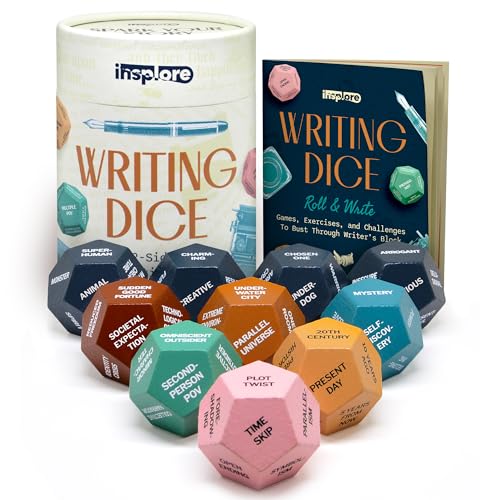
- 10 colorful 12-sided wooden dice
- 48-page playbook with games and exercises
- Designed for teen and adult writers
Best For: Writer's block, brainstorming, D&D, and writing practice
Best for Advanced Story Prompts
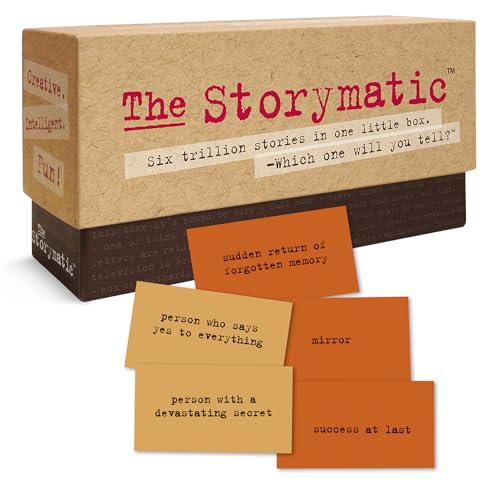
- 540 character and complication cards
- Includes prompts booklet and story games
- Recommended for ages 12 and up
Best For: Teen and adult writers, teachers, and creative groups
Genre-Spanning Inspiration – Words Are Hard Writing Prompt Deck
For writers looking for storytelling card sets for writers, the Words Are Hard deck offers 150 prompts across eight genres, including fantasy, science fiction, romance, mystery, and adventure. Draw a card whenever you need a focused starting point, then write on paper or a Freewrite device.
Best For: Writers who want broad genre variety, attractive presentation, and a ready-made way to overcome the blank page.
Pros:
- Includes 150 prompts spanning eight fiction genres.
- Cards feature illustrated designs and come in a matte black case with gold foil accents.
- Includes a custom wooden display stand.
- Suitable for independent writing practice or gifting.
Cons:
- The prompts are oriented toward creative fiction rather than structured writing lessons.
- The compact set is designed for indoor use and manual drawing.
This is a polished, versatile prompt deck for writers who enjoy switching genres and want a decorative set that can remain on their desk between writing sessions.
Group Storytelling Pick – The Moth Presents: A Game of Storytelling
Among storytelling card sets for writers, The Moth Presents: A Game of Storytelling is geared toward sharing true stories aloud. Its 100 themes and more than 300 additional prompts support casual conversation, public-speaking practice, and organized group play.
Best For: Friends, families, classrooms, coworkers, and groups that want an interactive way to tell personal stories and practice speaking.
Pros:
- Offers 100 themes plus more than 300 prompt variations.
- Supports several play formats, including individual sharing, team play, and a competitive StorySLAM.
- Can encourage lively conversations and public-speaking practice.
- Works with a wide range of groups and settings.
Cons:
- It emphasizes true, spoken stories rather than solitary fiction drafting.
- The group formats may be less suitable for writers seeking a quiet solo prompt deck.
This is the strongest choice here for social storytelling. Choose it when the goal is connection, performance, and conversation rather than a private daily writing routine.
Daily Practice Companion – Writing Down the Bones Deck
Writers comparing storytelling card sets for writers may prefer this 60-card deck for a more reflective, repeatable practice. Each card presents a writing topic on one side and a short Natalie Goldberg lesson on the reverse, offering guidance as well as a prompt.
Best For: New and experienced writers who want to build consistency, focus on details, and develop confidence through regular freewriting.
Pros:
- Provides 60 all-new writing topics.
- Each card combines a prompt with a short instructional lesson.
- Many topics offer multiple angles for repeated use.
- Comes in a magnetic enclosure box with an introductory booklet.
Cons:
- It has fewer cards than the larger prompt decks in this roundup.
- The reflective writing focus may be less suited to users seeking a game or genre-specific prompts.
This deck functions like a compact writing course: it is a thoughtful fit for anyone who wants encouragement and structure while establishing or renewing a daily writing habit.
Improv Brainstorming Game – Storymatic Synapsis
Storymatic Synapsis – Creative Writing Prompts for Adults and Young Writers – Storytelling Game
Check Price On AmazonStorymatic Synapsis brings an improvisational angle to storytelling card sets for writers. With 250 cards, it guides players from a strange sentence into questions that help develop characters, settings, scenes, plots, and motivations.
Best For: Adults and young writers age 10 and up, teachers, students, improv groups, and families wanting solo or collaborative story exercises.
Pros:
- Includes 250 cards for spontaneous story development.
- Supports solo play or groups of two to six people.
- Helps generate characters, scenes, settings, plots, and motivations.
- Portable format and cardstock construction suit game-night or classroom use.
Cons:
- The unusual-sentence starting point may feel less direct than conventional writing prompts.
- It is designed for improvisational play, so it may not match writers seeking quiet, lesson-based practice.
This is the most game-oriented option in the group. Its flexible structure makes it particularly useful when writer’s block calls for playful collaboration or an unexpected creative challenge.
Character Depth Pick – Character Development Deck
For writers seeking storytelling card sets for writers focused on character work, this compact deck offers thought-provoking questions across 13 subjects. It is designed to help develop more detailed, believable characters wherever you write.
Best For: Writers who want structured prompts for backstory, personality, relationships, flaws, and other character-building areas.
Pros:
- Covers 13 character-development subjects.
- Compact 3.5-by-2.5-inch format is easy to carry.
- Supports solo creative writing and character-development practice.
- Questions encourage depth, authenticity, and emotional detail.
Cons:
- Focuses on character development rather than broader plot generation.
- Contains one deck, so its prompt variety is narrower than a larger multi-tool set.
This is a practical choice when your draft has a plot premise but its people still feel thin. Its portable design also makes it useful for spontaneous brainstorming away from your desk.
Roll-and-Write Pick – Two Tumbleweeds Writing Dice
Among storytelling card sets for writers and other prompt tools, these nine writing dice take a playful, flexible approach to idea generation. Roll them to combine character dimensions, time, place, point of view, conflict, and theme into open-ended story possibilities.
Best For: Writers, teachers, workshops, and groups looking for hands-on prompts for stories, screenplays, classroom exercises, or tabletop RPGs.
Pros:
- Nine color-coded dice offer millions of possible combinations.
- Open-ended prompts leave room for the writer’s own ideas.
- Suitable for solo use, collaborative sessions, and classrooms.
- Solid wood, one-inch dice include upgraded printing and instructions.
Cons:
- Dice format may feel less suitable for writers who prefer quiet, card-based browsing.
- Recommended for ages 15 and up.
This set is strongest when you want a quick way to move from a blank page to a set of creative constraints. It provides structure without prescribing a complete story.
Oracle-Style Inspiration Pick – The Story Oracle
The Story Oracle brings an interpretive approach to storytelling card sets for writers, pairing 78 illustrated cards with a 96-page guidebook. Draw cards for a narrative direction, character arc, plot twist, or fresh way out of writer’s block.
Best For: Writers who enjoy oracle or tarot-inspired tools and want multiple interpretations for developing stories and characters.
Pros:
- Includes 78 cards with bright, iconic illustrations.
- Guidebook provides upright and reversed meanings for each card.
- Sample layouts establish different story conditions.
- Can support story direction, character arcs, and unexpected twists.
Cons:
- Interpretive readings may feel less structured than direct writing questions.
- The deck’s oracle-inspired format may not suit writers who prefer conventional prompts.
This is a good fit for writers who want inspiration rather than step-by-step instruction. Its broad card meanings encourage experimentation across genres and narrative stages.
Best for Young Writers – Storymatic Kids
Storymatic Kids – Writing Prompts for Young Writers – Storytelling Games – Teacher Tool
Check Price On AmazonStorymatic Kids is a family-friendly option among storytelling card sets for writers, offering 360 prompt cards for children, teens, and adults. Combine character and complication cards to create stories, conversations, or classroom activities.
Best For: Children age 5 and up, homeschoolers, teachers, families, English language learners, and young writers who benefit from guided prompts.
Pros:
- Includes 360 cards, a booklet, and 20 blank cards for custom prompts.
- Supports writing, speaking, listening, collaboration, empathy, and sequential thinking.
- Works for solo play, groups, drama, improv, drawing, bedtime stories, and family game night.
- Made in the USA and suitable for ages 5 and up.
Cons:
- Its kid-focused format may feel less challenging for advanced adult writers.
- Card-based prompts may be better for guided creativity than detailed craft instruction.
Choose this set when you want an accessible, flexible way to get young writers talking and creating. The blank cards also make it easy to tailor activities to a classroom or family.
Best Dice-Based Prompt Tool – 12-Sided Creative Writing Dice
These 12-sided creative writing dice offer a tactile alternative to storytelling card sets for writers. Roll the 10 themed wooden dice to combine character dimensions, conflicts, settings, and other prompts when you need a fresh starting point.
Best For: Teen and adult authors, poets, screenwriters, English teachers, D&D players, and writers seeking repeatable exercises for overcoming writer’s block.
Pros:
- Ten 12-sided dice provide many possible prompt combinations.
- Includes a 48-page playbook with six games, seven exercises, and two challenges.
- Painted 1-inch beech wood dice come in a compact cardboard canister.
- Supports solo or group use and is recommended for ages 13 and up.
Cons:
- Dice prompts may be less convenient than cards for writers who prefer browsing options.
- The set focuses on creative prompting rather than a full writing curriculum.
This is a strong pick for writers who enjoy randomness and hands-on brainstorming. The included playbook adds structure, while the dice allow repeated use across fiction, poetry, games, and screenwriting.
Best for Advanced Story Prompts – Storymatic Classic
Storymatic Classic – Creative Writing Prompts and Story Games – Storyteller Cards – Teacher Tool
Check Price On AmazonStorymatic Classic is a substantial choice among storytelling card sets for writers, with 540 cards for combining characters and complications. Its prompt booklet and non-competitive games make it useful for independent writing, teaching, and group storytelling.
Best For: Writers age 12 and up, teachers, students, songwriters, novelists, performers, improv groups, artists, and creative families.
Pros:
- Provides 540 cards for a broad range of character and complication combinations.
- Includes prompts, suggestions, and non-competitive storytelling games.
- Can be used alone or in classrooms, homeschool settings, remote learning, and groups.
- Supports creativity, sequential thinking, speaking, listening, and collaboration.
Cons:
- Its 12-and-up recommendation makes it less suitable for very young children.
- The larger card count may feel like more material than a casual user needs.
Pick Storymatic Classic if you want a versatile, reusable prompt library with enough variety for repeated sessions. It is particularly well suited to educators and writers who want both solo warmups and collaborative story games.
How We Picked the Best Storytelling Card Sets for Writers
We evaluated each set for prompt variety, replayability, ease of use, audience fit, and usefulness during an actual writing session. We also considered whether the prompts support more than one stage of storytelling, such as generating characters, building conflict, exploring themes, or developing a full plot.
Because these products serve different purposes, the list includes focused character decks, broad creative-writing prompts, storytelling games, and dice-based tools. A compact deck may be ideal for daily practice, while a larger game-style set can work better for workshops or group sessions.
Quick Comparison
| Best For | Look For | Format |
|---|---|---|
| Daily solo writing | Fast, open-ended prompts | Cards or dice |
| Character development | Questions about motives, history, and flaws | Character-focused deck |
| Group storytelling | Rules, turns, and collaborative play | Storytelling game |
| Classrooms and young writers | Accessible language and guided activities | Kids’ game or prompt tool |
| Flexible plot generation | Several prompt categories | General writing deck |
Key Buying Factors for Storytelling Card Sets for Writers
Prompt Scope and Variety
Choose a focused deck if you already know what you need, such as stronger characters or more vivid scenes. For broader brainstorming, select a set with prompts covering genre, setting, conflict, relationships, and point of view. Variety matters because repeated prompt patterns can become predictable over time.
Solo Use Versus Group Play
Some sets are designed to spark private writing, while others depend on players drawing cards, responding aloud, or building a shared story. Check the intended format before buying. A game can be excellent for a writers’ group but less convenient for a quiet daily writing routine.
Age and Writing Experience
Adult-oriented decks may use abstract themes or challenging questions, whereas children’s tools typically offer clearer prompts and more guided play. Beginners often benefit from structured instructions; experienced writers may prefer minimal rules and more interpretive freedom.
Portability and Setup
Cards and dice are useful because they require little equipment and can travel easily. If you plan to use a set at a café, on trips, or during short writing breaks, consider box size, card handling, and whether a guidebook or table is necessary.
Who Should Buy Which Storytelling Card Sets for Writers?
Choose a general prompt deck if you want a dependable source of ideas for fiction, journaling, or creative exercises. Choose a character deck if your plots are strong but your people feel flat. Choose a storytelling game for writing groups, parties, workshops, or collaborative practice.
Choose writing dice if you enjoy randomness and want to combine prompts quickly without drawing and sorting cards. Choose a children’s set for classrooms, family activities, or young writers who respond better to play than to conventional assignments. The best Storytelling Card Sets for Writers are the ones that match your preferred level of structure and make it easier to begin writing immediately.