Accurate color work depends on more than a calibrated display. The right spectrophotometer can measure samples, create device profiles, compare color differences, and improve consistency across print, paint, textiles, manufacturing, and design workflows.
We selected 10 spectrophotometer color calibration tools spanning portable colorimeters, handheld spectrocolorimeters, benchtop instruments, and complete display-to-printer calibration systems. Use the guide below to match aperture options, accuracy, software support, and portability to your application.
Best 10 Spectrophotometer Color Calibration Tools Picks for 2026
Best All-in-One Workflow

- Profiles cameras, displays, printers, scanners, and projectors
- Includes ColorChecker Classic Mini for RAW camera profiling
- Uses adaptive profiling and ambient-light measurement
Best For: Photographers managing color from capture through print
Best Portable Measurement Value

- Dual optical paths target dE*ab ≤ 0.04 repeatability
- Provides 30+ parameters and nearly 40 evaluation light sources
- Stores up to 10,000 measurements with PC ColorExpert software
Best For: Printing and production measurement workflows
Best for Industrial Color QC
Six-Aperture Spectrocolorimeter

- Six apertures accommodate different sample sizes
- Adds UV measurement, SCI/SCE modes, and D/8 geometry
- Supports broad color spaces, illuminants, and quality software platforms
Best For: Industrial color matching and quality-control teams
Best Compact Professional Option

- Combines spectrophotometer and densitometer functions
- Provides Delta-E, CMYK, RGB, HEX, and ink-density data
- Lightweight design with M0/M1/M2 modes and app access
Best For: Portable print, packaging, and graphic-arts color control
Portable Color Control
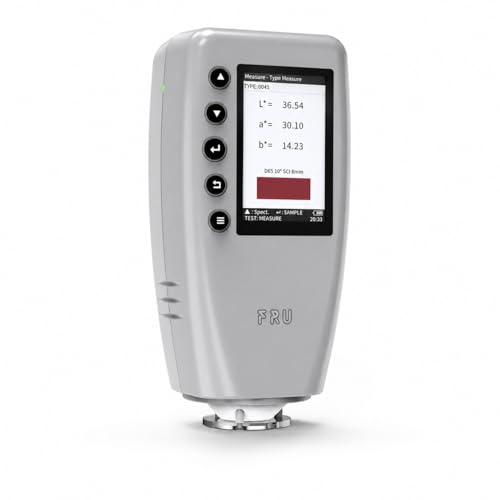
- 400–700 nm measurement range with CIELAB output
- 8 mm aperture and included calibration boards
- Rechargeable handheld design with PC software
Best For: Portable color checks across production and quality-control settings
Benchtop Precision
PCE-CHM 700 Color Spectrophotometer

- Supports multiple color spaces and observer angles
- 5 mm and 14 mm apertures with two orientations
- Stores 1,000 readings and connects via USB-C
Best For: Stationary color matching, analysis, and report generation
Connected Color Matching
Mini Handheld Spectrophotometer
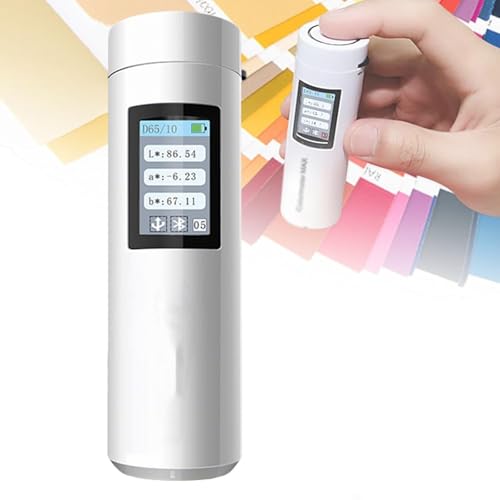
- D/8 design with repeat accuracy of ΔE ≤ 0.05
- AI color search and 2°/10° viewing angles
- Cloud sharing, USB, and up to 10,000 measurements
Best For: Portable, collaborative color matching for paint, textiles, and leather
Best Overall

- Five aperture sizes from 3mm to 11mm
- Repeatability rated at dE*ab ≤ 0.02
- 30+ indexes and nearly 40 light sources
Best For: Professional color measurement and management workflows
Best for Fast Field Checks
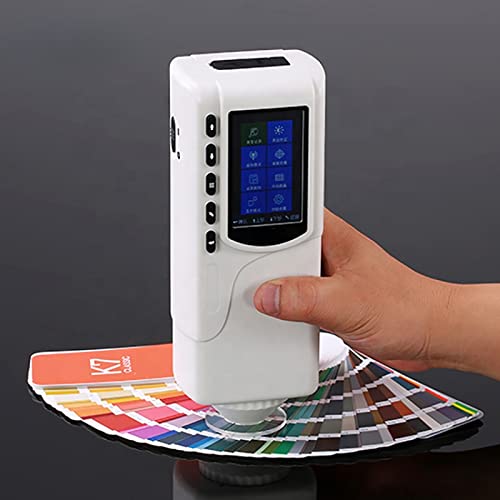
- Built-in calibration for quick startup
- Dual positioning supports alignment accuracy
- 4mm aperture suits plastics, textiles, and paints
Best For: Portable, repeatable measurements across varied materials
Best for Touchscreen Operation

- SCI and SCE testing support
- 30 test parameters and 26 illuminants
- IPS touchscreen with USB data storage
Best For: Routine portable color checks with accessible controls
Best All-in-One Workflow – ColorChecker Studio
The Calibrite ColorChecker Studio is a versatile choice for photographers seeking spectrophotometer color calibration tools across the complete capture-to-output workflow. It supports monitor, projector, printer, paper, scanner, and camera profiling through Calibrite PROFILER software.
Best For: Photographers and creators who need one system for camera profiling, display calibration, print matching, and scanner profiling.
Pros:
- Supports calibration and profiling for displays, projectors, printers, paper, cameras, and scanners.
- Includes a ColorChecker Classic Mini for custom camera profiles in RAW workflows.
- Adaptive iterative profiling and ambient-light measurement help improve consistency between screens and prints.
Cons:
- Its broad feature set may be more than users need for display-only calibration.
- The ColorChecker Classic Mini is intended for camera profiling rather than a larger chart workflow.
This is the strongest fit when color consistency matters at multiple stages, from capture and editing through proofing and final output.
Best Portable Measurement Value – D/8 Spectrocolorimeter
This portable D/8 spectrocolorimeter is designed for users who need spectrophotometer color calibration tools with extensive measurement options. It combines dual optical paths, automatic calibration, broad evaluation-light support, and PC-based ColorExpert software for printing and color management tasks.
Best For: Print and production environments needing repeatable handheld measurements, multiple evaluation settings, and substantial onboard data storage.
Pros:
- Dual optical path design targets repeatability of dE*ab ≤ 0.04.
- Offers more than 30 measurement parameters and nearly 40 evaluation light sources.
- Stores up to 10,000 data records and includes a calibration base with a zirconium reference.
- Works with PC-based ColorExpert color-management software.
Cons:
- At about 11 pounds, it is less convenient than smaller handheld options despite being described as portable.
- The supplied workflow centers on PC-based software, which may not suit users seeking mobile management.
Choose this model when measurement repeatability, configurable evaluation conditions, and high data capacity are more important than lightweight portability.
Best for Industrial Color QC – Six-Aperture Spectrocolorimeter
This six-aperture handheld spectrocolorimeter is a strong industrial option among spectrophotometer color calibration tools. Its D/8 geometry, UV capability, SCI/SCE measurement modes, and broad color-space and illuminant support are suited to color matching and quality control across varied materials.
Best For: Manufacturers and quality teams working with plastics, paints, inks, textiles, ceramics, coatings, cosmetics, and other materials.
Pros:
- Six apertures support measurements from 1×3 mm up to 8 mm for varied sample sizes.
- Full-waveband balanced LED and UV lighting support visible and fluorescent-sample measurements.
- Supports SCI/SCE modes, 2°/10° observer angles, multiple illuminants, and numerous color spaces.
- Quality-management software works across Android, iOS, Windows, WeChat, and Hongmeng systems.
Cons:
- The extensive settings and industry-focused features may be excessive for basic color checks.
- Its listed weight of 6.6 pounds is substantial for a handheld instrument.
This model stands out for production environments that need flexible sample handling, fluorescent-material measurement, and cross-platform quality-data management.
Best Compact Professional Option – Nix Spectro L
The Nix Spectro L combines spectrophotometer and densitometer functions in a compact device for print, packaging, and graphic-arts workflows. As spectrophotometer color calibration tools go, it emphasizes Delta-E analysis, ink-density readings, broad color-format recognition, and app-based access to color libraries.
Best For: Professionals who want a lightweight color-quality device for print and packaging work, with mobile library access and cloud-enabled organization.
Pros:
- Measures or recognizes CMYK, ink density, RGB, HEX, and other color information.
- Delta-E functionality supports detailed color-difference analysis.
- Uses M0, M1, and M2 measurement modes for work involving optical brighteners.
- Compact 110-gram design includes USB-C charging and Nix Toolkit access to more than 200,000 paint shades.
Cons:
- Enhanced Pantone, RAL, and NCS compatibility requires a subscription.
- Its feature set is oriented toward print, packaging, and graphic arts rather than full device profiling.
The Nix Spectro L is a practical choice when portability, Delta-E reporting, and app-connected color libraries matter more than a complete camera-to-print calibration system.
Portable Color Control – WR10 Digital Colorimeter
The WR10 is a practical handheld option for buyers comparing spectrophotometer color calibration tools for routine color checks. It measures across 400–700 nm, uses an 8 mm aperture, and displays CIELAB results on its built-in color screen.
Best For: Portable color-quality checks in textiles, printing, paint, plastics, leather, and related production work.
Pros:
- Portable handheld design with an 8 mm test aperture.
- Includes white and black calibration boards.
- Rechargeable lithium-ion battery is included.
- PC software supports color analysis and workflow use.
Cons:
- Its 8 mm aperture may not suit every sample size.
- The supplied notes do not specify internal measurement storage capacity.
Choose the WR10 when portability, straightforward operation, and broad industry compatibility matter more than benchtop measurement features.
Benchtop Precision – PCE-CHM 700 Color Spectrophotometer
The PCE-CHM 700 is a benchtop choice for buyers evaluating spectrophotometer color calibration tools for detailed color matching and sample analysis. It supports several color spaces, two observer angles, dual measurement orientations, and two aperture sizes.
Best For: Benchtop color matching and documented analysis where broad measurement capabilities and PC reporting are useful.
Pros:
- Supports CIE Lab, CIE LCh, Yxy, RGB, and other color measurements.
- Offers 2° and 10° observer angles for flexible analysis.
- Provides 5 mm and 14 mm apertures with horizontal and vertical modes.
- Stores up to 1,000 measurements and connects through USB-C.
Cons:
- Benchtop construction is less convenient for field use than a handheld unit.
- Its wider feature set may be more than needed for simple color checks.
For labs and production stations, the PCE-CHM 700 stands out for its display, measurement flexibility, onboard storage, and report-oriented PC connectivity.
Connected Color Matching – Mini Handheld Spectrophotometer
This mini handheld spectrophotometer is aimed at buyers seeking spectrophotometer color calibration tools with portability and connected color management. Its D/8 integrating-sphere design, 8 mm aperture, AI color search, and cloud support target repeatable color work for paint, textiles, leather, and monitor-related analysis.
Best For: Portable color matching teams that need RAL analysis, cloud sharing, and frequent measurements between charges.
Pros:
- Uses D/8 diffuse lighting and reports repeat accuracy of ΔE ≤ 0.05.
- Includes 2° and 10° viewing-angle options.
- AI color search can help identify and match target colors.
- Supports cloud synchronization, USB connectivity, and up to 10,000 measurements per charge.
Cons:
- The 8 mm aperture may limit compatibility with very small or unusually shaped samples.
- Cloud-based collaboration may be unnecessary for users who only need local readings.
This model is a strong fit when portability is paired with automated color search, RAL analysis, and remote data sharing rather than standalone measurement alone.
Best Overall – 5-Aperture Spectrophotometer
For demanding spectrophotometer color calibration tools applications, this model combines five aperture sizes with highly precise repeatability and broad color-analysis support. Its horizontal, low-center-of-gravity design and observation window also make surface positioning easier to monitor during measurements.
Best For: Professional color measurement workflows that need multiple apertures, extensive evaluation options, and software connectivity.
Pros:
- Five apertures from 3mm to 11mm support varied measurement surfaces.
- Repeatability is rated at dE*ab ≤ 0.02.
- Provides more than 30 measurement indexes and nearly 40 evaluation light sources.
- Works with ColorExpert software through Bluetooth or USB, plus supported mobile platforms.
Cons:
- At 6.6 pounds, it is heavier than the other listed portable options.
- The broad feature set may be more than occasional users need.
This is the strongest fit when precision, aperture flexibility, and comprehensive color-management software matter more than minimizing size or weight.
Best for Fast Field Checks – Portable Colorimeter
This portable spectrophotometer is designed for efficient spectrophotometer color calibration tools workflows, with built-in calibration parameters for quick startup. Dual light and cross positioning help align the device consistently, while the 4mm aperture suits a range of materials.
Best For: Professionals measuring plastics, textiles, paints, and other surfaces who value quick, repeatable portable testing.
Pros:
- Built-in calibration parameters reduce startup steps.
- Dual positioning combines light positioning with cross positioning.
- Integrating sphere optics are designed to reduce stray-light interference.
- Rechargeable lithium-ion polymer battery supports extended use.
Cons:
- The single 4mm aperture offers less size flexibility than multi-aperture models.
- The supplied notes do not specify supported indexes, illuminants, or software platforms.
Choose this model when streamlined operation and portable versatility are priorities, especially for routine material checks across several industries.
Best for Touchscreen Operation – Auto-Calibration Colorimeter
This portable spectrocolorimeter offers practical spectrophotometer color calibration tools features, including auto calibration, an IPS full-color touchscreen, and USB data storage. It also supports SCI and SCE testing, making it useful when instrumental results need to align more closely with visual evaluation.
Best For: Users who want a straightforward portable instrument with touchscreen controls, USB storage, and broad routine testing options.
Pros:
- Supports both SCI and SCE testing.
- Offers about 30 test parameters, including opacity, whiteness, and yellowness indexes.
- Provides 26 illuminants for selection.
- Auto calibration and a full-color IPS touchscreen simplify operation.
Cons:
- Repeatability is specified at dE*ab 0.08, lower than the 0.02 rating of the first model.
- Uses two AA batteries rather than a stated rechargeable battery system.
- Its 4mm aperture provides less flexibility than the five-aperture option.
This model is a sensible choice for routine color checks when accessible controls, SCI/SCE testing, and data storage are more important than the highest stated repeatability.
How We Picked These Spectrophotometer Color Calibration Tools
We focused on the specifications that most affect real-world color measurement: stated repeatability and accuracy, wavelength coverage, measurement geometry, aperture flexibility, calibration methods, data storage, connectivity, and included software or color libraries. The selection also covers different user needs, from photographers and print professionals to paint retailers, laboratories, designers, and production teams.
Because specifications are not always presented consistently across manufacturers, treat advertised accuracy as a starting point. Workflow compatibility, measurement conditions, sample type, and regular calibration can have just as much impact on results.
Quick Comparison
- Complete display and printer profiling: Choose a system such as the Calibrite ColorChecker Studio when monitor, projector, scanner, and printer workflows must work together.
- Portable color matching: Handheld and mini spectrophotometers are practical for field checks, retail paint matching, production floors, and on-site inspections.
- Flexible sample measurement: Models with several aperture sizes can better accommodate small targets, textured surfaces, and larger color samples.
- Laboratory or controlled production work: A benchtop instrument can offer a more stable setup and repeatable positioning than a handheld device.
- Digital reporting: USB, network support, internal storage, and compatible analysis software matter when measurements must be archived or shared.
Key Buying Factors for Spectrophotometer Color Calibration Tools
Measurement Geometry and Aperture
D/8 geometry is common for diffuse sample measurement, while other configurations may better suit specific materials or appearance conditions. Aperture size affects how much of a sample is measured: smaller openings help with detailed targets, while larger ones can average out surface variation.
Accuracy, Repeatability, and Calibration
Look beyond a low advertised ΔE figure. Repeatability describes consistency between readings, whereas accuracy describes closeness to a reference standard. Built-in white-tile calibration, temperature stability, and clear calibration prompts make dependable operation easier.
Wavelength Range and Light Source
A 400–700 nm range covers the visible spectrum for many color applications. UV illumination may be important when materials contain optical brighteners or fluorescent components, but it can also require more careful control of measurement conditions.
Software and Workflow Support
Confirm whether the device works with your operating system, profiling software, paint or textile libraries, and preferred color spaces such as CIELAB, RGB, or spectral data. Built-in screens and storage help in the field; desktop software is often better for advanced reporting and profile creation.
Who Should Buy Which Spectrophotometer Color Calibration Tools?
Photographers, Designers, and Print Professionals
Prioritize a complete color-management package that supports displays, projectors, scanners, and printers. Software quality and device profiling capabilities may matter more than maximum portability.
Paint, Coatings, and Retail Color-Matching Users
Choose a handheld model with a broad color database, a suitable aperture for curved or textured samples, simple guided operation, and fast transfer to a phone, tablet, or computer.
Manufacturing and Quality-Control Teams
Look for repeatable positioning, multiple apertures, robust calibration, data export, and network or USB connectivity. A benchtop model is worthwhile when measurements are frequent and performed in a controlled area.
Mobile Inspectors and Small Businesses
A compact instrument with internal storage, automatic calibration, long battery life, and a clear display offers the best balance for occasional on-site checks. Before buying, verify the reference standards, included accessories, warranty, and software costs.