Lateral thinking puzzle books are a fun way to stretch problem-solving skills, spark conversation, and turn screen-free time into a challenge everyone can join.
Whether you want beginner-friendly riddles, family after-dinner activities, or tougher brain teasers, this roundup highlights the best options for different ages and experience levels.
Best 10 Lateral Thinking Puzzle Books Picks for 2026
Classic Story Puzzles

- Almost 100 story-style conundrums
- Easy-to-fiendishly-hard range
- Revised edition with new illustrations
Best For: Readers who want a classic, varied lateral thinking challenge
Quick Fire Brain Teasers

- Over 60 puzzles in a short format
- Works for adults, kids, and groups
- Built around creative problem solving
Best For: Casual puzzlers and mixed-age groups
Group-Solving Classics
Great Lateral Thinking Puzzles

- Classic story brainteasers for groups
- Includes clues and sample Q&A
- Solvable solo or with others
Best For: Fans of traditional yes-or-no puzzle sessions
Family Challenge Pack
Brainteasers and Riddles for Gritty Kids

- 300 mixed riddles and puzzles
- Three chapters with rising difficulty
- Answers included in the back
Best For: Families and kids who want a varied brain workout
True Story Pick
The World’s First Book of True Lateral Thinking Puzzles

- 165 true-event puzzles
- Each answer includes a factual backstory
- Suitable for solo play or group game nights
Best For: Readers who want true-story puzzles with extra context
Large Practice Set
Lateral Thinking Puzzles: 200 Mind-Bending Riddles
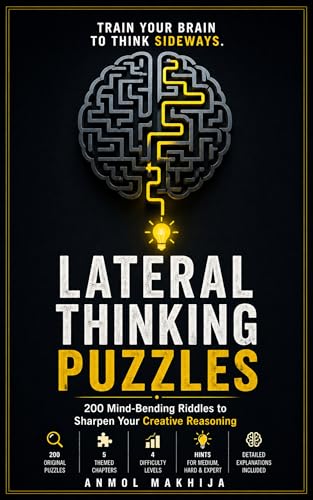
- 200 original puzzles across five themed chapters
- Four difficulty levels with hints included
- Full explanations support learning and review
Best For: Families, students, and teachers wanting a structured puzzle collection
Family Entry Pick
61 Lateral Thinking Puzzles for Family Activities

- 61 entry-level logic and riddle puzzles
- Built for after-dinner family conversation
- Compact format is easy to use casually
Best For: Families and beginners who want a short, approachable puzzle book
Beginner-Friendly Pick
Lateral Thinking Puzzles for Beginners & Families

- Original mysteries with hints and answers
- Built for family play and beginners
- Good for casual, at-your-own-pace solving
Best For: Beginners and families who want an approachable intro
Value Puzzle Pack
101 Lateral Thinking Puzzles for Adults

- 101 puzzles with mixed difficulty
- No pen, paper, or calculator needed
- Good for game nights and casual challenge
Best For: Adults and seniors looking for a big, easy-to-use puzzle set
Big Collection Choice
Lateral Thinking Riddles for All Ages

- Over 200 puzzles in one collection
- Designed for solo or group play
- Good gift option for puzzle lovers
Best For: Readers who want lots of puzzles and creative challenge
Classic Story Puzzles – Lateral Thinking Puzzlers
If you’re comparing lateral thinking puzzle books, this revised edition is a strong pick for classic story-style conundrums that ask you to reason from vague details and yes-or-no questions. With almost 100 puzzles ranging from relatively easy to fiendishly hard, it suits readers who want a varied challenge rather than a quick, repetitive riddle book.
Best For: Puzzle fans who enjoy group solving, solo challenge, and a good range of difficulty.
Pros:
- Almost 100 classic lateral puzzles for extended use
- Difficulty ranges from easier to very challenging
- Designed to reward mental agility and imaginative thinking
- Revised edition with entirely new illustrations
Cons:
- At 96 pages, it’s a compact book rather than a huge collection
- Best fit for readers comfortable with yes-or-no style puzzle play
This is a practical choice if you want a well-known style of lateral thinking book with plenty of variety and a clear emphasis on thinking differently. It works well for anyone who likes to puzzle through clues, not just solve by pure logic.
Quick Fire Brain Teasers – 67 Lateral Thinking Puzzles
67 Lateral Thinking Puzzles: Games And Riddles To Kill Time And Build Brain Cells
Check Price On AmazonFor shoppers browsing lateral thinking puzzle books, this title is geared toward fast, accessible brain teasers that can be used for a quick mental break or a small-group challenge. It includes over 60 puzzles and is positioned for both adults and children, making it a flexible pick for entertainment at home, in schools, or during training sessions.
Best For: Families, mixed-age groups, and anyone who wants a short puzzle book for casual play.
Pros:
- Over 60 lateral thinking puzzles in one slim volume
- Suitable for adults and children
- Can be used in schools, training courses, or small groups
- Emphasizes creative, outside-the-box problem solving
Cons:
- Only 61 pages, so the collection is relatively brief
- Independently published format may feel more basic than branded editions
This book makes sense if you want a straightforward, portable set of puzzles that can be pulled out for entertainment or a quick challenge. Its broad use cases are the main draw.
Group-Solving Classics – Great Lateral Thinking Puzzles
If you want lateral thinking puzzle books with a more classic, group-friendly feel, this title focuses on story brainteasers meant to be solved with yes-or-no questions. It also includes a clues section with sample questions and answers, which makes it easier to play solo if you don’t have a group on hand.
Best For: Readers who like traditional puzzle-room style play and optional solo solving support.
Pros:
- Classic story brainteasers designed for group solving
- Yes-or-no question format is clearly suited to interactive play
- Includes a clues section with sample questions and answers
- Compact 96-page Puzzlewright edition
Cons:
- Older edition published in 1994
- Only 24 black-and-white illustrations
This is a solid pick for readers who want a traditional lateral puzzle experience with a built-in hint structure. The clues section adds flexibility, especially if you plan to use the book alone.
Family Challenge Pack – Brainteasers and Riddles for Gritty Kids
Among lateral thinking puzzle books for families, this one stands out for its large 300-puzzle collection and kid-friendly structure. It mixes lateral thinking, logic, and math riddles across three progressively harder chapters, with answers in the back for when players need a hint.
Best For: Kids, families, and educators looking for a broad, progressive puzzle workout.
Pros:
- 300 total riddles and puzzles for long-term use
- Mixes lateral thinking, logic, and math challenges
- Three chapters increase in difficulty
- Answers are included in the back
Cons:
- Many puzzles are mixed across types, so the book is less narrowly focused on lateral thinking alone
- 67 pages means a lot of content is packed into a short book
This is a strong family-friendly option if you want variety and a structured progression rather than a pure lateral puzzle anthology. It offers a lot of material for one small book.
True Story Pick – The World’s First Book of True Lateral Thinking Puzzles
If you’re comparing lateral thinking puzzle books, this one stands out for a simple reason: every puzzle is based on a true event. With 165 brand-new scenarios, it offers the usual surprise-and-solution format, but adds factual backstories that make the answers more memorable and interesting.
Best For: Readers who want a large collection of true-story lateral thinking puzzles with extra factual context.
Pros:
- All 165 puzzles are described as true events, not invented scenarios.
- Includes a factual backstory with each answer for added interest.
- Covers quirky, macabre, and humorous situations.
- Works solo or as a puzzle party game.
Cons:
- The true-story format may be less traditional than standard fiction-based puzzle books.
- Some scenarios lean into the bizarre or macabre.
- Best suited to readers who enjoy detailed explanations after solving.
This is a strong pick if you want lateral thinking puzzle books that go beyond trick questions and offer real-world weirdness. The combination of quantity, originality, and factual context makes it especially appealing for readers who like puzzles with substance.
Large Practice Set – Lateral Thinking Puzzles: 200 Mind-Bending Riddles
Lateral Thinking Puzzles: 200 Mind-Bending Riddles to Sharpen Your Creative Reasoning
Check Price On AmazonFor shoppers browsing lateral thinking puzzle books, this one is built as a broad training set for creative reasoning. It offers 200 original puzzles across five themed chapters, plus hints and full explanations, so it can work well for both practice and casual play.
Best For: Adults, teens, students, teachers, and families who want a large, structured lateral thinking collection.
Pros:
- Contains 200 completely original lateral thinking puzzles.
- Organized into five themed chapters for variety.
- Includes four difficulty levels, from Easy to Expert.
- Hints and full explanations are provided.
Cons:
- The publication date is listed in the future, which may matter to some buyers.
- Those wanting only very short or casual puzzles may find the format more study-like.
- It is positioned as a reasoning tool, so some readers may prefer a lighter tone.
This is a practical choice if you want a large, organized book with a clear progression in difficulty. The themed structure and included hints make it easy to use for self-study, classrooms, or group puzzle time.
Family Entry Pick – 61 Lateral Thinking Puzzles for Family Activities
If you’re looking for beginner-friendly lateral thinking puzzle books, this one is designed with family after-dinner conversation in mind. It offers 61 logic-based word problems and riddles, making it a compact option for readers who want short sessions and shared discussion.
Best For: Families and casual puzzlers who want an entry-level book for group conversation.
Pros:
- Designed as an entry-level book for family use.
- Includes 61 puzzles and riddles for discussion.
- Short format makes it easy to pick up for dinner-table activities.
- Focuses on logic-based problem solving and conversation.
Cons:
- Much shorter than larger puzzle collections.
- May feel too basic for experienced lateral-thinking fans.
- Less variety than books with themed chapters or difficulty tiers.
This is a solid pick if you want a simple, approachable book rather than a dense puzzle anthology. Its compact size and family-oriented design make it a good fit for casual use and shared solving.
Beginner-Friendly Pick – Lateral Thinking Puzzles for Beginners & Families
If you want lateral thinking puzzle books that are easy to start and fun to share, this one is built for casual solving. It focuses on original mysteries with a clear puzzle, hints, and answer format, so readers can work at their own pace and use yes/no/irrelevant questions to uncover the truth.
Best For: Beginners, families, and anyone who wants a relaxed intro to lateral thinking with plenty of “Aha!” moments.
Pros:
- Designed for beginners and family play
- Each mystery includes puzzle, hints, and answer pages
- Encourages creative, outside-the-box thinking
- Works well as a conversation starter or time-passer
Cons:
- Smaller puzzle count than some longer collections
- Print Replica format may not suit every reader
- Best for guided play rather than heavy challenge seekers
This is a good choice if you want a friendly entry point into lateral thinking without a steep learning curve. The built-in hints make it easier to enjoy solo or with a group.
Value Puzzle Pack – 101 Lateral Thinking Puzzles for Adults
101 Lateral Thinking Puzzles: The Best Logic Games And Riddles Book For Seniors And Adults
Check Price On AmazonThis is a straightforward pick if you want lateral thinking puzzle books with a lot of variety in a compact format. The puzzles range in difficulty, and the book emphasizes quick, creative thinking without calculators or pen and paper, making it a practical choice for solo puzzling or game night.
Best For: Adults, seniors, and groups who want a large set of short lateral thinking puzzles for casual challenge and conversation.
Pros:
- Contains 101 puzzles for plenty of replay value
- Puzzles vary in difficulty for mixed skill levels
- No calculator or pen and paper needed
- Works well for family gatherings and game nights
Cons:
- Some puzzles may feel easy, others more frustrating
- Short format may leave fast solvers wanting more depth
- Focuses on quantity over elaborate presentation
Overall, this book is best if you want a large batch of accessible riddles that can be used in different social settings. It’s a simple, no-fuss way to get more lateral thinking practice.
Big Collection Choice – Lateral Thinking Riddles for All Ages
If you’re comparing lateral thinking puzzle books and want a larger collection, this title stands out for volume. It includes over 200 lateral thinking puzzles designed to push creativity, reward unconventional answers, and work well whether you’re solving alone or with family and friends.
Best For: Readers who want a large puzzle collection for creative challenge, group play, or gifting.
Pros:
- Over 200 lateral thinking puzzles in one book
- Built to encourage creative, unconventional thinking
- Suitable for solo use, friends, or family
- Makes a thoughtful gift for puzzle fans
Cons:
- Publication date is listed far in the future
- Heavy focus on quantity may mean uneven puzzle depth
- May feel broad rather than tightly curated
This is the strongest pick if your main goal is getting the largest stash of puzzles. It’s aimed at curiosity, fun, and mental stretching more than a highly polished single-theme experience.
How We Picked the Best Lateral Thinking Puzzle Books
We focused on books that offer a strong mix of clarity, variety, and replay value. The best Lateral Thinking Puzzle Books should present clever scenarios, encourage discussion, and avoid overly vague wording that makes solving frustrating instead of fun.
We also looked for books with clear target audiences, because the right difficulty level matters more than raw puzzle count. A great family book may be easier and more conversational, while a book for adults or seniors may lean into more challenging deduction and creative reasoning.
Quick Comparison
For quick decision-making, think in three buckets: beginner and family-friendly books, mid-range collections for casual puzzlers, and harder sets for readers who want deeper challenge. Smaller books can be ideal for road trips or short sessions, while larger collections suit ongoing use and gift-giving.
Key Buying Factors for Lateral Thinking Puzzle Books
Difficulty and Audience
Match the book to the reader. Kids and families usually benefit from shorter clues, clearer setups, and collaborative solving. Adults may prefer more open-ended puzzles with a stronger “aha” payoff. If you are buying for mixed ages, choose a book that is explicitly designed for families or beginners.
Puzzle Style and Structure
Some Lateral Thinking Puzzle Books are built around true scenario-based mysteries, while others lean more toward riddles, logic problems, or brainteasers. If you want conversation-driven play, look for books that encourage asking yes-or-no questions and reasoning through hidden details.
Usability for Groups
If the book will be used at game night, during travel, or after dinner, the best choice is usually one with accessible formatting and puzzles that work well aloud. Books labeled for family use are often the easiest to share because they reduce the chance of one reader dominating the solution.
Length and Value
Higher puzzle counts can offer more value, but a shorter book may still be the smarter purchase if the quality and difficulty fit your needs better. For gift buyers, the best value is often a book that feels approachable and polished rather than simply large.
Who Should Buy Which Lateral Thinking Puzzle Books?
Choose beginner-focused Lateral Thinking Puzzle Books if you want an easy entry point or a family-friendly activity. Pick mid-level collections if you already enjoy riddles and want a balanced challenge. Go for advanced or adult-oriented books if you prefer tougher logic, trickier wording, and more satisfying reveal moments.
If you are buying for kids, prioritize clarity and age-appropriate language. For seniors or adults, look for larger collections with a steadier challenge level. And if the goal is shared entertainment, the best pick is usually the book that is easiest to discuss, not necessarily the hardest to solve.