A great knitting stitch dictionary can transform simple patterns into custom-looking projects, giving you more options for texture, lace, cables, and colorwork.
Below, you’ll find 10 standout books chosen for variety, usability, and the kinds of stitches knitters actually reach for most often.
Best 10 Knitting Stitch Dictionary Picks for 2026
Essential Stitch Reference

- 400-plus stitch patterns in eight categories
- Written and charted instructions for each stitch
- Full-color photos and basic technique guidance
Best For: Knitters who want a broad, easy-to-use stitch dictionary
Japanese Pattern Classic
250 Japanese Knitting Stitches

- 250 original patterns by Hitomi Shida
- Diagram and photo for each stitch
- Borders, cables, popcorns, and variations
Best For: Experienced knitters who want intricate Japanese-style motifs
Versatile Technique Guide
Up, Down, All-Around Stitch Dictionary

- 150 stitch patterns worked four different ways
- Charted and text instructions with photographed swatches
- Includes garment formulas and eight projects
Best For: Knitters who want stitch ideas plus construction flexibility
Japanese Stitch Archive
Japanese Knitting Stitch Bible

- 260 exquisite stitch patterns from Hitomi Shida
- Step-by-step diagrams plus practice projects
- Covers cables, popcorns, twisted stitches, and edgings
Best For: Advanced knitters seeking elegant, intricate stitch references
Starter Reference
Knit Stitch Dictionary: 250 Essential Stitches

- 250 essential knit stitches in one compact reference.
- Offers both written and charted instructions.
- Includes a photo glossary for quick browsing.
Best For: Knitters who want a colorful, easy-to-use stitch reference
Pattern Library
The New Knitting Stitch Dictionary

- 500 stitch patterns across textures, lace, cables, and more.
- Charted instructions support design planning.
- Strong source of inspiration for garments and accessories.
Best For: Knitters who want a large, idea-rich stitch dictionary
Classic Deep Dive
Vogue Knitting Stitchionary Volume One

- About 300 stitches with charts, photos, and illustrations.
- Covers rib, lace, traveling, and unusual stitch patterns.
- Edited by the team behind Vogue Knitting Magazine.
Best For: Knitters who want a detailed, professionally edited stitch reference
AlterKnit Spotlight
AlterKnit Stitch Dictionary: 200 Modern Knitting Motifs

- 200 modern stranded colorwork motifs
- Covers charts, floats, and color choice
- Includes five project examples
Best For: Creative knitters who want modern colorwork motifs
All-Around Reference
The Ultimate All-Around Stitch Dictionary: More Than 300 Stitch Patterns to Knit Every Way
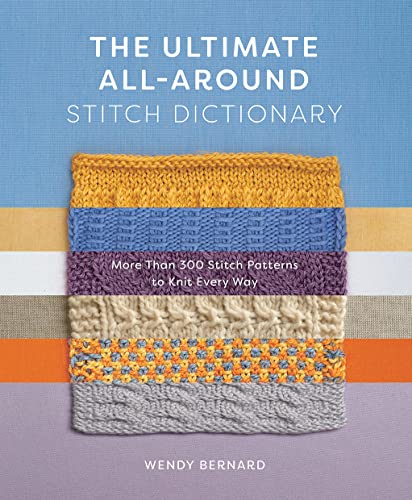
- More than 300 stitch patterns
- Works for multiple knitting constructions
- Adds 30 new stitches
Best For: Knitters wanting a broad all-purpose reference
Classic Companion

- 150 stitch patterns across key categories
- Works with multiple knitting directions
- Includes customizable pattern templates
Best For: Knitters who want adaptable patterns and customization
Essential Stitch Reference – 400 Knitting Stitches
If you want a practical knitting stitch dictionary that covers the basics and beyond, this volume delivers a broad range of stitch patterns with written and charted directions. It is organized into eight categories, making it easier to browse from knit-purl textures to cables, lace, and more decorative motifs.
Best For: Beginners and experienced knitters who want a large, straightforward reference for exploring many stitch styles.
Pros:
- Includes 400-plus stitch patterns across eight clear categories.
- Provides both written and charted instructions for each stitch.
- Features full-color photographs plus basic knitting techniques up front.
- Covers everything from simple textures to fancy, more advanced patterns.
Cons:
- Best suited to knitters who like a traditional reference-book format.
- Does not focus on a single design style or niche technique.
This is a strong all-purpose stitch dictionary if you want a dependable bookshelf reference with wide coverage and clear presentation. It works well whether you are sampling new textures or looking for a pattern source to support your own designs.
Japanese Pattern Classic – 250 Japanese Knitting Stitches
This knitting stitch dictionary is a good pick if you want elegant, intricate patterns with a distinctly Japanese design style. The book presents 250 stitches with a stitch diagram and photo for each pattern, and it includes guidance from translator and instructor Gayle Roehm to help knitters work through the details.
Best For: Experienced knitters who want decorative, inventive stitch patterns and can handle detailed charts and diagrams.
Pros:
- Contains 250 distinctive stitch patterns from Hitomi Shida.
- Includes a stitch diagram and photo for every pattern.
- Features borders, edgings, cables, popcorn stitches, and variations.
- Translated and introduced by an experienced teacher of Japanese knitting.
Cons:
- Likely better for knitters comfortable with more complex stitch work.
- Focuses heavily on decorative patterns rather than simple basics.
If you already enjoy chart-based knitting and want a source of refined, highly original motifs, this book stands out. It is especially appealing when you want a reference that feels more like a pattern library than a beginner primer.
Versatile Technique Guide – Up, Down, All-Around Stitch Dictionary
If you want a knitting stitch dictionary that does more than list patterns, this one adds flexible construction guidance. It gives more than 150 stitch patterns and shows how to work each one four ways: top down, bottom up, back and forth, and in the round.
Best For: Knitters who want to adapt stitch patterns to different garment constructions and learn by example.
Pros:
- Shows each of the 150 patterns in four working directions.
- Includes lace, cables, colorwork, and fancy edgings.
- Pairs swatches with charted and text instructions.
- Adds eight garment instructions and garment formulas without a pattern.
Cons:
- Less about sheer volume than some larger stitch dictionaries.
- Best value comes if you want garment-building guidance too.
This book is especially useful if you like to modify patterns or build garments from stitch ideas rather than follow a single method. Its combination of stitch reference and construction help makes it a practical pick for design-minded knitters.
Japanese Stitch Archive – Japanese Knitting Stitch Bible
This knitting stitch dictionary is aimed at experienced knitters who want intricate, high-impact patterns. It offers 260 exquisite designs from Hitomi Shida, with step-by-step diagrams and extra practice projects to help knitters understand how the stitches work in real pieces.
Best For: Advanced knitters looking for detailed, elegant stitch patterns and practice projects to build confidence.
Pros:
- Includes 260 intricate and original stitch patterns.
- Covers cables, popcorn stitches, twisted stitches, and edgings.
- Provides detailed step-by-step diagrams for basic stitches.
- Includes small projects for practicing larger and lacy pattern arrangements.
Cons:
- Designed mainly for knitters comfortable with complex patterns.
- Not focused on beginner-level stitch basics.
For knitters who want a deep library of ornate Japanese-inspired stitches, this book is a standout reference. The mix of diagrams, pattern variety, and practice projects makes it especially useful when you want to move beyond simple textures.
Starter Reference – Knit Stitch Dictionary: 250 Essential Stitches
If you want a practical knitting stitch dictionary that covers the basics plus plenty of room to explore, this 250-stitch reference is a strong fit. It organizes stitches into clear categories and includes both written and charted instructions, so you can follow along in the format that works best for you.
Best For: Knitters who want a colorful, easy-to-use reference with a broad mix of essential stitch patterns.
Pros:
- Includes 250 knit stitches across many stitch families.
- Provides both written and charted instructions for each stitch.
- Covers basics, lace, cables, colorwork, and textured patterns.
- Photo glossary makes it easy to browse stitch options quickly.
Cons:
- Focuses on essential stitches rather than the largest possible collection.
- At 192 pages, it is more compact than some larger stitch references.
This is a solid all-purpose choice if you want a friendly, visual stitch book you can reach for often. It balances variety and usability without feeling overwhelming.
Pattern Library – The New Knitting Stitch Dictionary
For knitters building ideas from a knitting stitch dictionary, this volume stands out for its sheer range and design inspiration. It offers 500 stitch patterns organized by type, with charted instructions that make it easier to visualize how each stitch will work in a project.
Best For: Knitters who want a large, idea-rich stitch dictionary for textures, lace, cables, and colorwork.
Pros:
- Contains 500 stitch patterns for a wide range of uses.
- Divides stitches into clear sections such as texture, lace, cables, and Fair Isle.
- Charted instructions help with visualization and design planning.
- Useful as a source of inspiration for sweaters, blankets, hats, and mittens.
Cons:
- Heavier and larger than more compact stitch references.
- Chart-only instructions may be less convenient for knitters who prefer written directions.
This is the pick for knitters who want more options and more room to experiment. It is especially appealing if you use stitch books as a starting point for your own designs.
Classic Deep Dive – Vogue Knitting Stitchionary Volume One
If you are comparing a knitting stitch dictionary for depth and clarity, this Vogue Knitting volume is a standout reference. It presents about 300 stitches with charts, photographs, and illustrations, making it a strong choice when you want to understand both how a stitch is built and how it can be used.
Best For: Knitters who want a detailed, professionally edited stitch reference with strong visual support.
Pros:
- Details some 300 stitches in a fully illustrated sourcebook.
- Includes charts, photographs, and illustrations for easier understanding.
- Covers a broad range of rib, lace, traveling, and unusual stitch patterns.
- Created by the editors of Vogue Knitting Magazine.
Cons:
- Focused on knit and purl stitches rather than a broader multi-volume set.
- Published in 2005, so the format may feel more traditional than newer guides.
This is a strong pick if you value a polished, authoritative reference book. It offers enough variety to keep experienced knitters exploring while still being approachable for newer ones.
AlterKnit Spotlight – AlterKnit Stitch Dictionary: 200 Modern Knitting Motifs
If you want a knitting stitch dictionary that pushes beyond traditional motifs, AlterKnit Stitch Dictionary focuses on 200 modern stranded colorwork designs. The charts draw from graphic design, with options ranging from geometric mountains and waves to bikes, skulls, and sheep. It also includes guidance on reading charts, managing floats, and choosing colors, plus five projects to show the motifs in action.
Best For: Creative knitters who want bold, modern colorwork motifs and practical stranded-colorwork guidance.
Pros:
- 200 fresh stranded colorwork motifs inspired by graphic design
- Includes chart-reading, float management, and color selection help
- Five projects provide real-use examples such as mitts, cowls, and sweaters
Cons:
- Focused specifically on stranded colorwork rather than all stitch types
- Best suited to knitters ready to work with charts and multiple colors
This is a strong pick if you want a knitting stitch dictionary that feels modern and design-forward. It is especially appealing for knitters who like to adapt motifs and create their own combinations.
All-Around Reference – The Ultimate All-Around Stitch Dictionary: More Than 300 Stitch Patterns to Knit Every Way
The Ultimate All-Around Stitch Dictionary: More Than 300 Stitch Patterns to Knit Every Way
Check Price On AmazonFor knitters who want a broad knitting stitch dictionary, The Ultimate All-Around Stitch Dictionary offers more than 300 stitch patterns in one reference. Wendy Bernard combines patterns from her earlier dictionaries with 30 new stitches, covering top down, bottom up, back and forth, and in-the-round knitting. The book is positioned as a practical bookshelf resource for starting projects, building skills, and expanding your stitch options.
Best For: Knitters who want a comprehensive all-purpose stitch dictionary with many stitch options and construction methods.
Pros:
- More than 300 stitch patterns in a single volume
- Covers top down, bottom up, back and forth, and in-the-round knitting
- Includes 30 new stitches alongside proven favorites
Cons:
- Primarily a reference book, so it is less project-focused than some alternatives
- May be more than casual knitters need if they only want a few motifs
If you want one knitting stitch dictionary to reach for again and again, this is the most versatile of the group. Its mix of breadth, updated content, and multiple construction formats makes it a practical all-around choice.
Classic Companion – Knitting All Around Stitch Dictionary: 150 New Stitch Patterns to Knit Top Down, Bottom Up, Back and Forth & in the Round
If you need a knitting stitch dictionary built around adaptable stitch patterns, Knitting All Around Stitch Dictionary focuses on 150 new designs that work top down, bottom up, back and forth, and in the round. It organizes stitches by type, including knit and purl, textured stitches, ribs, lace, cables, and a chapter on mosaic knitting. Each chapter also includes a customizable pattern, making it easier to swap in your own stitch choices.
Best For: Knitters who want adaptable stitch patterns and customizable templates across many construction methods.
Pros:
- 150 new stitch patterns organized by stitch type
- Supports top down, bottom up, back and forth, and in-the-round knitting
- Includes customizable patterns for easy stitch swapping
- Covers mosaic knitting in addition to core stitch categories
Cons:
- Contains fewer stitch patterns than the newer all-around collection
- Reference-heavy format may not appeal to knitters seeking project instructions first
This title is a strong choice if you value flexibility and want a knitting stitch dictionary that helps you build your own garments and accessories. Its customizable structure makes it especially useful for knitters who like to modify patterns.
How We Picked the Best Knitting Stitch Dictionary Books
We focused on books that offer practical stitch variety, clear organization, and reusable patterns that work across real projects. A strong Knitting Stitch Dictionary should be easy to navigate, dependable for swatching, and useful whether you knit garments, accessories, or blankets.
We also looked for range: books for beginners who want straightforward textures, as well as deeper reference books for knitters who enjoy lace, cables, motifs, and charted designs.
Quick Comparison
If you want a broad all-purpose reference, choose a volume with a large stitch count and clear categories. If you prefer visual impact, look for motif-heavy or modern pattern collections. If you knit sweaters and accessories in different directions, all-around stitch books are especially useful because they support top-down, bottom-up, flat, and circular construction.
Key Buying Factors for a Knitting Stitch Dictionary
Stitch Variety
Check whether the book emphasizes knit-and-purl textures, lace, cables, colorwork, or decorative motifs. The best choice depends on what you actually make most often.
Chart Quality and Readability
Many stitch books rely on charts. Clean symbols, legible labels, and consistent formatting make a big difference when you’re swatching or adapting a pattern.
Construction Compatibility
Some stitch patterns look best flat, while others are designed to shine in the round or in multiple directions. If you knit garments, an all-around format can be more versatile than a strictly flat reference.
Skill Level
Beginners usually benefit from simple, repetitive structures and clear instructions. More advanced knitters may want denser pattern libraries, intricate lace, or motif-driven designs that reward careful stitch reading.
Project Usefulness
A good Knitting Stitch Dictionary should do more than look impressive on the shelf. It should help you choose swatches quickly, match yarn to stitch texture, and adapt ideas to real projects.
Who Should Buy Which Knitting Stitch Dictionary?
If you want a dependable everyday reference, choose a broad stitch library with classic textures and clear organization. If you love Japanese-style textures and elegant detail, a Hitomi Shida collection is a strong fit. If your projects are modern and graphic, a motif-focused book may be the better match. And if you want maximum flexibility for garments and accessories, prioritize an all-around volume that works in every construction style.
In short, the best Knitting Stitch Dictionary is the one that matches your favorite projects, your preferred level of complexity, and the way you like to design at the needle stage.