Choosing the right math book can make early learning feel simple, structured, and fun. The best kindergarten math workbooks help kids practice counting, number recognition, shapes, and basic addition without overwhelming them.
In this roundup, we focused on workbooks that balance age-appropriate activities, clear directions, and enough variety to keep young learners engaged.
Best 10 Kindergarten Math Workbooks Picks for 2026
Modern Kid Press Pick
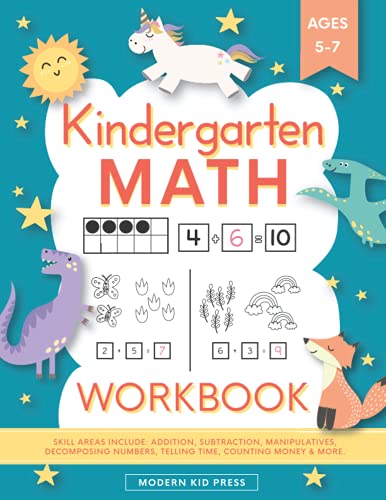
- Covers number recognition, addition, subtraction, time, and money
- Large 8.5 x 11 pages with 95 printed pages
- Cute animal and magical-creature themes help keep attention
Best For: Families who want a colorful beginner-friendly math workbook for ages 4 to 6
Brain Quest Choice

- Educator-vetted and aligned with math standards
- Includes stickers, progress map, certificate, and mini card deck
- Covers adding/subtracting, sorting, shapes, and position
Best For: Parents and teachers seeking structured, standards-aligned practice with fun rewards
Highlights Favorite

- 256 pages of mixed readiness activities and puzzles
- Math practice includes counting, patterns, shapes, and comparing numbers
- Developed with teachers and aligned with curriculum standards
Best For: Children who enjoy puzzles and families wanting a broader kindergarten prep workbook
School Zone Pick

- Covers numbers 0-20, addition, subtraction, time, and money
- Perforated pages and compact size suit travel or tear-out use
- Clear examples and goals support guided practice
Best For: Families seeking a portable, structured math workbook for ages 5 to 7
Playful Skill Builder

- 101 games and activities.
- Covers counting, shapes, money, and time.
- Colorful, kid-friendly illustrations.
Best For: summer learning and playful early math practice
Structured Practice Pick

- 100+ pages of guided practice.
- Covers shapes, money, time, and more.
- Large format with colorful visuals.
Best For: guided kindergarten prep with broad topic coverage
Daily Practice Choice

- 115 worksheets across 23 weeks.
- Common Core aligned core skills.
- Includes answer key and final assessment.
Best For: daily homeschool or classroom-style practice
All-in-One Practice
Kindergarten Math Activity Book

- 108 pages of varied math activities
- Covers counting, tracing, time, money, and word problems
- Large format with guided instructions and a certificate
Best For: Ages 5 to 7 who need broad, engaging early math practice
Portable Tear-Out Pad
School Zone Get Ready for Math Workbook

- 48 easy-tear activity pages
- Teaches counting, basic addition and subtraction, shapes, and time
- Compact pad with sturdy backing for travel
Best For: Quick practice for ages 5 to 7 at home or on the go
Full-Year Coverage

- 190 pages across 8 skill areas
- Starts with worked examples and gradual difficulty growth
- Includes place value, money, and word problems
Best For: Families wanting a comprehensive, year-long kindergarten math workbook
Modern Kid Press Pick – Kindergarten Math Workbook
If you want kindergarten math workbooks that mix foundational skills with engaging themes, this Modern Kid Press book is a practical choice. It covers number recognition, addition, subtraction, decomposing numbers, telling time, money, and more, with plenty of space for young learners to work.
Best For: Families looking for a colorful, full-size workbook for ages 4 to 6 that balances core math practice with fun activities.
Pros:
- Covers a broad range of early math skills, including counting, addition, subtraction, time, and money
- Uses cute magical-creature and animal themes to keep kids engaged
- Large 8.5 x 11 format gives children room to complete exercises
- Printed on 60 lb interior stock with a premium matte cover
Cons:
- Focused mainly on math practice rather than a full readiness curriculum
- Best suited to younger beginners, not advanced kindergarteners
This workbook is a solid option if your priority is straightforward, hands-on math practice in a child-friendly format. It leans into repetition and visual appeal, which can help keep early learners interested while they build basic skills.
Brain Quest Choice – Kindergarten Math Workbook
Brain Quest Math Workbook: Kindergarten is a strong pick among kindergarten math workbooks if you want educator-vetted practice aligned with math standards. It focuses on hands-on activities that introduce and reinforce core concepts while adding built-in support like explanations and review tools.
Best For: Parents and teachers who want a standards-aligned workbook with extra learning support and motivating rewards.
Pros:
- Written and vetted by educators and aligned with math standards
- Includes targeted support, an illustrated glossary, and additional resources
- Comes with stickers, a progress map, a completion certificate, and a mini Smart Card deck
- Covers adding and subtracting, measuring, sorting, shapes, and order/position
Cons:
- At 160 pages, it may feel more extensive than a quick practice book
- Designed for kindergarten to grade 1, so it may overlap with early first-grade skills
This workbook stands out for its structured approach and added engagement features. It is a practical choice if you want something that feels both educationally grounded and motivating for young children.
Highlights Favorite – Big Fun Kindergarten Workbook
If you want kindergarten math workbooks that also support broader readiness skills, this Highlights Big Fun workbook is a versatile pick. It mixes math with tracing, alphabet practice, puzzles, and classic Highlights-style activities, giving children a fresh way to practice school-readiness basics.
Best For: Kids who learn well through puzzles and mixed activities, especially families wanting a broader kindergarten prep book.
Pros:
- Includes 256 pages of varied activities, including Hidden Pictures, mazes, matching, and scavenger hunts
- Covers math skills such as counting, patterns, shapes, and comparing numbers
- Also builds language arts readiness with alphabet practice, handwriting, and rhyming
- Developed with teachers and aligned with curriculum standards
Cons:
- Not a math-only workbook, so it may be less focused than dedicated math practice books
- Large page count may be more than some families need for simple skill review
This is a good all-around option if you want math practice wrapped into a bigger kindergarten prep experience. Its mix of puzzles and core skills can make learning feel more like play than drill.
School Zone Pick – Math Readiness Workbook
School Zone’s Math Readiness Workbook is a practical choice if you want kindergarten math workbooks that can also carry into first grade. It focuses on core skills like numbers 0-20, addition, subtraction, telling time, and counting money, with clear instructions and perforated pages for easy use.
Best For: Families wanting a portable, standards-based math workbook for ages 5 to 7 with tear-out pages.
Pros:
- Covers multiple essential math skills, including numbers, shapes, addition, subtraction, time, and money
- Clear examples, instructions, and goals support independent practice
- Perforated pages make worksheets easy to tear out
- Compact size is convenient for backpacks or on-the-go learning
Cons:
- Only 64 activity pages, so it is shorter than some other workbook options
- More focused on skill reinforcement than on highly playful variety
This workbook is best if you want straightforward math reinforcement in a durable, travel-friendly format. It is especially useful for parents who value clear structure and easy page removal for practice sessions.
Playful Skill Builder – My Kindergarten Math Workbook
My Kindergarten Math Workbook: 101 Games and Activities to Support Kindergarten Math Skills
Check Price On AmazonIf you want kindergarten math workbooks that feel more like play than drill, this one is built around games and activities that keep young learners engaged. It covers early math through mazes, matching, tracing, coloring, secret codes, connect-the-dots, and other age-appropriate practice for kids ages 5 to 6.
Best For: Families who want a fun, activity-heavy workbook for summer learning or early kindergarten practice.
Pros:
- Includes 101 activities and puzzles for plenty of practice.
- Covers counting, shapes, sorting, measuring, addition, subtraction, money, and time.
- Colorful illustrations help keep kids interested.
- Activities gradually become more challenging as children progress.
Cons:
- Focused on playful activities rather than a strict lesson format.
- May be better suited for practice and reinforcement than intensive instruction.
This workbook is a strong choice if you want an approachable way to reinforce early math skills without losing a kindergartener’s attention. It works especially well as a summer-before-kindergarten resource or a light supplement during the school year.
Structured Practice Pick – Kindergarten Math Workbook
Among kindergarten math workbooks, this option stands out for its structured, topic-by-topic approach and large amount of practice. It offers 100+ pages that move through skip counting, shapes, measurement, addition, subtraction, time, money, and more in a progression designed for kindergarten and 1st grade prep.
Best For: Parents who want a broad, guided workbook with lots of practice and a clear learning sequence.
Pros:
- More than 100 pages of math practice.
- Covers a wide range of topics, including number bonds, number lines, shapes, and word problems.
- Progressive layout builds from early number skills to addition, subtraction, and telling time.
- Includes colorful illustrations and large 8.5″ x 11″ pages.
Cons:
- Less activity-driven than some play-based workbooks.
- May feel dense for children who prefer shorter, game-style exercises.
This is a practical pick if you want a comprehensive workbook that covers many kindergarten math foundations in one place. It’s especially useful when you want steady, guided practice with a mix of visual appeal and skill building.
Daily Practice Choice – Kindergarten Math Workbook
If you’re comparing kindergarten math workbooks for consistent skill building, this one is organized around daily practice with 115 worksheets spread across 23 weeks. It focuses on core kindergarten topics like counting, number sense, basic addition, shapes, and comparing numbers, while keeping the format varied enough to stay engaging.
Best For: Homeschooling, classroom supplements, or parents who want a steady day-by-day math routine.
Pros:
- 115 worksheets provide a full routine of daily practice.
- Common Core aligned and focused on essential kindergarten math skills.
- Includes multiple-choice, short-answer, true/false, and matching questions.
- Comes with an answer key and final assessment for easy progress tracking.
Cons:
- More worksheet-based than activity-heavy or game-based.
- Best suited to families looking for structured repetition rather than open-ended play.
This workbook is a smart fit if consistency matters most and you want a clear plan for daily kindergarten math practice. The built-in answer key and final assessment also make it easier to monitor progress over time.
All-in-One Practice – Kindergarten Math Activity Book
If you want kindergarten math workbooks that keep kids busy while covering a wide range of early skills, this 108-page activity book is a strong all-around option. It includes counting, number tracing, addition, subtraction, time, money, word problems, and more, with large fonts and guided instructions to support independent practice.
Best For: Parents, grandparents, caretakers, and teachers looking for a colorful, broad math activity book for ages 5 to 7.
Pros:
- 108 pages of activities, exercises, games, and quizzes
- Covers counting, addition, subtraction, tracing, time, money, and simple word problems
- Large 8.5″ x 11″ format with easy-to-read fonts and guided instructions
- Includes a certificate at the end of the book
Cons:
- Broad coverage may feel less focused if you want only one skill area
- Best suited to ages 5 to 7, so older kids may outgrow it quickly
This is a practical pick if you want a single kindergarten math workbook with a lively, child-friendly style and plenty of variety. The Lucas & Friends characters and illustration-heavy pages help make practice feel more engaging for younger learners.
Portable Tear-Out Pad – School Zone Get Ready for Math Workbook
For families comparing kindergarten math workbooks, this School Zone pad stands out as a compact, take-along option with 48 tear-out pages. It focuses on early number recognition, counting, addition, subtraction, shapes, and telling time, making it a straightforward choice for short practice sessions.
Best For: Kids ages 5 to 7 who need a portable, worksheet-style math pad for home or travel.
Pros:
- 48 activity pages in a top-bound, easy-tear format
- Covers number recognition 0-12, counting, addition, subtraction, shapes, and time
- Sturdy backing creates a writing surface for on-the-go use
- Compact size fits easily in backpacks and totes
Cons:
- Shorter than many workbook options at just 48 pages
- Best for basic practice rather than a deeper long-term curriculum
This is a smart pick if you want something simple, portable, and easy to pull out for quick math practice. The tear-out worksheet style is especially useful for families who want individual pages rather than a bound workbook.
Full-Year Coverage – Kindergarten Math Essentials
If you want kindergarten math workbooks with more depth, this 190-page option is built to cover a full sequence of early skills. It moves from counting and number recognition through addition, subtraction, shapes, patterns, comparing numbers, measurement, money, place value, and word problems, with worked examples at the start of each section.
Best For: Parents who want a more complete, structured workbook that can support a full school year of kindergarten math practice.
Pros:
- 190 pages of practice across 8 complete skill areas
- Uses worked examples before independent activities
- Builds from picture-based problem solving to more abstract equations
- Covers place value, money, and word problems in addition to core basics
Cons:
- Much longer than a typical workbook, which may be more than some families need
- Publication date is listed as 2026, so availability details may matter to shoppers
This is the strongest choice if you want one workbook that goes well beyond the basics and follows a deliberate learning sequence. It is especially appealing for parents who want more repetition, more coverage, and a clearer progression from simple to more advanced kindergarten math skills.
How We Picked the Best Kindergarten Math Workbooks
We looked for Kindergarten Math Workbooks that match the attention span and skill level of young children. That means large, easy-to-read layouts, simple instructions, and activities that support core early math goals like counting, number writing, pattern recognition, and intro addition and subtraction.
We also favored books with a practical mix of repetition and variety. For kindergarteners, a workbook should reinforce skills without feeling too repetitive or too advanced.
Quick Comparison: What to Look for
Some Kindergarten Math Workbooks focus on readiness skills such as tracing, number formation, and counting. Others lean more into skill practice with addition, subtraction, time, money, and basic word problems. If your child is just getting started, begin with readiness and number sense. If they already know numbers well, look for more challenge and broader math coverage.
Key Buying Factors for Kindergarten Math Workbooks
Skill Level
Choose a workbook that matches your child’s current ability. For beginners, prioritize counting, number tracing, shapes, and comparisons. For stronger learners, look for addition, subtraction, measurement, and simple word problems.
Activity Variety
Young children learn best when pages alternate between writing, circling, matching, coloring, and counting. Variety helps maintain interest and supports different learning styles.
Page Layout and Instructions
Clear fonts, uncluttered pages, and short directions matter. A good workbook should feel approachable even when a child is working with minimal adult help.
Scope and Length
Shorter books can work well for quick practice or summer review, while longer Kindergarten Math Workbooks are better for a full-year supplement. More pages can be useful, but only if the content stays age-appropriate.
Reinforcement Goals
Decide whether you want a workbook for school readiness, homeschool support, or extra practice. Some books are designed to build confidence gradually, while others aim to cover a wider range of early math topics.
Who Should Buy Which Kindergarten Math Workbooks?
If your child is just starting with numbers, choose a workbook centered on tracing, counting, and basic recognition. If they already know most kindergarten basics, a more advanced option with addition, subtraction, time, and money may be the better fit.
Parents who want a flexible at-home supplement should look for a workbook with a mix of fun activities and structured practice. Teachers and homeschool families may prefer books with a fuller progression and more pages for consistent daily work. The best Kindergarten Math Workbooks are the ones your child can use confidently, regularly, and with growing independence.