The best jigsaw puzzles for homeschool turn geography, science, and early-learning practice into hands-on activities. This roundup compares ten educational options, from wooden preschool sets to large world-map floor puzzles.
Use the guide below to match puzzle size, theme, materials, and difficulty with your child’s age, curriculum, and attention span.
Best 10 Jigsaw Puzzles for Homeschool Picks for 2026
Best Multi-Theme Set
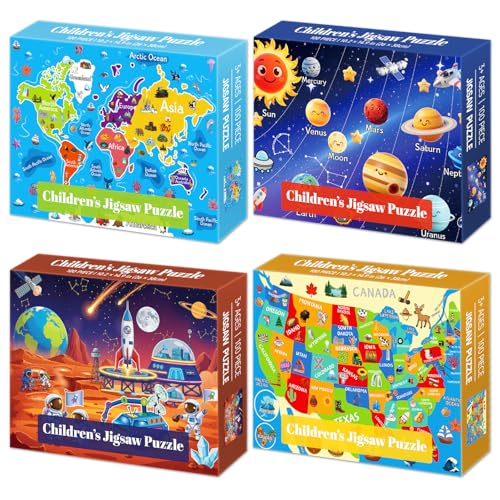
- Four map and space themes
- 100 pieces per puzzle with posters
- Supports concentration and problem-solving
Best For: Homeschool families needing several themed puzzles for ages 4–10
Best Geography Board
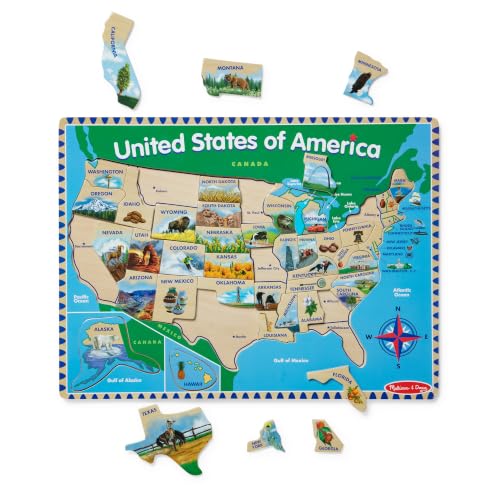
- Wooden board and state pieces
- Covers all 50 states
- Includes capitals and state facts
Best For: Hands-on U.S. geography practice for ages 5–8
Best Space-Themed Activity

- Solar-system artwork for themed learning
- 100 pieces with a reference poster
- Supports concentration and problem-solving
Best For: Space-themed homeschool activities for ages 4–8
Best Floor Puzzle

- Large 2-by-3-foot finished map
- Introduces continents and oceans
- 33 pieces for accessible assembly
Best For: Large-format world geography activities for ages 6+
Best Starter Set
20-Piece Wooden Learning Puzzles

- Four themes: dinosaurs, animals, space, and transportation
- Wooden trays with removable illustrated guides
- Designed for early fine-motor and problem-solving practice
Best For: Preschool learners ages 3–6 beginning puzzle activities
Best Geography Pick
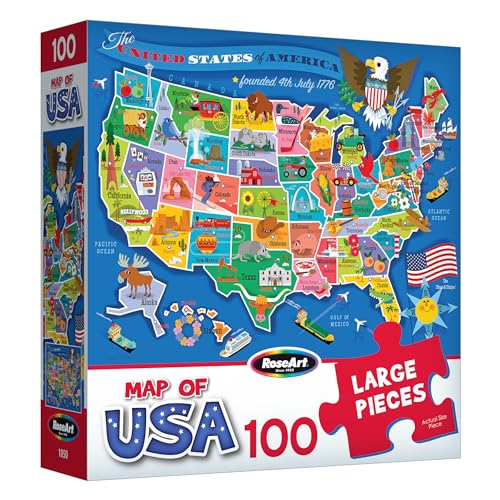
- Covers all 50 states and regional illustrations
- Large pieces and a 24-by-18-inch finished map
- Supports geography, spatial awareness, and memory skills
Best For: Homeschool geography lessons for ages 6 and up
Best Multi-Level Set

- Solar system, dinosaur, jungle, and ocean themes
- Reference posters and lettered backs support assembly
- Builds concentration and problem-solving through 100-piece play
Best For: Children ages 4–10 ready for themed 100-piece challenges
State-by-State Explorer

- Covers states, capitals, landmarks, and state animals
- Wooden 37-piece beginner format
- Supports hands-on geography practice
Best For: Beginning homeschool geography lessons
Global Geography Lab
World Map Puzzle with Flags and Capitals

- Includes country pieces, flags, and capital stickers
- Adds a detailed Europe map
- Supports geography and spatial-learning activities
Best For: Ages 5–13 studying world geography
Four-Theme Learning Rotation
4-Pack 100-Piece Educational Puzzles

- Includes USA map, animals, ocean, and space themes
- Lettered backs simplify sorting
- Comes with posters and storage bags
Best For: Varied homeschool practice for ages 4–10
Best Multi-Theme Set – 4-Pack Map and Space Puzzles
This four-puzzle set is a flexible pick for families building a collection of jigsaw puzzles for homeschool. With USA and world maps plus solar-system themes, it combines tabletop puzzle practice with geography and space-related visual learning.
Best For: Homeschool families wanting several 100-piece puzzles for children ages 4–10.
Pros:
- Includes four themes: USA map, world map, solar system, and Mars adventure.
- Each puzzle has 100 pieces, a 1:1 reference poster, and a 15-by-10-inch finished size.
- Letters on the backs can help with assembly, while the puzzles support concentration, problem-solving, and hand-eye coordination.
Cons:
- The four puzzles share the same 100-piece format, so there is limited variety in difficulty.
- The cardboard construction may be less durable than a wooden puzzle board.
Choose this set when you want theme variety and multiple activities in one purchase. It is especially useful for rotating independent work or family puzzle time across a homeschool week.
Best Geography Board – USA Map Wooden Puzzle
This wooden USA map puzzle is a focused geography choice for homeschool lessons. State pieces, capital labels, and facts printed on the back provide several ways to reinforce location and shape recognition during hands-on practice.
Best For: Children ages 5–8 who are beginning structured U.S. geography work.
Pros:
- Uses wooden pieces and a puzzle board for a sturdy, reusable activity.
- Helps children identify all 50 states by size, shape, and location.
- Includes state-capital identification and fun facts on the back of the board.
Cons:
- It focuses only on U.S. geography, rather than offering multiple subject themes.
- The product contains small parts, so supervision may be appropriate for younger children.
For a homeschool shelf centered on geography, this is a more targeted choice than a general jigsaw. Its board format and state information make it suitable for repeated review alongside map lessons.
Best Space-Themed Activity – Solar System 100-Piece Puzzle
This 100-piece solar-system puzzle offers a compact activity for homeschool tables, quiet time, or a space-themed unit. The included poster can support assembly, while the format encourages concentration, creativity, motor skills, and problem-solving.
Best For: Children ages 4–8 and families seeking a space-themed puzzle that grandparents and children can complete together.
Pros:
- Features a solar-system theme and measures about 15 by 10 inches when completed.
- Includes a 1:1 poster for assembly support.
- Suitable for individual play or collaborative family activity, including grandparent-child time.
Cons:
- It is a single puzzle, so it offers less variety than a multi-pack.
- The 100-piece format may require more sustained attention from younger children.
This is a practical add-on for homeschoolers covering space or planets. Its single-theme focus makes it easy to pair with a related lesson, book, or discussion without adding a large activity set.
Best Floor Puzzle – Jumbo World Map Floor Puzzle
This jumbo world map floor puzzle gives homeschool learners a large, collaborative way to explore geography. Its 33 pieces assemble into a 2-by-3-foot map, making continent and ocean locations easier to examine together on the floor.
Best For: Children ages 6 and up who benefit from a large-format, introductory world geography activity.
Pros:
- Large 2-by-3-foot finished size creates an engaging floor-based learning activity.
- Introduces the locations, shapes, and names of continents and major world oceans.
- Supports hand-eye coordination and problem-solving while allowing one or more players.
Cons:
- The 33-piece format provides less assembly challenge than a 100-piece puzzle.
- It requires more floor space than a tabletop jigsaw.
Choose this puzzle when visual scale and shared participation matter more than piece count. It works well for map introductions, group discussion, or a screen-free geography break in a homeschool routine.
Best Starter Set – 20-Piece Wooden Learning Puzzles
For younger learners beginning with jigsaw puzzles for homeschool, this four-pack offers manageable 20-piece challenges in dinosaur, animal, space, and transportation themes. The wooden trays and illustrated guides make setup, assembly, and cleanup practical for preschool activities.
Best For: Preschool learners ages 3–6 who are developing fine-motor coordination, spatial awareness, and early problem-solving skills.
Pros:
- Four engaging educational themes support repeat play.
- Wooden construction and smooth, rounded edges are designed for young children.
- Built-in trays and removable guides simplify organization and assembly.
- 20-piece format is approachable for beginning puzzlers.
Cons:
- At 20 pieces, these puzzles may be too simple for older or advanced students.
- The set is intended for tabletop play rather than large completed displays.
This is a practical choice for homeschool families introducing puzzles as a hands-on learning activity. Its smaller piece count and sturdy wooden trays make it especially suitable for short preschool lessons or independent practice.
Best Geography Pick – 100-Piece USA Map Puzzle
This USA map puzzle brings geography practice into a jigsaw puzzles for homeschool routine. Its 100 large pieces form a 24-by-18-inch map featuring all 50 states, major landmarks, and regional illustrations that can support map recognition and discussion.
Best For: Homeschool students ages 6 and up studying U.S. geography, state recognition, spatial awareness, and memory.
Pros:
- Features all 50 states along with landmarks and regional icons.
- Large pieces are designed for easier handling by young children.
- Colorful illustrations can make geography concepts more memorable.
- Finished puzzle measures a substantial 24 by 18 inches.
Cons:
- Only one puzzle is included, rather than a themed multi-pack.
- The cardboard material may require more careful handling than a wooden puzzle.
Choose this option when you want puzzle time to reinforce a specific social studies topic. The map format gives the activity clear instructional value, while the large finished size allows students to review the states and illustrations together.
Best Multi-Level Set – Four 100-Piece Kids Puzzles
Families looking for more challenging jigsaw puzzles for homeschool can use this four-pack across several study themes and skill levels. It includes solar system, dinosaur, jungle animal, and ocean designs, with each puzzle measuring 15 by 10 inches when completed.
Best For: Children ages 4–10 who are ready to build concentration, observation, logical thinking, and problem-solving skills through repeated 100-piece practice.
Pros:
- Four science- and nature-oriented themes provide variety.
- Each puzzle includes a 1:1 reference poster for guidance.
- Thickened cardboard pieces have smooth edges and bright printing.
- Letters on the backs can help younger children sort and assemble pieces.
Cons:
- All four puzzles use 100 pieces, which may be demanding for some beginners.
- Cardboard pieces are less durable than the wooden option in this roundup.
- The set does not include a storage tray or frame for each puzzle.
This set offers the most sustained practice of the three options, especially for children progressing toward independent 100-piece puzzles. The reference posters and back-of-piece letters provide useful support without removing the central challenge.
State-by-State Explorer – Wooden USA Map Puzzle
For younger learners, this wooden USA map puzzle makes a practical addition to a collection of jigsaw puzzles for homeschool. Its 37 pieces introduce all 50 states along with capitals, animals, and landmarks through a hands-on tabletop activity.
Best For: Homeschool geography lessons and beginners ages 4–8 who benefit from a tactile, map-based activity.
Pros:
- Introduces states, capitals, landmarks, and state animals.
- Wooden construction is designed for repeated use.
- Supports matching, spatial awareness, creative thinking, and problem solving.
- Beginner-friendly format for tabletop learning.
Cons:
- With 37 pieces, it may offer limited challenge for advanced puzzle solvers.
- The compact 14.8-by-10-inch size may be less suitable for group instruction.
This is a focused choice for families seeking an introductory geography puzzle rather than a broad collection of themes. The wooden format and state-focused content make it especially useful for recurring homeschool review.
Global Geography Lab – World Map Puzzle with Flags and Capitals
This world map puzzle is a strong fit for families building geography into their jigsaw puzzles for homeschool rotation. Country-shaped pieces, flags, capitals, and a dedicated Europe map provide several ways to explore international geography.
Best For: Homeschool geography units for children ages 5–13 who are ready to study countries, borders, flags, and capitals.
Pros:
- Includes 75 country-shaped pieces and 65 world flags.
- Provides capital stickers and an additional Europe map.
- Supports spatial awareness, fine motor skills, concentration, and critical thinking.
- Uses 8 mm EVA foam pieces that conform to ASTM toy standards, according to the supplied product information.
Cons:
- The number of components may require organized storage and setup.
- Country and capital content may be more demanding for younger beginners.
Compared with a simple regional map, this set offers more material for a multi-session homeschool geography study. Its flags, stickers, and Europe-focused content can support both puzzle time and follow-up identification activities.
Four-Theme Learning Rotation – 4-Pack 100-Piece Educational Puzzles
Families looking for variety in jigsaw puzzles for homeschool may appreciate this four-pack. It combines USA geography, ocean animals, wild animals, and the solar system, allowing children to rotate subjects while practicing the same 100-piece puzzle skills.
Best For: Homeschool families wanting reusable, themed activities for children ages 4–10 and mixed-interest learning time.
Pros:
- Includes four separate 100-piece educational puzzles.
- Covers geography, ocean life, wildlife, and space.
- Back-of-piece letters help younger children sort sections.
- Includes posters, individual boxes, and zip-lock storage bags.
Cons:
- The 100-piece format may be challenging for some younger beginners.
- Paper construction may be less durable than a wooden puzzle.
- It is an intermediate-level set rather than a single introductory map puzzle.
This set works well when homeschool activities need both educational variety and independent practice. Letter-marked backs can reduce frustration, while the four subjects make it easier to connect puzzle time with science and geography themes.
How We Picked These Jigsaw Puzzles for Homeschool
We focused on puzzles that support practical learning while remaining engaging enough for independent or guided play. The selection includes USA and world maps, space and planet themes, dinosaurs, animals, transportation, and mixed educational sets. We also considered piece count, recommended age range, puzzle dimensions, materials, and whether each option can support lessons beyond simple assembly.
Because homeschool learners vary widely in fine-motor ability and experience, the list includes both manageable 20-piece wooden puzzles and more challenging 100-piece designs. Large floor puzzles offer a collaborative format, while compact sets can rotate through a weekly activity plan.
Quick Comparison
| Best For | Look For |
|---|---|
| Preschool practice | Large wooden pieces and 20-piece sets |
| Geography lessons | USA or world maps with labels, landmarks, flags, or capitals |
| Science units | Solar-system, wildlife, dinosaur, or ocean imagery |
| Family learning | Large-format floor puzzles and higher piece counts |
| Variety on a budget | Multi-pack sets with several educational themes |
Key Buying Factors for Jigsaw Puzzles for Homeschool
Age and Difficulty
Choose piece size and count according to the child’s current ability, not only the printed age range. Beginners often do better with chunky wooden pieces, clear illustrations, and familiar subjects. Older children may benefit from 100-piece puzzles that encourage sorting, visual planning, and persistence.
Curriculum Connection
Maps can reinforce state names, continents, landmarks, countries, flags, and capitals. Space puzzles can introduce planet order and vocabulary, while animal and dinosaur puzzles provide starting points for classification, habitats, and research projects. Select a theme that complements your current lessons.
Materials and Format
Wooden puzzles are useful for repeated preschool play and are generally easy to handle. Cardboard puzzles may offer more detailed artwork and larger educational scenes. Check dimensions before buying: a floor puzzle needs more space, while smaller sets are easier to store and use at a desk.
Number of Puzzles Included
Multi-pack collections provide variety and can serve multiple children or several units of study. However, confirm the piece count and recommended ages for each puzzle, since sets may be better suited to different skill levels.
Who Should Buy Which Jigsaw Puzzles for Homeschool?
- For preschoolers: Choose a wooden 20-piece set with simple themes and large, durable pieces.
- For geography learners: Select a USA or world map puzzle with clear labels, landmarks, flags, or capitals.
- For science units: Pick a solar-system, dinosaur, wildlife, or ocean-themed puzzle that can lead into reading and discussion.
- For siblings: Consider a multi-pack so children can work at different difficulty levels or complete separate activities.
- For group lessons: A large world-map floor puzzle encourages collaboration and provides a visible classroom display.
Before ordering, verify the current age guidance, dimensions, piece count, and included materials. The best choice is the puzzle that fits your child’s skill level and gives you clear opportunities to extend play into conversation, labeling, mapping, or research.