Copperplate calligraphy rewards patience, precision, and the right instruction. The best books make it easier to build consistent strokes, confident letterforms, and a smoother pointed-pen workflow.
Below, you’ll find a focused roundup of copperplate calligraphy books chosen for practical exercises, clear teaching style, and long-term usefulness for learners at different skill levels.
Best 10 Copperplate Calligraphy Books Picks for 2026
Step-by-Step Copperplate Guide
Mastering Copperplate Calligraphy

- Covers letters, numbers, punctuation, and basic strokes
- Explains tools, paper, ink, spacing, and corrections
- Shows practical uses for cards, envelopes, and invitations
Best For: Beginners who want a comprehensive traditional copperplate manual
Practice Workbook
Copperplate Calligraphy: a pointed pen workbook

- Guided exercises to build muscle memory
- Traditional slant and baseline guideline sheets
- Stroke-by-stroke examples with traceable letters
Best For: Students who want a focused pointed-pen practice workbook
Two-Script Techniques
Italic and Copperplate Calligraphy

- Teaches both Italic and Copperplate scripts
- Moves from basics into flourishes and design
- Includes layout advice and project inspiration
Best For: Learners with some experience who want two classic scripts
Modern Beginner Projects
Classic Calligraphy for Beginners

- Teaches Copperplate and Spencerian basics
- Includes warm-ups, nib exercises, and guide sheets
- Features 25+ projects on paper, wood, glass, and fabric
Best For: Beginners who want traditional scripts plus modern projects
Classic Starter Guide
Calligraphy in the Copperplate Style
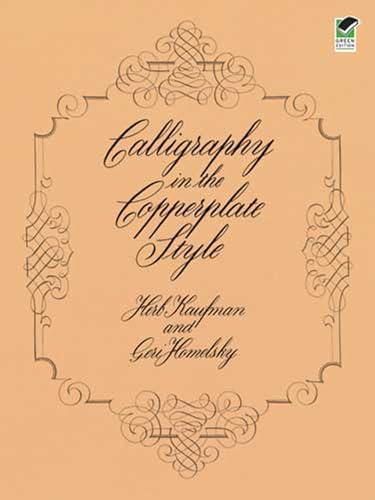
- Step-by-step basics from strokes to full letters
- Includes exercises plus guide sheets in three sizes
- Compact 32-page Dover instruction guide
Best For: Beginners seeking a concise Copperplate introduction
Trace & Learn Workbook
ASK A to Z of Copperplate Calligraphy

- Trace-and-learn format for beginner practice
- Covers letters, numbers, sentences, and paragraphs
- 108-page workbook for handwriting and penmanship
Best For: Learners who want guided tracing and broad practice
Hands-On Practice Pad
Copperplate Calligraphy Practice Book

- Worksheet and drill-driven practice pad
- Perforated pages and blank workspace included
- Covers strokes, letters, and pointed-pen techniques
Best For: Practice-focused learners building technique through repetition
Classic Copperplate Workbook

- Traditional workbook with basic strokes and examples.
- Includes guide sheets plus letter and number practice.
- Adds a historical intro to copperplate and round hand.
Best For: Learners who want a straightforward, historically grounded copperplate practice book.
Modern Step-by-Step Guide
Copperplate Calligraphy from A to Z

- Full-color, photo-packed lessons for beginners.
- Includes practice pages, tips, flourishes, and DIY projects.
- Makes pointed-pen calligraphy feel approachable.
Best For: Beginners who want a colorful, easy-to-follow copperplate workbook with project ideas.
All-in-One Calligraphy Guide
The Complete Guide to Modern Calligraphy

- Teaches Copperplate, Spencerian, brush lettering, and faux calligraphy.
- Starts with tools, posture, ink, nibs, and pen control.
- Includes creative projects for cards, envelopes, tags, and decor.
Best For: Readers who want a broad modern calligraphy resource that still teaches Copperplate and Spencerian fundamentals.
Step-by-Step Copperplate Guide – Mastering Copperplate Calligraphy
Mastering Copperplate Calligraphy: A Step-by-Step Manual (Lettering, Calligraphy, Typography)
Check Price On AmazonIf you want one of the most practical copperplate calligraphy books for learning the script from the ground up, this manual offers a structured path through the alphabet, numbers, punctuation, and basic strokes. It also covers tools, paper, ink, spacing, and how copperplate can be used for envelopes, name cards, invitations, and short quotations.
Best For: Beginners and self-learners who want a traditional, comprehensive copperplate workbook-style manual with clear stroke-by-stroke instruction.
Pros:
- Step-by-step demonstrations for each letter, with clear explanations.
- Includes a useful overview of essential tools and their tradeoffs.
- Covers practical uses like invitations, envelopes, and commercial lettering.
- Also discusses retouching, correcting, cropping, and calligraphy terms.
Cons:
- At 192 pages, it is detailed but not a quick-start booklet.
- Focuses strongly on traditional copperplate rather than modern variations.
Overall, this is a strong pick if you want a classic, thorough copperplate reference that balances technique with real-world application. It looks especially useful for readers who prefer a traditional teaching style and want a book they can return to as skills improve.
Practice Workbook – Copperplate Calligraphy: a pointed pen workbook
This is one of the more practice-focused copperplate calligraphy books, designed to help you build muscle memory through guided repetition. It includes traditional guidelines, stroke-by-stroke letter examples, and space to trace over gray letters before moving to freehand practice.
Best For: Learners who want a hands-on pointed pen workbook with plenty of guided practice pages.
Pros:
- Built around practice, repetition, and muscle-memory training.
- Includes traditional guideline layouts with ascender, baseline, and slant lines.
- Shows each letter with stroke-by-stroke examples.
- Created by an experienced calligrapher and teacher.
Cons:
- Very short at 44 pages, so it is lighter on broader theory.
- Best suited to active practice rather than in-depth historical study.
For readers who learn best by doing, this workbook is a focused, low-friction way to practice copperplate basics. It is especially appealing if you want structured drills instead of a long instructional text.
Two-Script Techniques – Italic and Copperplate Calligraphy
Italic and Copperplate Calligraphy: The Basics and Beyond (Lettering, Calligraphy, Typography)
Check Price On AmazonIf you are comparing copperplate calligraphy books and want one that goes beyond the basics, this title pairs Copperplate with Italic in a step-by-step format. It begins with fundamentals, then moves into variations in letter size, form, weight, flourishes, layout, and design ideas for original projects.
Best For: Novices with some experience who want to expand into both copperplate and italic styles.
Pros:
- Teaches both Italic and Copperplate in one illustrated guide.
- Uses a clear three-part approach that builds from basics to design.
- Covers flourishes, layout, and project inspiration.
- Good bridge between learning fundamentals and creating original work.
Cons:
- May feel broad if you only want a dedicated copperplate-only book.
- Better for students with some experience than absolute beginners.
This is a smart choice if you want a wider calligraphy foundation without losing copperplate instruction. The added focus on design and project use makes it especially helpful once you are ready to apply technique more creatively.
Modern Beginner Projects – Classic Calligraphy for Beginners
For readers who want copperplate calligraphy books with a modern, project-based angle, this beginner guide combines Copperplate and Spencerian fundamentals with contemporary applications. It covers tools, nib exercises, essential strokes, and letter forms, then shows how to apply those skills to projects on paper, wood, glass, fabric, and more.
Best For: Beginners who want copperplate fundamentals plus modern projects and surface variety.
Pros:
- Introduces Copperplate and Spencerian scripts together.
- Includes warm-ups, nib exercises, and basic stroke instruction.
- Offers 25+ modern projects across multiple surfaces.
- Provides sample guide sheets for Copperplate, Spencerian, and brush calligraphy.
Cons:
- Not a pure Copperplate-only book, since it also includes Spencerian and brush work.
- Project focus may be less ideal if you want a deep traditional history lesson.
This book stands out if you want practical creativity along with script fundamentals. It is a strong pick for beginners who want to practice traditional lettering while also making usable modern pieces.
Classic Starter Guide – Calligraphy in the Copperplate Style
If you’re comparing copperplate calligraphy books for a clear first step into pointed-pen lettering, this Dover guide is built for straightforward learning. It walks through the basic strokes, letter assembly, word joining, numerals, punctuation, materials, and preparation in a simple step-by-step format, with exercises at each stage.
Best For: Beginners who want a concise, structured introduction to the Copperplate style.
Pros:
- Explains the nine basic strokes before moving into letters and words
- Includes practical exercises throughout the instructional sections
- Provides guide sheets in three sizes for tracing practice
- Grounded in experienced adult-education teaching
Cons:
- Only 32 pages, so it is a compact overview rather than an in-depth manual
- Older Dover format may feel minimal if you want a large workbook
This is a strong pick if you want a classic, no-frills foundation in Copperplate lettering. It focuses on teaching the essentials clearly and efficiently, making it a practical choice for self-study.
Trace & Learn Workbook – ASK A to Z of Copperplate Calligraphy
Among copperplate calligraphy books aimed at learners, this trace-and-learn workbook is designed to make practice approachable. It covers letters, numbers, sentences, and paragraphs, and positions itself as a beginner-friendly way to explore handwriting, penmanship, and elegant lettering for everyday uses like envelopes, invitations, menus, and gift tags.
Best For: Beginners who want guided tracing practice and a broad A-to-Z learning format.
Pros:
- Trace-and-learn format makes practice more guided
- Covers letters, numbers, sentences, and paragraphs
- Useful for decorative writing applications like invitations and gift tags
- Large 108-page workbook gives plenty of space to practice
Cons:
- Part of a series, so it may be better as one step in a larger learning path
- Independent publishing means fewer details are provided about teaching style
This workbook is a practical option if you prefer a hands-on approach and want to build comfort through repetition. It leans more toward guided practice than theory, which can be helpful for new learners.
Hands-On Practice Pad – Copperplate Calligraphy Practice Book
If you want copperplate calligraphy books that focus on repetition and technique, this practice pad is built for daily drills. It includes worksheets, templates, tips, blank space for practice, and perforated sheets, with exercises covering basic strokes, lowercase and uppercase letters, letter combinations, and pointed-pen fundamentals.
Best For: Beginners and modern calligraphy learners who want a practice-heavy workbook.
Pros:
- Filled with drills, templates, and worksheet-style practice
- Includes tips and blank workspace alongside guided exercises
- Perforated sheets make it easy to remove pages for use
- Covers letterforms, strokes, and pointed-pen techniques
Cons:
- More practice-focused than explanation-heavy
- Smaller trim size may feel less spacious than a full-size guide
This is a strong choice if you already know you learn best by doing. It functions more like a hands-on practice pad than a traditional lesson book, which makes it useful for building muscle memory.
Classic Copperplate Workbook – Copperplate Calligraphy
If you want copperplate calligraphy books that focus on fundamentals, this Dover workbook gives you a traditional, practice-first path. Dick Jackson explains the basic strokes behind almost every letter, then adds simple examples, flourishes, strikings, and guide sheets so you can build the script step by step with just a pen and ink.
Best For: Learners who want a straightforward, historically grounded copperplate practice book with guided worksheets.
Pros:
- Clear instruction on basic strokes for most letters in the copperplate alphabet.
- Includes guide sheets and letter/number practice for hands-on study.
- Offers a historical introduction to copperplate’s development and round hand roots.
- Uses a workbook format that supports repeated practice.
Cons:
- At 96 pages, it is relatively compact compared with larger modern guides.
- Its traditional approach may feel less visually modern than photo-heavy workbooks.
This is a solid pick if you value clear drills and classic instruction over flashy presentation. It looks especially useful for beginners who want a focused foundation in copperplate rather than a broad calligraphy survey.
Modern Step-by-Step Guide – Copperplate Calligraphy from A to Z
Among copperplate calligraphy books, this one leans modern and beginner-friendly, with a full-color, photo-packed format that breaks down pointed-pen lettering into manageable steps. It covers the basics, flourishes, practice pages, and even DIY projects, making it a practical choice if you want clear visuals and structured instruction.
Best For: Beginners who want a colorful, easy-to-follow copperplate workbook with practice pages and project ideas.
Pros:
- Full-color, photo-heavy lessons make the process easy to follow.
- Includes step-by-step instruction, practice pages, and expert tips.
- Covers flourishes, embellishments, and DIY projects for real use.
- Designed to reduce intimidation for new pointed-pen learners.
Cons:
- Focuses on a modern learning style rather than a deep historical overview.
- At 128 pages, it may not be as expansive as larger reference guides.
This book stands out if you learn best from photographs and guided exercises. It should appeal to beginners who want copperplate basics plus enough inspiration to start using the style in personal projects.
All-in-One Calligraphy Guide – The Complete Guide to Modern Calligraphy
If you want one of the more expansive copperplate calligraphy books, this guide goes beyond a single script and combines Copperplate, Spencerian, brush lettering, faux calligraphy, and creative projects. It starts with tools, nibs, ink, posture, and pen control, then moves into strokes, alphabets, spacing, flourishing, and practical design applications.
Best For: Readers who want a broad modern calligraphy resource that still teaches Copperplate and Spencerian fundamentals.
Pros:
- Covers Copperplate and Spencerian alongside brush lettering and faux calligraphy.
- Includes foundational guidance on tools, nibs, paper, ink, and posture.
- Extensive focus on creative projects like cards, envelopes, tags, and decor.
- Large 313-page format offers broad coverage and structured progression.
Cons:
- Its broad scope may be more than someone seeking only Copperplate basics needs.
- As a 2026 title, it is a newer release with less track record than older workbooks.
This is the strongest pick if you want a single guide that can grow with you. It is especially appealing for learners who plan to move from pointed-pen practice into modern lettering projects.
How We Picked the Best Copperplate Calligraphy Books
We looked for books that teach the fundamentals clearly, provide enough guided practice, and support steady progression from basic strokes to full lowercase and uppercase forms. Strong Copperplate Calligraphy Books should also explain nib angle, pressure control, spacing, and rhythm in a way that feels approachable rather than overwhelming.
We favored titles that work well as both learning tools and reference books, since many buyers want something they can return to while improving technique.
Quick Comparison
If you want a structured step-by-step manual, choose books built around lessons and drills. If you prefer hands-on learning, workbook-style options are usually the best fit. Broader modern-calligraphy guides can be useful if you also want Spencerian, flourishing, or related lettering styles, but they may be less focused than a dedicated copperplate resource.
Key Buying Factors for Copperplate Calligraphy Books
Skill Level
Beginners should look for clear stroke breakdowns, simple alphabets, and plenty of tracing or practice pages. Intermediate learners may benefit more from books that cover letter connections, spacing, rhythm, and stylistic refinement.
Instruction Style
Some Copperplate Calligraphy Books are highly structured, while others feel more like practice companions. Choose a format that matches how you learn best. If you need motivation and routine, a workbook may help. If you want deeper technical understanding, a manual or guide may be better.
Practice Depth
Good practice content matters more than decorative presentation. Look for repeated drills, letter families, and examples that build muscle memory. Books with too little guided repetition may look attractive but offer limited improvement.
Script Focus
Not every book stays strictly on copperplate. Some include Italic, Spencerian, or general modern calligraphy. That can be helpful if you want variety, but it’s best to choose a focused copperplate title if your main goal is mastering the pointed-pen style.
Who Should Buy Which Copperplate Calligraphy Books?
Beginners should start with the most structured Copperplate Calligraphy Books that emphasize fundamentals and practice. Hobbyists who want a giftable, easy-entry option may prefer trace-and-learn or workbook formats. More serious lettering students should prioritize books with deeper technique instruction and broader reference value. If you want one all-around resource, choose a comprehensive guide that combines copperplate with related styles and creative projects.
In short, the right book depends on whether you want instruction, repetition, or versatility. Matching the format to your goals will make learning more enjoyable and far more effective.