The best board games for kids make family time more engaging while building skills such as turn-taking, memory, matching, and simple strategy. This roundup covers classic favorites for preschoolers, quick competitive games, and flexible options for mixed-age groups.
Use the age recommendations, player counts, play styles, and setup requirements below to find a game that fits your child and your household.
Best 10 Board Games for Kids Picks for 2026
Best Classic Starter
- No reading required for ages 3 and up
- Color-based play supports early learning
- About 15 minutes for 2-4 players
Best For: Preschoolers and first-time board gamers
Best Guessing Game

- Picture-based yes-or-no guessing play
- Works with 2-6 players ages 6 and up
- Builds deduction and communication skills
Best For: Family game nights and social play
Best Pop-and-Play Classic
- Built-in Pop-O-Matic die roller
- Easy setup for ages 5 and up
- Optional Power Up Spaces add variety
Best For: Family game nights and playdates
Best Active Dexterity Game

- Action-focused fishing gameplay
- Helps practice hand-eye coordination
- For 1-4 players ages 4 and up
Best For: Young children who prefer active play
Classic Strategy Pick
- Race-to-home gameplay with card-driven moves
- For 2–4 players ages 6 and up
- Includes 12 pawns, 45 cards, and gameboard
Best For: Competitive family game nights
Travel-Friendly Deduction Pick

- Choose between people or pet character cards
- Two-player play for ages 6 and up
- Folds up for convenient storage and travel
Best For: One-on-one playdates and trips
Preschool Action Pick

- Fast marble-chomping play for ages 4 and up
- Supports 2–4 players with simple rules
- Instant reload and built-in storage case
Best For: Energetic preschool playdates and family games
Best with Extra Features

- Two-player blocking strategy
- Includes blue Blocker Discs
- No batteries required
Best For: Family game nights with kids ages 6 and up
Active Party Favorite

- Movement-based color game
- For 2 or more players
- Includes mat and spinner
Best For: Energetic parties and family group play
Preschool Learning Classic

- Designed for ages 3 and up
- No reading required
- Practices counting skills
Best For: Preschoolers and beginner family play
Best Classic Starter – Candy Land
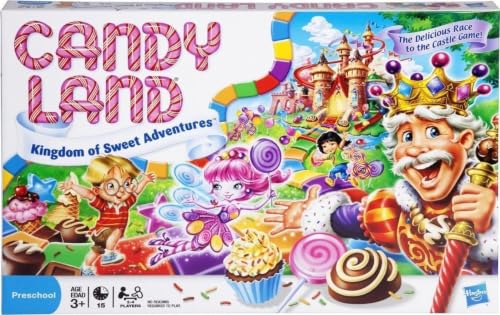
Candy Land is a straightforward pick for families searching for board games for kids ages 3 and up. Players use colored cards to move gingerbread man pawns toward the castle, so young children can join in without needing to read.
Best For: Preschoolers learning colors, turn-taking, and basic game etiquette.
Pros:
- No reading required, making it accessible to early learners.
- Simple card-based movement is easy to explain and play.
- Supports color recognition, taking turns, and sportsmanship.
- Short, approximately 15-minute play time suits young attention spans.
Cons:
- Recommended for ages 3 to 6, so older children may outgrow it.
- Gameplay centers on card-based movement rather than strategic choices.
With its familiar theme, simple rules, and colorful board, Candy Land is a practical first board game for younger children. It works especially well when the goal is easy family play rather than complex strategy.
Best Guessing Game – Hedbanz
Hedbanz adds active conversation to the board games for kids category. Players wear a headband, display a picture card, and ask yes-or-no questions to identify it, creating a quick social game for children and adults ages 6 and up.
Best For: Family game nights, parties, and groups that enjoy deduction and communication.
Pros:
- Supports critical thinking, deduction, and problem-solving.
- Accommodates 2-6 players and takes about 20 minutes.
- Includes picture cards, so gameplay does not depend on extensive reading.
- Encourages turn-taking, communication, and social interaction.
Cons:
- Requires players to be comfortable asking and answering questions aloud.
- The headband format may be less appealing to children who prefer quiet games.
Hedbanz is a strong choice when you want board games for kids that keep everyone involved between turns. Its simple question-and-guess format makes it easy to bring out for family nights or gatherings.
Best Pop-and-Play Classic – Trouble
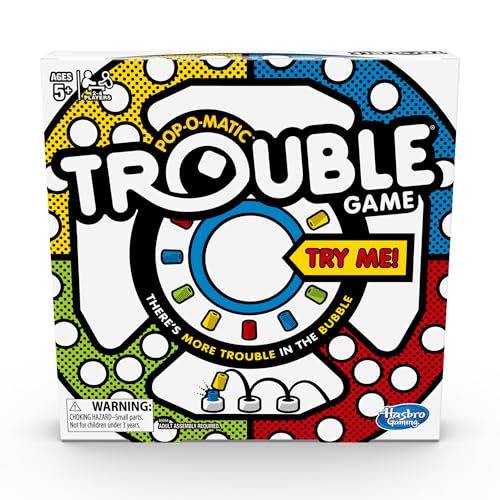
Trouble is an easy-to-learn option for families comparing board games for kids ages 5 and up. Players press the built-in Pop-O-Matic roller and race their pieces around the board, with optional Power Up Spaces for added variety.
Best For: Family game nights, playdates, and children who enjoy tactile game components.
Pros:
- Pop-O-Matic roller keeps the die attached and adds hands-on fun.
- Simple setup and rules make it approachable for new players.
- Supports 2-4 players with approximately 30-minute games.
- Optional Power Up Spaces offer a more challenging variation.
Cons:
- Recommended for ages 5 and up, limiting its use with preschoolers.
- Race-style movement offers less strategic depth than strategy-focused games.
For families wanting board games for kids with familiar rules and a satisfying physical feature, Trouble is a dependable choice. The alternative Power Up Spaces can also help keep repeat games from feeling identical.
Best Active Dexterity Game – Let's Go Fishin'
Let's Go Fishin' Game by Pressman - The Original Fast-Action Fishing Game!, 1-4 players
Check Price On AmazonLet’s Go Fishin’ brings fast physical play to board games for kids ages 4 and up. Players use mini fishing poles to catch colorful fish from a rotating pond as the fish open and close their mouths.
Best For: Children who enjoy action-based play and practicing hand-eye coordination.
Pros:
- Hands-on fishing mechanics help develop hand-eye coordination.
- Includes 21 colorful fish and four plastic fishing poles.
- Supports solo play or groups of up to four players.
- Rotating pond and moving fish create an active challenge.
Cons:
- Requires a D battery for operation.
- Small parts and magnets mean adults should review the listed safety information.
- Fast-action gameplay may be more stimulating than a quiet board game.
Let’s Go Fishin’ is a practical pick among board games for kids when dexterity and movement matter more than reading or strategy. Its rotating pond gives young players a clear, engaging objective while they practice precise control.
Classic Strategy Pick – Sorry! Board Game
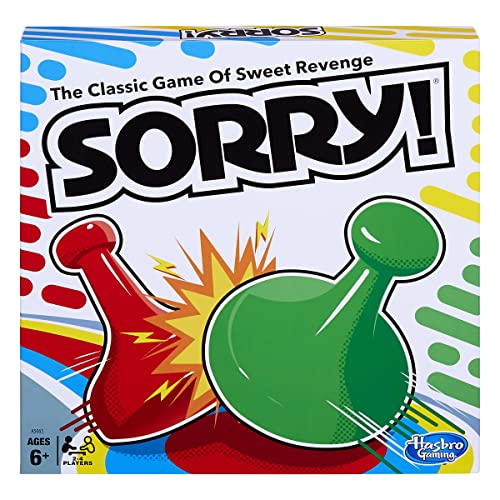
For families looking for classic board games for kids, Sorry! delivers a competitive race-to-home format with simple rules and plenty of twists. Players move pawns based on drawn cards, while slides and collisions can send opponents back to the start.
Best For: Families with kids ages 6 and up who enjoy strategic, competitive game nights.
Pros:
- Supports 2–4 players for family play.
- Combines racing, card decisions, slides, and collisions.
- Includes the gameboard, 12 pawns, 45 cards, and instructions.
- Requires no batteries and is easy to use indoors.
Cons:
- Small parts may not be suitable for younger children.
- Competitive pawn-sending can be frustrating for players who prefer cooperative games.
Sorry! is a strong choice when you want a familiar family game that mixes accessible rules with changing outcomes and light strategy.
Travel-Friendly Deduction Pick – Guess Who? Plus
Guess Who? Plus is a compact option among board games for kids, giving two players a quick deduction challenge. Children ask yes-or-no questions to eliminate possibilities and can choose between people or pet character sets.
Best For: Two children ages 6 and up who enjoy guessing, questioning, and short games.
Pros:
- Offers both people and pet card sets.
- Encourages critical thinking, deduction, and communication.
- Uses a one-motion setup and folds for storage or travel.
- Fast, straightforward gameplay suits playdates and after-school play.
Cons:
- Designed for exactly 2 players.
- Its replay value depends on players enjoying repeated guessing rounds.
With its simple question-and-elimination format and fold-up design, Guess Who? Plus works well for one-on-one play at home or on the go.
Preschool Action Pick – Hungry Hungry Hippos
Hungry Hungry Hippos brings fast, hands-on action to board games for kids, with preschool-friendly rules and a marble-chomping race. Players launch marbles into the center and press their hippos to collect as many as possible.
Best For: Preschoolers ages 4 and up who enjoy energetic, easy-to-learn games for 2–4 players.
Pros:
- Simple point-to-win gameplay is easy to learn.
- Instant marble reload keeps rounds moving.
- Marble storage case helps contain pieces between games.
- Hippos push down for more compact storage and transport.
Cons:
- Real-time gameplay may feel noisy or overly hectic for some children.
- Contains small balls and small parts, creating choking hazards.
This is a lively pick for preschool game time, especially when you want quick rounds, physical interaction, and minimal setup.
Best with Extra Features – Connect 4
Hasbro Gaming Connect 4 Strategy Board Game for Ages 6 and Up (Amazon Exclusive)
Check Price On AmazonConnect 4 is a straightforward strategy choice for families seeking board games for kids ages 6 and up. Two players take turns dropping colored discs into the grid, aiming to connect four while using blocker discs to create additional tactics.
Best For: Two-player family game nights and children who enjoy simple blocking and planning challenges.
Pros:
- Supports strategic blocking and board manipulation.
- Includes four blue Blocker Discs for added gameplay options.
- Requires no batteries and typically takes about 30 minutes to play.
Cons:
- Designed for exactly two players.
- Small parts may present a choking hazard.
Choose Connect 4 if you want a compact, replayable game with familiar rules and a little more strategy than basic roll-and-move play.
Active Party Favorite – Classic Twister
Classic Twister brings movement into the category of board games for kids, using a floor mat and spinner rather than a traditional tabletop board. Players follow color instructions with their hands and feet, making it a lively option for indoor gatherings or team play.
Best For: Parties, family activities, and groups of two or more players who want an energetic game.
Pros:
- Can be played by 2 or more players, with team-play instructions included.
- Encourages movement and team-building skills.
- Works indoors or outdoors and requires no batteries.
Cons:
- Requires enough floor space for the vinyl mat.
- Physical play may be less suitable for children who prefer quiet tabletop games.
Twister is a strong pick when the goal is to get kids, tweens, teens, and adults moving together rather than sitting around a table.
Preschool Learning Classic – Chutes and Ladders
Chutes and Ladders is an accessible choice among board games for kids ages 3 and up. Players spin, count spaces, climb ladders, and slide down chutes, so children can participate without needing to read.
Best For: Preschoolers learning counting and number recognition, classroom play, and beginner family game sessions.
Pros:
- No reading is required to play.
- Supports counting and number recognition practice.
- Accommodates 2 to 4 players.
Cons:
- Gameplay relies primarily on spinning and moving, with limited strategic control.
- Includes small parts and a marble-related choking warning.
For young children starting their first games, Chutes and Ladders offers simple rules, recognizable progression, and an easy way to practice early number skills.
How We Picked the Best Board Games for Kids
We focused on recognizable games with clear age guidance, approachable rules, and formats that work well for families. The selection includes preschool games, classic race-and-move games, guessing challenges, dexterity activities, and simple strategy titles. We also considered player count, setup and storage, expected interaction, and whether a game can hold a child’s attention across repeated sessions.
Because children develop at different rates, age labels are a useful starting point rather than a strict guarantee. Younger players may need help reading cards, counting spaces, or following multi-step turns, while older children may prefer more choice and competition.
Quick Comparison
| Best For | Recommended Picks | Typical Age Range |
|---|---|---|
| Preschool beginners | Candy Land, Chutes and Ladders, Hungry Hungry Hippos | 3–5+ |
| Fast-action play | Let’s Go Fishin’, Trouble, Hungry Hungry Hippos | 4–6+ |
| Guessing and conversation | Hedbanz, Guess Who? | 6+ |
| Classic competitive play | Sorry!, Connect 4 | 6+ |
| Active group entertainment | Twister | 6+ |
Key Buying Factors for Board Games for Kids
Age, Reading, and Attention Span
Choose a game that matches the youngest regular player. Picture-based and color-based games are usually easier for preschoolers, while question-based or strategic games may suit children who can read, compare options, and wait through longer turns.
Player Count and Family Fit
Check whether the game supports the number of people who typically play. Two-player games can be ideal for one-on-one time, while four-player and group games work better for siblings, playdates, and family gatherings.
Play Style and Skill Level
Chance-driven games can keep the experience accessible and low-pressure. Guessing games encourage communication, dexterity games add physical excitement, and strategy games give older children more control over outcomes. For mixed ages, look for simple rules with enough interaction to keep everyone involved.
Setup, Storage, and Durability
Frequent family games should be easy to assemble and put away. Look for sturdy components, contained pieces, and rules that can be explained quickly. Active games may need additional floor space, while games with small pieces should be stored safely around very young children.
Who Should Buy Which Board Games for Kids?
For a first game collection, Candy Land or Chutes and Ladders offers simple, familiar play for younger children. Families seeking energetic rounds should consider Let’s Go Fishin’, Trouble, or Hungry Hungry Hippos. Hedbanz and Guess Who? are strong choices for children who enjoy asking questions and identifying people or pictures.
Choose Sorry! for a classic race-and-capture experience, or Connect 4 when an older child is ready for more deliberate planning. Twister is the better fit for parties and active play rather than a traditional tabletop session. Before buying, confirm the listed age, player count, available space, and whether the game’s level of randomness or competition suits your household.