If you want a dependable way to explore major thinkers, core ideas, and philosophical traditions, the right reference book can make a big difference. The best philosophy encyclopedias organize complex concepts into a format that is easier to study, compare, and revisit.
This roundup focuses on books that balance clarity, depth, and usefulness so you can choose the right fit for casual reading, coursework, or long-term reference.
Best 10 Philosophy Encyclopedias Picks for 2026
Kids’ Starter Pick
Philosophy A Visual Encyclopedia

- Visual, age-friendly introduction to philosophy
- Covers Plato, Confucius, Simone de Beauvoir, and more
- Includes thought experiments and reflection prompts
Best For: Middle-grade readers new to philosophy
Occult Reference Pick
The Secret Teachings of All Ages

- Huge reference on occult, symbolic, and esoteric topics
- Includes illustrations, plates, bibliography, and index
- Best for readers wanting a classic, dense compendium
Best For: Adults interested in esoteric philosophy and symbolism
Best Overall Visual Guide

- Broad overview of philosophy from ancient to modern times
- Clear explanations with bold visuals and context boxes
- Updated edition with recent developments
Best For: Readers wanting a broad, visual philosophy overview
Compact Intro Pick

- Lively primer on major thinkers and ideas
- Uses illustrations and thought puzzles to stay engaging
- Portable format for quick, approachable reading
Best For: Beginners who want a concise philosophy primer
Authoritative One-Volume Reference
The Cambridge Dictionary of Philosophy

- Single-volume philosophy dictionary
- 400 new entries in the second edition
- Strong non-Western and applied ethics coverage
Best For: Readers who want an authoritative, accessible one-volume philosophy reference
Classic Multi-Volume Set
The Encyclopedia of Philosophy (Complete Set)
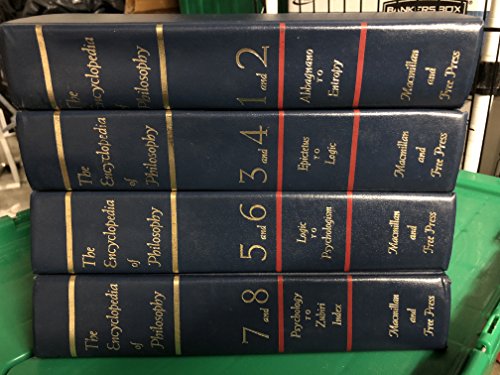
- Major English encyclopedia of philosophy
- Covers Eastern and Western thought
- Supplement updates scholarship and new topics
Best For: Collectors, libraries, and readers seeking a classic multi-volume reference
Compact Reference Classic
The Encyclopedia of Philosophy (8 Volumes in 4)

- Comprehensive Eastern and Western thought coverage
- Four-volume format reduces the bulk of the original set
- Tracks concepts, movements, and key individuals
Best For: Readers who want a substantial classic philosophy encyclopedia in a 4-volume format
Classic Reference
The Concise Encyclopedia of Western Philosophy

- Updated third edition of a classic reference
- Readable, authoritative coverage of Western philosophy
- Works as both reference and introduction
Best For: Readers seeking a compact, credible Western philosophy overview
Library Set
The Encyclopedia of Philosophy Complete Set

- Complete 8-volume reference set
- Built for library-style, in-depth use
- Large and substantial rather than portable
Best For: Collectors and libraries needing a full multi-volume philosophy reference
Modern Concepts Guide
Martell’s Concise Encyclopedia of Modern Philosophy Concepts

- Over 1,000 entries across key philosophy areas
- Clear, accessible explanations for broad readership
- Digital reference with strong academic-study appeal
Best For: Students and readers who want an approachable modern philosophy reference
Kids’ Starter Pick – Philosophy A Visual Encyclopedia
If you’re shopping for philosophy encyclopedias for a younger reader, this DK title is built to make big ideas approachable. It introduces classic questions, major thinkers, and the basics of philosophical debate with colorful visuals and a reader-friendly layout aimed at ages 11 and up.
Best For: Middle-grade readers who want an engaging first philosophy encyclopedia with clear visuals and age-appropriate explanations.
Pros:
- Uses vibrant illustrations to make abstract ideas easier to follow.
- Covers influential philosophers from around the world, including Plato, Confucius, and Simone de Beauvoir.
- Includes thought experiments that encourage reflection and discussion.
- Designed for readers aged 11+ with a straightforward, accessible style.
Cons:
- Focused on younger readers, so it may feel too introductory for older students.
- At 208 pages, it is broad rather than deeply technical.
This is a strong pick if you want a visually engaging philosophy encyclopedia that explains the basics without overwhelming the reader. It works especially well as an entry point into history of ideas, ethics, and logical thinking.
Occult Reference Pick – The Secret Teachings of All Ages
For shoppers browsing philosophy encyclopedias with a more esoteric angle, this Dover classic offers an expansive survey of occult, symbolic, and mystical traditions. It draws together ancient mythology, religion, and philosophy in a dense reference work that rewards readers who want breadth and historical curiosity.
Best For: Adults and serious general readers interested in occult symbolism, esoteric traditions, and a wide-ranging reference volume.
Pros:
- Massive scope covering mythology, religion, philosophy, and symbolism.
- Includes hundreds of entries and nearly 600 experts’ teachings distilled by Manly P. Hall.
- Features color plates, black-and-white illustrations, a bibliography, and an index.
- Classic reference format suited to detailed lookup and long-form reading.
Cons:
- Highly specialized content may be too niche for casual philosophy readers.
- The 736-page length and dense subject matter can feel intimidating.
This is less a beginner’s guide than a deep reference for readers drawn to symbolic philosophy and occult history. If you want a substantial, classic compendium with enormous range, it stands out immediately.
Best Overall Visual Guide – The Philosophy Book
If you want philosophy encyclopedias that explain major ideas in a clear, modern format, this DK Big Ideas volume is an easy fit. It walks through the history of philosophy from ancient Greece and China to today, using accessible explanations, bold visuals, and context boxes to make complex theories easier to grasp.
Best For: Readers who want a broad, updated, visually structured overview of philosophy’s major ideas and thinkers.
Pros:
- Covers major schools, movements, and thinkers across philosophy’s history.
- Clear, simple explanations make abstract concepts easier to understand.
- Updated edition includes developments from the last 5–10 years.
- Biography and context boxes add historical and cultural grounding.
Cons:
- Visual, overview style may not satisfy readers seeking deep academic detail.
- At 360 pages, it prioritizes breadth over exhaustive coverage.
This is one of the most practical all-around choices if you want a polished, easy-to-use philosophy encyclopedia. It balances scope, readability, and visual learning well, making it especially useful for newcomers and casual learners.
Compact Intro Pick – Philosophy 101
This compact entry in the philosophy encyclopedias category is designed for readers who want an energetic, easy-to-digest primer. It covers the history of thought, major figures, and big questions like free will and metaphysics in a lively format with illustrations and thought puzzles.
Best For: Readers who want a portable, fast-moving introduction to philosophy without textbook-style heaviness.
Pros:
- Accessible, engaging style avoids the dryness of many philosophy textbooks.
- Covers key thinkers and topics from Plato and Socrates to existentialism and metaphysics.
- Includes illustrations and thought puzzles to keep the material lively.
- Compact size makes it easy to handle and revisit.
Cons:
- Shorter format means less depth than larger encyclopedia-style volumes.
- Best suited to general overview rather than detailed reference use.
This is a smart choice if you want a lightweight philosophy reference that stays approachable. It’s especially useful for beginners who prefer a concise primer over a more formal encyclopedia.
Authoritative One-Volume Reference – The Cambridge Dictionary of Philosophy
If you’re comparing philosophy encyclopedias and want a single-volume reference with broad coverage, The Cambridge Dictionary of Philosophy is built for practical everyday use. This second edition expands the original with 400 new entries, strong coverage of major philosophers, and substantial updates in fast-moving areas like philosophy of mind and applied ethics.
Best For: Readers who want an authoritative, accessible one-volume philosophy reference with wide topical and international coverage.
Pros:
- Widely acclaimed as an authoritative and accessible one-volume dictionary.
- Includes 400 new entries, including over 50 on contemporary philosophers.
- Covers non-Western philosophy more fully than comparable volumes.
- Expanded coverage of Continental philosophy and applied ethics.
Cons:
- As a single volume, it may not match the depth of multi-volume sets.
- Published in 1999, so it is less current than newer reference works.
For buyers who prioritize ease of use and broad scope, this is one of the strongest philosophy encyclopedias in a compact format. It balances authority, accessibility, and coverage well for study or general reference.
Classic Multi-Volume Set – The Encyclopedia of Philosophy (Complete Set)
Among philosophy encyclopedias, this complete set stands out as a classic reference for readers who want a broad, established survey of the field. The notes identify it as one of the two major English encyclopedias of philosophy, with the original eight-volume edition later reprinted in four volumes and supplemented with updates on developments since 1967.
Best For: Collectors, libraries, and readers who want a major classic reference set with historical depth.
Pros:
- Recognized as one of the two major English encyclopedias of philosophy.
- Comprehensive coverage of Eastern and Western thought.
- Supplement volume adds developments, new subjects, and scholarship updates.
- Large multi-volume format suits more serious reference use.
Cons:
- Originally published in 1967, so the core set is dated.
- The full set is heavy and bulky at 18.5 pounds.
If you want a foundational reference rather than a quick desk dictionary, this set has the scale and reputation to match. It is especially appealing for long-form research and collection-building.
Compact Reference Classic – The Encyclopedia of Philosophy (8 Volumes in 4)
This edition is a strong fit if you’re shopping philosophy encyclopedias and want a broad reference work in a somewhat more compact 4-volume format. The supplied notes describe it as a comprehensive survey of Eastern and Western thought, with entries on concepts, movements, and individuals that shaped intellectual history.
Best For: Readers who want a substantial classic philosophy encyclopedia in a 4-volume format for study or reference.
Pros:
- Comprehensive coverage of Eastern and Western thought.
- Focuses on concepts, movements, and individuals in intellectual history.
- 4-volume format is more compact than the original 8-volume set.
Cons:
- First edition content dates back to 1967.
- Less updated than later revised or supplemented reference works.
This is best viewed as a classic, broad-based reference rather than a current survey. For readers who value depth and historical scope, it remains a practical option among philosophy encyclopedias.
Classic Reference – The Concise Encyclopedia of Western Philosophy
If you want one of the most established philosophy encyclopedias for Western thought, this edition is built as both a reference work and an approachable introduction. It is described as lively, readable, comprehensive, and authoritative, with updated coverage that brings the classic 1960 work fully up to date.
Best For: Readers who want a compact, credible overview of Western philosophy with strong readability.
Pros:
- Third edition updates a long-running classic for modern use
- Combines reference value with an introduction-friendly style
- Authoritative coverage of Western philosophy as a whole
- Features articles by many leading philosophical authors
Cons:
- Focused on Western philosophy rather than a broader global scope
- At 410 pages, it is concise rather than exhaustive
This is a strong choice if you want a well-regarded philosophy encyclopedia that balances depth, clarity, and portability. Its updated third edition makes it especially appealing for general reference and guided study.
Library Set – The Encyclopedia of Philosophy Complete Set
For buyers looking at major philosophy encyclopedias, this complete 8-volume set is the most expansive option in the roundup. The listing identifies it as a four-volume set with each book containing two volumes, making it a substantial reference library for in-depth consultation.
Best For: Collectors, libraries, and readers who want a large multi-volume philosophy reference set.
Pros:
- Complete 8-volume philosophy reference set
- Designed as a substantial library-style resource
- Useful when broad, multi-volume coverage is the priority
Cons:
- Very large set, so it is not compact or portable
- Publication date is older, from 1972
- Listing details are basic compared with newer editions
This is the strongest pick if your goal is volume and scope rather than convenience. It suits serious reference use, but the size and age make it less practical for casual reading.
Modern Concepts Guide – Martell’s Concise Encyclopedia of Modern Philosophy Concepts
If you are comparing philosophy encyclopedias for modern topics, this title is aimed at making contemporary ideas easier to navigate. It promises over 1,000 detailed entries across ethics, metaphysics, epistemology, and political philosophy, with clear, accessible explanations for a wide audience.
Best For: Students, educators, and curious readers who want a broad, easy-to-follow guide to modern philosophy concepts.
Pros:
- Over 1,000 detailed entries across many philosophy areas
- Covers major figures and movements such as Sartre, Wittgenstein, and Derrida
- Written in a clear, accessible style
- Large 1,508-page reference with academic-study appeal
Cons:
- Digital-only format may not suit buyers who prefer print
- Broad scope may still require supplemental sources for deeper study
This is a practical pick for readers who want breadth and accessibility in a modern philosophy reference. Its large entry count and student-friendly presentation make it useful for study and quick lookup alike.
How We Picked These Philosophy Encyclopedias
We looked for books that offer strong editorial quality, broad coverage, and practical usability. For Philosophy Encyclopedias, that means clear definitions, reliable authorship or editorial oversight, and a structure that helps readers find topics quickly. We also considered whether a title is best suited to newcomers, students, or collectors who want a more comprehensive reference set.
Quick Comparison
Some Philosophy Encyclopedias are designed as approachable introductions with visuals and short entries, while others are multi-volume references built for deeper study. A compact overview works well if you want fast answers and broad context. A larger set is better if you need more precise definitions, historical depth, and coverage of specialized schools of thought.
Key Buying Factors for Philosophy Encyclopedias
Scope and Depth
Decide whether you need a general survey of major ideas or a deeper reference focused on Western philosophy, modern concepts, or specialized traditions. Broader coverage is useful for general learning, while narrower works can be stronger on detail.
Format and Usability
Visual or concise encyclopedias are easier for beginners and younger readers, while multi-volume editions are better for libraries and advanced study. Check how entries are organized, how easy it is to cross-reference topics, and whether the index is practical.
Audience Level
Not all Philosophy Encyclopedias are written for the same reader. Introductory titles should explain terms plainly, while advanced references may assume prior knowledge. Choose based on whether you are studying for class, building a reference shelf, or reading for personal enrichment.
Editions and Completeness
For larger sets, confirm that the edition is complete and in good condition if buying used. With reference works, missing volumes or abridged versions can significantly reduce value.
Who Should Buy Which Philosophy Encyclopedias?
Beginners and casual readers should look for concise, accessible Philosophy Encyclopedias that explain major concepts without heavy jargon. Students may benefit most from balanced reference works that combine clarity with enough detail for papers and revision. Collectors, researchers, and dedicated readers should consider comprehensive multi-volume sets or specialized encyclopedic works that go deeper into terminology, historical development, and major schools of thought.
If you want the simplest path, choose a visually guided or concise entry-level book. If you need the strongest long-term reference value, prioritize completeness, editorial credibility, and depth of coverage over portability.