Advanced players need more than routine checkmate drills. The right chess puzzle book should challenge calculation, pattern recognition, defensive awareness, and practical decision-making at a level that matches your current strength.
We’ve gathered 10 demanding options, including large problem collections and focused workbooks covering sacrifices, openings, defense, and forced mates. Use the guide below to match each format with your training goals.
Best 10 Chess Puzzle Books for Advanced Players Picks for 2026
Advanced Tactics Trainer
1001 Chess Exercises for Advanced Club Players
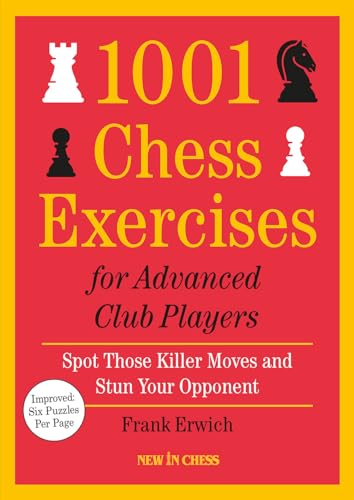
- 1,001 exercises for advanced club players
- Builds pattern recognition and calculation
- Updated 2024 edition; 304 pages
Best For: Experienced club players focused on tactical calculation
Comprehensive Problem Archive
Chess: 5334 Problems, Combinations and Games

- More than 5,000 instructional situations
- Includes mates, endgames, and game combinations
- 1,104 pages with 6,000+ illustrations
Best For: Players wanting a broad, high-volume puzzle reference
Step-by-Step Tactics Practice
The Chess Puzzles & Tactics Blueprint

- More than 2,000 tactical exercises
- Arranged by theme and difficulty
- Uses practical positions from actual games
Best For: Players seeking structured, progressive tactics training
Grandmaster-Level Challenge
The Ultimate Chess Puzzle Book

- Progresses from easy positions to extreme challenges
- Includes themed and no-clue graded tests
- Written by Grandmaster John Emms
Best For: Serious solvers seeking varied and demanding tests
Best for Progressive Mate-in-Five Practice
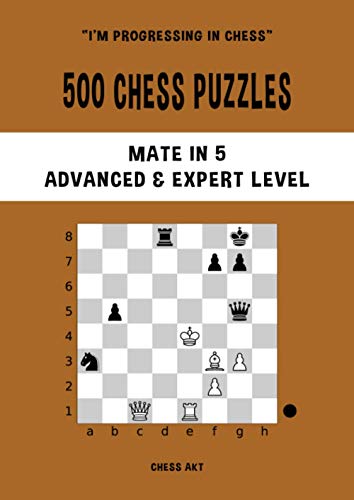
- 500 mate-in-five problems with solutions
- Progressive difficulty for structured practice
- Large-format diagrams and tactical themes
Best For: Amateur and advanced players focused on progressive checkmate training
Best for Challenging Variety and Quiet Moves
The Big Chess Puzzle Advent Calendar Book

- 192 puzzles in eight problem types
- Detailed solutions, hints, and difficulty ratings
- Targets players roughly rated 1600 to 2000
Best For: Advanced players seeking varied, explanation-rich tactical challenges
Best for Defensive Tactics from Real Games

- 100 puzzles from real-life games
- Focuses on avoiding tactical damage
- Designed for ratings 1500 to 1800
Best For: Club players building practical defensive awareness
Advanced Mate-in-Four Practice

- 500 progressive mate-in-four problems
- Solutions included for self-checking
- Large 8.27-by-11.69-inch format
Best For: Confirmed players seeking focused mate-in-four practice
Sacrifice Tactics Training

- 100 puzzles from real-life games
- Focused on tactical sacrifices
- Solutions follow each puzzle
Best For: Players rated about 1500–1800 developing sacrifice recognition
Opening Advantage Tactics

- 100 opening-focused tactical puzzles
- Emphasizes mate in three moves
- Real-game positions with solutions
Best For: 1500–1800 players training opening-stage tactical vision
Advanced Tactics Trainer – 1001 Chess Exercises for Advanced Club Players
For players specifically seeking chess puzzle books for advanced players, this updated collection focuses on the calculation and pattern-recognition skills needed beyond beginner tactics. FIDE Master Frank Erwich covers identifying weaknesses, recognizing combinations, visualizing tricks, and calculating effectively across 1,001 exercises.
Best For: Advanced club players who want structured tactical practice and a focused step up from general club-level exercises.
Pros:
- Contains 1,001 exercises aimed at advanced club players.
- Targets weak-spot recognition, combinations, visualization, and calculation.
- Updated 2024 edition from New in Chess.
- Offers a substantial 304 pages of practice material.
Cons:
- Its advanced focus may be demanding for beginners or casual players.
- The supplied description emphasizes tactics rather than broad opening or endgame instruction.
This is the most directly targeted choice for experienced club players who want a dedicated tactical workout rather than a general chess reference. Its clear advanced positioning and updated edition make it a strong fit for regular calculation practice.
Comprehensive Problem Archive – Chess: 5334 Problems, Combinations and Games
Among chess puzzle books for advanced players, this illustrated volume stands out for sheer breadth. It combines more than 5,000 instructional situations with checkmate problems, endgames, tournament combinations, and complete game-based examples, making it useful for players who want varied practice in one large reference.
Best For: Players who want an extensive, all-in-one puzzle collection covering multiple problem types and practical game situations.
Pros:
- Includes more than 5,000 problems, combinations, and games.
- Covers mates in one, two, and three, plus simple endgames and tournament combinations.
- More than 6,000 illustrations support visual study.
- Solutions are organized at the back for self-testing.
Cons:
- Its inclusion of basic rules and novice material may make it less focused for advanced-only study.
- At 1,104 pages and 2.7 pounds, it is a substantial book to handle.
- Published in 2013, so it is not a recent edition.
This is a strong volume for players who value quantity and variety over a tightly graded advanced curriculum. It can serve as a long-term puzzle library, though advanced solvers may need to select the more challenging sections.
Step-by-Step Tactics Practice – The Chess Puzzles & Tactics Blueprint
This newer option among chess puzzle books for advanced players offers more than 2,000 exercises organized by theme and difficulty. The supplied description highlights practical tactics from actual games, ranging from forks and pins to sacrifices, with a step-by-step structure intended to support improvement across different playing levels.
Best For: Players who prefer themed, progressively arranged tactical practice connected to real-game positions.
Pros:
- Provides more than 2,000 chess puzzles and tactical exercises.
- Organizes practice by theme and difficulty.
- Uses positions described as coming from actual games.
- Covers tactical ideas including forks, pins, and sacrifices.
Cons:
- The description presents it as suitable for every level, so it may not be exclusively advanced.
- The supplied notes do not specify the exact balance of difficulty or solution format.
- Its 2025 publication date means it has less established publication history than older titles.
This book is appealing if you want a modern, guided progression instead of an undifferentiated collection. Advanced players should find useful tactical themes, while the broad level range may also make it suitable for mixed-strength study.
Grandmaster-Level Challenge – The Ultimate Chess Puzzle Book
For advanced solvers comparing chess puzzle books for advanced players, John Emms’s collection offers a deliberately wide difficulty range. It progresses from 100 relatively easy positions to 100 extremely tough puzzles, includes themed selections and clue-free graded tests, and sometimes requires finding a positional move rather than a flashy combination.
Best For: Experienced players who want unfamiliar tactical positions, graded difficulty, and challenging tests without automatic theme clues.
Pros:
- Ranges from accessible exercises to extremely difficult puzzles.
- Includes tactical themes, graded tests, and positions requiring positional solutions.
- Puzzles were selected from games and checked for sound solutions with computer assistance.
- Written by Grandmaster John Emms, an experienced trainer and chess author.
Cons:
- Published in 2001, making it the oldest title in this selection.
- Its 240 pages provide fewer total positions than the larger collections.
- The toughest sections may be unsuitable for novices despite the easier opening section.
This is a particularly good fit for serious solvers who want to avoid predictable, familiar patterns. Its graded structure accommodates progression, while the hardest puzzles and no-clue tests provide a meaningful challenge for advanced players.
Best for Progressive Mate-in-Five Practice – 500 Chess Puzzles, Mate in 5
For players comparing chess puzzle books for advanced players, this large-format collection offers 500 progressive mate-in-five problems with solutions. It is designed for regular tactical practice, especially if you want a structured step up from shorter mating exercises.
Best For: Amateur and advanced players who want progressive checkmate training and a substantial problem set.
Pros:
- Includes 500 mate-in-five puzzles with solutions.
- Problems are arranged with progressive difficulty.
- Large 8.27-by-11.69-inch format provides room for diagrams.
- Focuses on tactical themes such as forks, pins, deflections, overloads, and sacrifices.
Cons:
- The 58-page softcover may provide a relatively compact presentation for 500 problems.
- Its narrow focus on mate in five may be less suitable for readers seeking varied tactical formats.
This is a straightforward drill book rather than a broad strategy guide. Choose it if you specifically want repeated, progressively harder mate-in-five practice and do not need extensive explanatory lessons.
Best for Challenging Variety and Quiet Moves – The Big Chess Puzzle Advent Calendar Book
Among chess puzzle books for advanced players, this collection stands out for its variety and emphasis on quiet key moves. Its 192 puzzles are organized into 24 daily chapters, with explanations, hints, difficulty ratings, and several forms of problem chess.
Best For: Players roughly rated 1600 to 2000 who enjoy demanding, varied puzzles and detailed explanations.
Pros:
- Offers 192 puzzles across eight formats, including mates, defensive puzzles, stalemate saves, selfmates, and helpmates.
- Solutions explain why the correct move works and how defenses fail.
- Includes 96 hints, large vector diagrams, and one-to-five-star difficulty ratings.
- Positions and variations were computer-verified according to the supplied description.
Cons:
- The Advent Calendar structure may feel less convenient than a conventional chapter-based puzzle book.
- Its stated target range may be demanding for players below approximately 1600.
This is the most varied option in the group and the strongest fit for readers who want to move beyond routine checks and captures. The daily format adds structure, while the explanations make it useful for studying failed attempts.
Best for Defensive Tactics from Real Games – 100 Defensive Chess Puzzles
If your search for chess puzzle books for advanced players centers on practical defense, this 100-puzzle collection focuses on finding the precise move that avoids mate, material loss, or another disadvantage. The positions come from real-life games and are aimed at players rated 1500 to 1800.
Best For: Club players who want focused defensive-tactics practice based on realistic game positions.
Pros:
- Contains 100 defensive puzzles taken from real games.
- Targets practical responses to threats, including avoiding mate and material loss.
- Solutions appear on the following page for straightforward checking.
- Part of a five-level series covering beginner through master-level tactics.
Cons:
- At 60 pages, it is a relatively short collection.
- The 5-by-8-inch format offers less diagram space than a large-format workbook.
- Its defensive focus may feel narrow for readers seeking broad tactical coverage.
This is a practical choice for players who often recognize attacking opportunities but miss the opponent’s threat. It provides concentrated defensive training without adding unrelated puzzle categories.
Advanced Mate-in-Four Practice – 500 Chess Puzzles, Mate in 4
For players comparing chess puzzle books for advanced players, this large-format workbook offers a focused set of 500 progressive mate-in-four problems. It is designed for regular tactical practice, with solutions included for checking your calculations.
Best For: Confirmed players who want a substantial, dedicated mate-in-four training book.
Pros:
- Includes 500 mate-in-four problems.
- Uses progressive difficulty to support continued practice.
- Solutions are included, with a spacious 8.27-by-11.69-inch format.
Cons:
- The 58-page booklet focuses specifically on mate-in-four positions.
- Its advanced difficulty may not suit beginners or players seeking broad strategic instruction.
This is a straightforward choice for advanced solvers who prefer volume and a single tactical theme. Consider it especially if you want a large-format practice routine rather than a general chess strategy guide.
Sacrifice Tactics Training – 100 “Sacrifice” Chess Puzzles
Among chess puzzle books for advanced players, this compact workbook concentrates on sacrifice tactics for players rated approximately 1500–1800. Its 100 puzzles come from real-life games and are intended to build recognition of combinations involving a temporary material investment.
Best For: Advanced club players who want to practice practical sacrifice decisions and tactical follow-through.
Pros:
- Focuses specifically on sacrifice-based tactics.
- Draws all 100 puzzles from real-life games.
- Solutions appear on the following page for convenient review.
Cons:
- The 60-page book covers a narrow tactical theme.
- The stated target range of 1500–1800 may not match every advanced player’s level.
This book makes sense when sacrifice puzzles are a particular weakness or training priority. Its real-game positions and immediate solutions support short, focused study sessions.
Opening Advantage Tactics – 100 “Opening” Chess Puzzles
This compact option among chess puzzle books for advanced players focuses on opening-stage tactics from real games. The 100 positions emphasize forcing checkmate in three moves, while also reinforcing patterns such as forks, skewers, decoys, and double attacks.
Best For: Players rated roughly 1500–1800 who want targeted practice spotting tactical mates from opening positions.
Pros:
- Contains 100 opening-focused tactical puzzles.
- Centers on checkmate in three moves.
- Uses real-life games and provides solutions on the following page.
Cons:
- The 60-page workbook concentrates on a specific opening-tactics theme.
- It may be less suitable for readers seeking opening theory or broad positional instruction.
Choose this workbook if you want to sharpen tactical alertness early in the game rather than study opening variations. The short format suits regular practice and quick solution checks.
How We Picked These Chess Puzzle Books for Advanced Players
We focused on books that offer meaningful tactical training rather than beginner-level pattern drills. The selection includes broad collections for varied practice, specialized puzzle books for specific weaknesses, and graded or rating-oriented material for players who want a clearer difficulty target.
We also considered puzzle volume, training focus, likely usefulness for independent study, and the variety of positions covered. Because solving preferences differ, the list includes both traditional collections and more structured formats, including mate-in-four and mate-in-five challenges.
Quick Comparison
| Training goal | Best format to consider | What it develops |
|---|---|---|
| Broad tactical improvement | Large mixed collections | Pattern recognition and calculation range |
| Sharper attacking play | Sacrifice and combination puzzles | Initiative, forcing moves, and evaluation |
| More reliable defense | Defensive puzzle collections | Threat detection and resource finding |
| Opening-related tactics | Opening puzzle books | Early tactical awareness and practical preparation |
| Deep mating calculation | Mate-in-four or mate-in-five books | Move-order accuracy and visualization |
Key Buying Factors
Difficulty and Player Rating
Check whether the book is aimed at advanced club players, expert-level solvers, or a stated rating range. A book that is too easy will provide recognition practice but limited calculation growth; one that is too difficult may slow progress and encourage guessing.
Scope of the Puzzle Collection
Large books provide variety and long-term value, while focused collections make it easier to target a weakness. Choose breadth if you want a general training library, or a specialized theme if your games repeatedly reveal the same problem.
Solution Quality and Training Format
Look for clear solutions that explain the key idea, not only the correct move. Decide whether you prefer quick daily exercises, serious calculation sessions, themed chapters, or a high-volume reference book you can revisit over time.
Practical Relevance
Mate problems can improve visualization and forcing-move calculation, but practical game improvement also requires defensive puzzles, opening tactics, and positions involving several candidate moves. A balanced training plan may benefit from more than one format.
Who Should Buy Which Chess Puzzle Books for Advanced Players?
Choose a broad problems-and-games collection if you want one substantial book for varied tactical practice. Players who often miss attacking chances should consider sacrifice, combination, or “killer move” material. If your losses commonly come from overlooking an opponent’s threat, a defensive collection is likely the more targeted choice.
Opening-focused puzzles suit players who want to reinforce tactical ideas in familiar early-game structures. Mate-in-four and mate-in-five books are better for solvers who enjoy deliberate, calculation-heavy challenges rather than rapid pattern drills. For a daily routine, a calendar-style collection can add structure and keep sessions short.
Whichever book you choose, solve positions without moving pieces or checking the answer too soon. Record your candidate moves, calculate variations, and review the explanation afterward. That process turns a puzzle collection into a repeatable training system instead of a book you simply browse.