Learning vocabulary is easier when each word comes with a clear visual cue and a pronunciation reference. The best language flash cards with pronunciation guides make short study sessions more consistent, whether you are learning Japanese, Spanish, Arabic, Korean, Russian, French, or English.
This roundup compares ten options by language, audience, card volume, audio or written pronunciation support, and study flexibility so you can choose a set that fits your goals.
Best 10 Language Flash Cards with Pronunciation Guides Picks for 2026
Travel-Ready Japanese
Japanese Flash Cards for Adults & Beginners

- Phonetic pronunciation on every word and sentence
- Practical travel vocabulary in sentence context
- Compact 60-card set with script guide
Best For: Japanese beginners and travelers who want pronunciation support
Illustrated Spanish Starter
eeBoo Spanish Vocabulary Flashcards

- Illustrated cards introduce basic Spanish words
- Bilingual sentences and pronunciation guidance included
- Designed for screen-free family or classroom practice
Best For: Young beginners learning foundational Spanish vocabulary
Audio Arabic Alphabet
Arabic Alphabet Flash Cards with Audio

- Native pronunciation available by QR code
- Covers four positional letter forms
- Durable laminated cards with chart and examples
Best For: Teen and adult beginners building Arabic alphabet skills
Comprehensive Spanish Practice
500+ Spanish Vocabulary Flash Cards

- 500+ cards cover verbs, nouns, adjectives, and phrases
- Pronunciation, gender, conjugation, and examples included
- Workbook, ebook, grammar sheets, and keychain rings
Best For: Serious Spanish beginners and students wanting broad coverage
Best Audio-Supported Pick

- 40 illustrated Hangul cards with stroke order and examples
- QR-code access to native Korean audio
- Glossy, water-resistant cards with storage box
Best For: Teens and adults starting Korean and learning Hangul
Best for Everyday Bilingual Practice
English/Spanish Everyday Words

- 56 double-sided cards for everyday vocabulary
- Includes Spanish pronunciation and activity suggestions
- Hole-punched cards and blank cards support organization
Best For: Children, families, and elementary classrooms
Best for Contextual Russian Vocabulary
Russian Flash Cards for Beginners
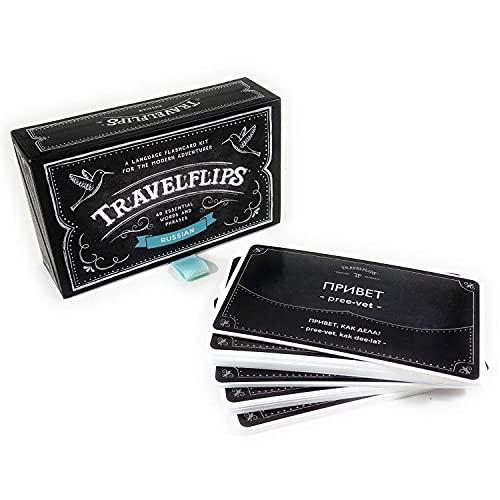
- 60 cards with words, sentences, translations, and phonetics
- Includes Cyrillic alphabet and reading guide
- Compact box supports travel-friendly study
Best For: Adults and beginners preparing for Russian conversation or travel
Best for Broad Spanish Vocabulary
Spanish Vocabulary Flash Cards

- 600 English-to-Spanish cards in 28 categories
- Example sentences and pronunciation guides
- Laminated, water-resistant cards with large type
Best For: Comprehensive Spanish study at home or in class
Best for French Travel Practice
French Flash Cards for Adults & Beginners

- 60 compact cards for everyday travel situations
- Sample sentences, translations, and phonetics
- Portable box with five included proverbs
Best For: Beginners and travelers preparing for France
Best for Russian-Speaking ESL Learners

- 300 English words across 15 everyday topics
- Russian translations, pictures, and phonetic pronunciation
- Useful for drills, games, tutoring, or solo study
Best For: Russian-speaking adults learning English vocabulary
Travel-Ready Japanese – Japanese Flash Cards for Adults & Beginners
For travelers and beginners seeking language flash cards with pronunciation guides, this 60-card Japanese set combines practical vocabulary with phonetic support. Each card adds a sample sentence, helping you study useful phrases for travel even before you can read Japanese scripts.
Best For: Adults, beginners, travelers to Japan, and students starting Japanese.
Pros:
- Includes phonetic pronunciation for every word and sample sentence.
- Teaches words in context with English translations and example sentences.
- Covers practical travel topics such as greetings, food, and directions.
- Compact box is easy to pack and includes a kanji, hiragana, and katakana guide.
Cons:
- The 60-card set focuses on travel vocabulary rather than broad language coverage.
- Its kid age-range listing may not reflect the adult-focused title and travel use case.
This is a focused, portable choice for building confidence with spoken Japanese and travel essentials. Choose it when pronunciation and immediate usability matter more than a large vocabulary inventory.
Illustrated Spanish Starter – eeBoo Spanish Vocabulary Flashcards
These illustrated language flash cards with pronunciation guides give children a visual, screen-free introduction to Spanish. The 56-card set pairs vocabulary with artwork, English and Spanish sentences, and included directions and pronunciation guidance.
Best For: Children ages 5 and up, families, and elementary classroom or group practice.
Pros:
- Uses illustrations to make basic Spanish vocabulary approachable.
- Cards include words and sentences in both English and Spanish.
- Supports vocabulary, word recognition, focus, and screen-free learning.
- Sturdy travel box and FSC-certified recycled materials with vegetable-based ink.
Cons:
- It focuses on introductory vocabulary rather than advanced Spanish.
- The product information lists both 56 total cards and 48 illustrated word cards.
With colorful artwork and simple bilingual examples, this set is well suited to early learners and shared practice. It is a better fit for foundational vocabulary than for adults seeking extensive grammar or conversation drills.
Audio Arabic Alphabet – Arabic Alphabet Flash Cards with Audio
For learners who need language flash cards with pronunciation guides, this Arabic alphabet set adds native audio through QR-code access. Its 40 cards cover letter forms, transliteration, and examples while supporting early reading, writing, and pronunciation practice.
Best For: Teen and adult beginners, students, tutors, and independent Arabic learners.
Pros:
- QR-code audio provides native pronunciation for each letter.
- Shows isolated, initial, medial, and final Arabic letter forms.
- Includes English transliteration, examples, alphabet chart, and instruction guide.
- 350 GSM laminated cardstock is water-resistant and designed for repeated handling.
Cons:
- The set concentrates on the alphabet rather than extensive vocabulary.
- Audio access requires scanning the included QR code.
This is a structured option for mastering Arabic letter recognition alongside pronunciation and writing foundations. Its durable construction and audio component make it especially useful for regular drills, tutoring, and formal study.
Comprehensive Spanish Practice – 500+ Spanish Vocabulary Flash Cards
This large Spanish set is designed for serious learners who want language flash cards with pronunciation guides and broad vocabulary coverage. More than 500 cards span verbs, nouns, adjectives, phrases, and practice materials, with example sentences and beginner-friendly reference support.
Best For: Older teens, adults, students, and travelers seeking a structured Spanish vocabulary system.
Pros:
- Includes 500+ cards covering regular, irregular, and reflexive verbs plus everyday vocabulary.
- Provides pronunciation guides, gender indicators, conjugations, and example sentences.
- Includes practice cards, an ebook, grammar rule sheets, and a printable workbook.
- Portable keychain rings support organized study on the go.
Cons:
- The large set may feel less convenient than a small travel-focused deck.
- Its extensive grammar and verb coverage may be more than casual beginners need.
This is the most comprehensive option in the roundup for learners who want a substantial, organized Spanish study resource. It offers more progression and reference material than a basic vocabulary-only deck, particularly for motivated students.
Best Audio-Supported Pick – Korean Alphabet Flash Cards
For learners seeking language flash cards with pronunciation guides, this Korean set combines visual Hangul practice with scannable native-speaker audio. Its 40 illustrated cards cover each letter with stroke order, pronunciation, and example words, making it a practical starting point for independent study or classroom use.
Best For: Teens and adults beginning Korean, especially learners who want Hangul writing guidance reinforced by audio.
Pros:
- Includes pronunciation, stroke order, and example words for every letter.
- QR codes provide native Korean audio for pronunciation practice.
- Water-resistant laminated cards have rounded edges and large fonts.
- Comes with 40 cards, an alphabet chart, instructions, and a storage box.
Cons:
- Focuses on the Korean alphabet rather than broad vocabulary.
- Audio access requires scanning the included QR codes.
This is a focused choice for building a Korean reading and pronunciation foundation. The combination of handwriting support, visual examples, and audio makes it especially useful for consistent beginner practice.
Best for Everyday Bilingual Practice – English/Spanish Everyday Words
These language flash cards with pronunciation guides are designed for practical English/Spanish vocabulary building. The 56 double-sided cards feature everyday words, correct Spanish pronunciation, colorful visuals, and activities suitable for individual, small-group, or classroom learning.
Best For: Children ages five and up, parents, teachers, and learners who want everyday English and Spanish vocabulary practice.
Pros:
- Covers useful everyday words in both English and Spanish.
- Includes Spanish pronunciation support, teacher tips, and suggested activities.
- Blank cards allow personalization.
- Corner holes support organization with a ring or string.
Cons:
- Cards are paper rather than laminated material.
- The set contains vocabulary cards but does not include audio access.
With its classroom-friendly instructions, full-color format, and storage features, this set suits structured vocabulary practice. It is a flexible option for families and elementary learning environments, though learners seeking audio pronunciation will need another resource.
Best for Contextual Russian Vocabulary – Russian Flash Cards for Beginners
For adults comparing language flash cards with pronunciation guides, this Russian set pairs practical vocabulary with phonetic support and context. Each of the 60 cards presents a Russian word and sample sentence, followed by English translations and pronunciation, while a guide card helps learners read Cyrillic.
Best For: Adults and learners ages 12 and up who want useful Russian phrases for travel, conversation, and beginner study.
Pros:
- Provides phonetic pronunciation for words and sample sentences.
- Teaches vocabulary in context rather than isolated word lists.
- Includes a Cyrillic alphabet and reading guide.
- Compact box is convenient for luggage, backpacks, and carry-ons.
Cons:
- Paper cards may be less durable than laminated alternatives.
- Focuses on basic Russian vocabulary and situations, not comprehensive grammar.
This set is a strong fit for beginners who want immediately useful Russian and a clear bridge into Cyrillic reading. Its travel-sized format also makes short review sessions easy while commuting or preparing for a trip.
Best for Broad Spanish Vocabulary – Spanish Vocabulary Flash Cards
For shoppers seeking language flash cards with pronunciation guides, the Briston set offers 600 English-to-Spanish cards covering 28 everyday categories. Example sentences, bilingual practice, color coding, and large type make it a versatile option for beginner through advanced learners, whether studying at home, in class, or while traveling.
Best For: Kids, teens, and adults building broad Spanish vocabulary through classroom, homeschool, travel, or independent study.
Pros:
- Includes 600 cards across 28 categories, including foods, action verbs, and everyday objects.
- Provides example sentences plus English and Spanish pronunciation support.
- Glossy laminated 350 GSM cardstock is water-resistant, with curved edges and large fonts.
- Color-coded cards support visual recognition and memorization.
Cons:
- The manufacturer lists a recommended age of 15 years and up, despite notes mentioning younger learners.
- The large 600-card set may be less convenient for travelers than a compact deck.
Choose this set if you want extensive Spanish coverage and durable cards rather than a small travel-focused pack. Its pronunciation guides and sentence-based practice add useful speaking support to standard vocabulary drills.
Best for French Travel Practice – French Flash Cards for Adults & Beginners
These language flash cards with pronunciation guides focus on practical French for travel. Each of the 60 cards combines a French word, a short sample sentence, English translations, and phonetic pronunciation, making the compact boxed set useful for preparing for cafés, trains, shops, and restaurants.
Best For: Adults, beginners, students, and travelers who want a portable French review tool for trips to France.
Pros:
- Uses travel-focused vocabulary for greetings, food orders, directions, and everyday situations.
- Shows words in sample sentences with English translations and phonetic pronunciation.
- Compact 60-card box fits easily in luggage, a backpack, or a carry-on.
- Includes five proverbs and is positioned as a practical travel gift.
Cons:
- At 60 cards, it covers fewer words than the larger vocabulary sets in this roundup.
- The focus on travel situations may be less suitable for learners seeking broad, systematic French study.
This is a strong pick when portability and real-world travel phrases matter most. The contextual sentences and phonetic guides make it easier to rehearse useful French before and during a trip, though serious vocabulary builders may want a larger set.
Best for Russian-Speaking ESL Learners – Russian-English Picture Cards
For Russian speakers learning English, this set combines picture-based vocabulary with pronunciation guides and Russian translations. The 300 cards cover 15 everyday topics, giving learners a flexible tool for drills, memory games, tutoring, homeschool routines, and independent English study.
Best For: Russian-speaking adults and ESL learners who benefit from visual associations, phonetic support, and Russian-English explanations.
Pros:
- Includes 300 English vocabulary cards organized across 15 practical topics.
- Each card combines an image, English word, phonetic pronunciation, topic label, and Russian translation.
- Supports solo practice, tutoring, pronunciation drills, memory games, and quick reviews.
- Compact card dimensions make the set easy to store and carry.
Cons:
- The cards are made from paper and cardboard rather than laminated cardstock.
- The set is specifically designed for Russian speakers, limiting its usefulness for other language backgrounds.
- It is listed for adults and ages 15 years and up.
This set is especially practical for Russian-speaking ESL learners who want translation and visual context on every card. It offers broad everyday coverage and flexible study options, although users seeking more durable cards may prefer a laminated alternative.
How We Picked the Best Language Flash Cards with Pronunciation Guides
We focused on sets that combine practical vocabulary with pronunciation help rather than relying on word-only cards. The selections cover several languages and learning needs, including adult beginners, children, families, English-language learners, and students focusing on alphabets or everyday phrases.
We also considered the number of cards, whether cards include pictures or sentences, age guidance, and the type of pronunciation support provided. Audio-enabled cards may be useful for learners who need to hear sounds, while printed pronunciation guides are convenient for portable, screen-free review.
Quick Comparison
- Best for broad Spanish vocabulary: Large Spanish sets with hundreds of words or sentences.
- Best for young learners: Age-labeled Spanish and everyday English/Spanish cards with accessible visuals.
- Best for alphabet foundations: Arabic and Korean sets that pair letters with pronunciation support.
- Best for adult beginners: Japanese, Russian, and French vocabulary cards designed for independent study.
- Best for Russian-speaking English learners: Bilingual English/Russian picture cards with pronunciation guidance.
Key Buying Factors for Language Flash Cards with Pronunciation Guides
Language and Learning Level
Choose cards that match your target language and current ability. Alphabet sets are appropriate for learners starting with a new writing system, while vocabulary and sentence cards are better for building usable communication skills.
Pronunciation Format
Check whether pronunciation is written with phonetic spellings, includes an audio component, or uses both. Audio can help with rhythm and unfamiliar sounds, but printed guides are easier to use anywhere and do not require batteries or a device.
Vocabulary Size and Organization
A 300- to 600-word set offers breadth, but a smaller deck may be easier to finish and review regularly. Look for categories such as food, travel, family, verbs, and everyday objects if you want structured practice.
Age, Format, and Durability
Picture-heavy cards with simple words suit children, while adult learners may prefer translations, example sentences, or more advanced vocabulary. For frequent handling, consider sturdy cards, readable type, and a manageable box or storage system.
Who Should Buy Which Language Flash Cards with Pronunciation Guides?
Adults beginning Japanese, French, or Russian can benefit from dedicated vocabulary decks with pronunciation support. Learners starting Arabic or Korean should consider alphabet cards with audio or pronunciation guidance before moving into larger vocabulary sets. Families and younger students may prefer colorful Spanish or bilingual everyday-word cards with clear age recommendations. Those studying Spanish more intensively should look at high-count decks or sets that add sentences. Russian speakers learning English may get the most value from a bilingual picture-card set tailored to their native language.