The best language flash cards make vocabulary practice more active, repeatable, and easier to fit into a busy routine. This roundup includes options for Spanish, Japanese, American Sign Language, world geography, early learning, and speech support.
Use the guide below to match card format, language coverage, audio features, and learner age with your specific goals.
Best 10 Language Flash Cards Picks for 2026
Sign & Communicate

- 105 cards covering 122 ASL signs
- Illustration-and-word format
- Includes alphabet, numbers, and everyday topics
Best For: Young children beginning American Sign Language
World Explorer

- Covers 264 countries and territories
- Lists capitals, languages, and continents
- Laminated cardstock for repeated study
Best For: Geography and global-language study for older learners
Everyday Spanish

- 100 cards for vocabulary and daily phrases
- English, Spanish, pronunciation, and illustrations
- Portable box for home, class, or travel
Best For: Beginner Spanish conversation practice
Action Builders

- 50 double-sided verb cards
- Large text and action illustrations
- Supports acting, sentences, and stories
Best For: Visual and active verb-vocabulary practice
Audio-Enhanced Japanese Practice

- 75 practical phrases for beginners
- QR codes provide native audio recordings
- Durable, portable laminated design
Best For: Teen and adult beginners learning Japanese for travel or conversation
Large-Deck Spanish Vocabulary

- Contains 1,000 color-coded vocabulary cards
- Covers travel and everyday subject areas
- Supports active recall and sorted review
Best For: Spanish learners seeking extensive physical vocabulary practice
Early Language Development

- Includes 160 photographic vocabulary cards
- Supports expressive and receptive language skills
- Features bilingual Spanish text and activity ideas
Best For: Toddlers, preschoolers, and special learners ages 3 to 6
Best Bilingual Pick
Airbition Spanish-English Talking Cards

- 510 Spanish-English vocabulary words
- Clear voice with American accent
- Reader supports independent toddler practice
Best For: Toddlers starting bilingual vocabulary
Best Sign Language Set

- 56 double-sided sign language cards
- Suitable for home or classroom use
- Includes activity suggestions and blank cards
Best For: Children ages four and up learning sign language
Best Foundational Set
Torlam Toddler Learning Flashcards
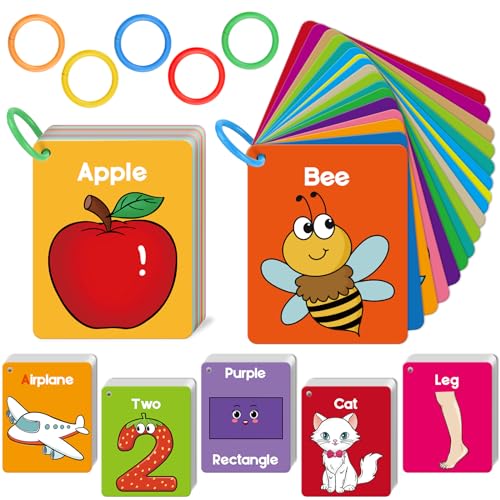
- 60 double-sided cards across core topics
- Includes five organizing rings
- Large rounded cards for little hands
Best For: Preschool vocabulary and kindergarten readiness
Sign & Communicate – ASL Flash Cards
For families or educators looking for language flash cards that introduce American Sign Language, this set combines colorful illustrations with corresponding words. It covers 122 signs across everyday categories, including letters, numbers, animals, food, people, feelings, and sight words.
Best For: Preschoolers, kindergarteners, and older children practicing introductory ASL with an adult, teacher, or caregiver.
Pros:
- Includes 105 cards covering 122 ASL signs.
- Double-sided format pairs signing illustrations with related words.
- Covers alphabet letters, numbers 1–20, animals, people, feelings, food, and more.
- Rounded corners make cards easier to sort and flip.
Cons:
- Designed primarily for introductory practice rather than advanced ASL instruction.
- The set is intended for shared practice, so younger learners may benefit from adult guidance.
This is a practical pick for building early signing and communication skills through hands-on practice, especially when an adult works through the cards alongside the child.
World Explorer – Country Flags Flashcards
These language flash cards take a geography-first approach, pairing flags with country names, capitals, languages, continents, and regions. With coverage of 264 countries and territories, they offer a broad visual reference for learners interested in global cultures and language facts.
Best For: Students, adults, classrooms, and families studying world geography, country languages, and flags.
Pros:
- Features 264 world flags and related country information.
- Includes capitals, languages, continents, and regions.
- Can be used for games, quizzes, classroom activities, or independent study.
- Premium cardstock and gloss lamination are designed for regular use.
Cons:
- Recommended for ages 12 and up, so it may not suit very young learners.
- The primary focus is geography and reference knowledge rather than conversational language practice.
Choose this set when you want language-related facts embedded in a comprehensive geography resource. Its extensive country coverage makes it particularly useful for quizzes and world studies.
Everyday Spanish – Conversational Phrase Cards
For beginners seeking language flash cards with immediate practical value, this Spanish set combines 50 vocabulary cards with 50 daily-language cards. Each card uses English on one side and Spanish, pronunciation, and a cartoon illustration on the other to support quick review.
Best For: Beginner Spanish learners, travelers, homeschoolers, classroom practice, and bilingual study on the go.
Pros:
- Includes 100 cards split between vocabulary and daily-language content.
- Provides English, Spanish, pronunciation, and illustrations.
- Rounded, wipeable cards are compact and portable.
- Useful for self-quizzing, pair work, games, and travel practice.
Cons:
- The set focuses on foundational vocabulary and phrases rather than a complete Spanish course.
- Small cards may provide less room for detailed explanations.
This is a convenient starter set for learners who want useful Spanish expressions in a portable format. The bilingual layout and pronunciation support make it accessible for early independent or guided practice.
Action Builders – Verb Picture Cards
These language flash cards focus on 50 common action words and reinforce meaning through a double-sided word-and-picture format. Their large size and activity-based design support vocabulary practice through matching, acting, sentence building, and short-story exercises.
Best For: Children, ESL learners, speech-therapy activities, homeschooling, and educators supporting autism or dementia-related language practice.
Pros:
- Includes 50 double-sided verb flash cards.
- Pairs readable text with vibrant illustrations of each action.
- Large 4-by-5.8-inch cards are easy to see and handle.
- Supports acting out verbs, matching, sentence creation, and storytelling.
Cons:
- Its scope is limited to action words rather than broad vocabulary categories.
- Some activities may work best with teacher, caregiver, or therapist guidance.
This set is a strong choice when active participation matters more than memorizing definitions. Acting out verbs and building sentences can make language practice more engaging for children and supported-learning settings.
Audio-Enhanced Japanese Practice – Japanese Conversation Cards
For beginners who want more than vocabulary drilling, these language flash cards focus on practical Japanese conversation. The 75-card set combines written support with native-speaker audio access for pronunciation and listening practice.
Best For: Teen and adult beginners studying Japanese for travel, school, or everyday conversation.
Pros:
- Covers useful phrases for greetings, travel, hobbies, and class.
- Includes Hiragana, Katakana, English translations, pronunciations, and QR-linked audio.
- Laminated, water-resistant cards are compact and portable.
- Includes a storage box and user guide.
Cons:
- The set contains 75 cards, so it is more focused than comprehensive.
- Designed primarily for beginners rather than advanced learners.
This is a practical choice if accurate pronunciation and real-world phrases matter more to you than a large card count. Its durable format also works well for classroom, home, or travel use.
Large-Deck Spanish Vocabulary – 1000 Spanish Flash Cards
Choose this language flash cards set if you want broad Spanish vocabulary coverage in a traditional, tactile format. Its 1,000 color-coded cards organize words by practical categories, making it suitable for structured review and active recall.
Best For: Spanish learners in high school, college, travel study, or app-based learning who want a large physical vocabulary deck.
Pros:
- Includes 1,000 cards across everyday topics such as food, travel, directions, family, and weather.
- Color coding groups vocabulary by subject area.
- Supports active recall, sorting difficult words, and repeat practice.
- Useful for individual study or practice with a partner.
Cons:
- The cards are supplied as a large, relatively heavy 2.03-pound deck.
- The supplied description does not indicate audio or pronunciation recordings.
- Its extensive vocabulary may feel less manageable for absolute beginners.
With twice the card count of many standard decks, this QuickStudy reference tool is built for breadth. It is a strong fit for learners who prefer physical review and want vocabulary organized into recognizable subject areas.
Early Language Development – Toddler Speech Therapy Cards
These language flash cards are designed for early learners rather than adult language study. The set uses 160 photographic vocabulary cards, guided questions, and bilingual Spanish text to support vocabulary, expressive language, and receptive language skills.
Best For: Toddlers, preschoolers, kindergarten learners, and special learners practicing basic vocabulary or speech skills.
Pros:
- Includes 160 photographic cards covering food, colors, animals, transportation, emotions, actions, and school activities.
- Provides bilingual Spanish text for added language support.
- Includes a resource guide with vocabulary lists and game ideas.
- Can be used at home, in classrooms, or during speech therapy activities.
Cons:
- Recommended for ages 3 to 6, so it is not intended for older or advanced learners.
- The paper card material may be less durable than laminated alternatives.
- The cards are relatively large, which may be less convenient for travel.
This set is a useful educational aid for building foundational communication through guided play. Its photos, prompts, and bilingual elements make it especially adaptable for preschool instruction and speech-support activities.
Best Bilingual Pick – Airbition Spanish-English Talking Cards
For parents seeking interactive language flash cards, the Airbition set combines Spanish and English audio with 510 vocabulary words across everyday themes. Its card reader is designed for young children and supports independent practice.
Best For: Toddlers and preschoolers beginning Spanish-English vocabulary development.
Pros:
- Provides bilingual Spanish and English learning in one set.
- Includes themes such as numbers, colors, animals, foods, transportation, and shapes.
- Uses a clear American-accented voice and simple card insertion for independent use.
Cons:
- Audio functionality requires the included card reader rather than cards alone.
- The recommended age range is geared toward young children, limiting its usefulness for older learners.
This is the strongest choice when spoken pronunciation and early bilingual exposure matter more than traditional, screen-free card practice.
Best Sign Language Set – Sign Language Flash Cards
These language flash cards focus specifically on sign language for children ages four and up. The double-sided, full-color cards are suitable for home, group, or classroom instruction and include activities for guided practice.
Best For: Families and elementary classrooms introducing sign language through structured activities.
Pros:
- Includes 56 double-sided cards with letters, common words, and questions.
- Works for individual, group, and classroom learning.
- Storage holes, a distinct corner shape, teacher tips, and suggested activities improve organization and use.
Cons:
- Paper cards may be less durable than plastic or cardboard alternatives.
- The set is focused on sign language rather than broad early-vocabulary topics.
Choose this pack if you want a classroom-friendly sign language resource with built-in activity guidance and easy ring or string storage.
Best Foundational Set – Torlam Toddler Learning Flashcards
The Torlam set offers broad early-learning coverage for families comparing language flash cards for preschool preparation. Sixty double-sided cards introduce first words alongside letters, numbers, colors, shapes, animals, foods, and body parts.
Best For: Toddlers and preschoolers building vocabulary, recognition, and kindergarten-readiness skills.
Pros:
- Covers multiple foundational topics, including alphabet, counting from 1 to 10, and first words.
- Large 4-by-5-inch cards have rounded edges for easier handling by young children.
- Five colored rings help organize cards by category and support portable storage.
Cons:
- Does not provide audio or bilingual instruction.
- The set is recommended for children ages three and up, rather than younger toddlers.
This is a practical all-purpose option for parents, homeschoolers, and classrooms that want one organized deck covering several early-learning skills.
How We Picked the Best Language Flash Cards
We evaluated these Language Flash Cards by looking at the learning goal each set supports, the amount and organization of its content, and how easily it can be used at home, in a classroom, during travel, or in therapy. We also considered whether cards rely on illustrations, written words, audio prompts, bilingual translations, sign demonstrations, or conversational phrases.
Because learners differ widely, this list includes focused vocabulary tools alongside broader early-learning and communication aids. A compact phrase deck may be more useful for a traveler, while a large reference set may better suit sustained study.
Quick Comparison
| Best for | Look for | Featured options |
|---|---|---|
| Travel conversation | Useful phrases and beginner-friendly translations | Spanish and Japanese phrase cards |
| Building vocabulary | Large word count and clear categories | Spanish vocabulary and bilingual talking cards |
| ASL practice | Visual demonstrations, labels, and associations | ASL and sign-language decks |
| Children and speech support | Simple images, durable cards, and repetition | Early-learning, verb, and toddler sets |
| Geography learning | Country, capital, language, and flag facts | World country flag flashcards |
Key Buying Factors for Language Flash Cards
Learning Objective and Vocabulary Scope
Choose cards that match the skill you want to practice. Phrase-based decks are practical for trips and speaking drills, while vocabulary sets support broader word recognition. Verb cards can help learners connect pictures and actions, and sign-language decks require especially clear visual instruction.
Format and Learning Aids
Illustrations can help children and visual learners connect meaning with a word. Bilingual printing is useful for translation practice, while audio-enabled cards may reinforce pronunciation and listening. Check whether audio requires batteries, a separate device, or an app before buying.
Age, Difficulty, and Usability
Review the recommended age and reading level. Toddlers need large, simple images and first words; beginners may benefit from common phrases; advanced learners often need more extensive vocabulary. Rounded corners, sturdy stock, and easy-to-sort categories matter when cards will be handled frequently.
Portability and Repetition
A smaller deck is convenient for travel and short daily sessions. Larger sets provide more coverage but may be harder to organize. For better retention, choose cards you can review repeatedly and combine them with speaking, writing, or spaced-practice routines.
Who Should Buy Which Language Flash Cards?
Travelers should prioritize conversational Spanish or Japanese cards with practical phrases. Learners building a Spanish vocabulary base may prefer a larger reference-style deck. Families and teachers introducing ASL should choose sign-focused cards with clear demonstrations and word associations.
For young children, speech practice, or learners who respond best to visual prompts, early-learning, action-verb, toddler, and talking bilingual sets offer accessible starting points. Geography students can use flag cards to connect countries with capitals, languages, and continents. The best choice is the set that fits the learner’s age, target language, preferred sensory format, and available practice time.