Hands-on phonics practice can make letter sounds, blending, and spelling easier for young learners to understand. Kits with magnetic tiles give children a simple way to build, change, and read words without relying only on worksheets.
We compared 10 phonics learning kits with letter tiles, focusing on tile variety, included boards and accessories, storage, durability, and suitability for different learning settings.
Best 10 Phonics Learning Kits with Letter Tiles Picks for 2026
Best All-in-One Set
265-Piece Phonics Magnetic Letter Tiles

- 249 phonics tiles plus 16 blanks
- Reusable dry-erase word-building board
- Color-coded and stored in a case
Best For: Homeschool, preschool, and classroom word practice
Best for Group Practice

- 234 foam uppercase and lowercase letters
- Double-sided magnetic writing board
- Color-coded vowels and consonants
Best For: Small groups and guided CVC or CCVC practice
Best Game-Based Option
Snap It Up! Phonics Word Families

- Fast-paced phonics card game
- Practices word families and vowel sounds
- Recommended for ages 6–10
Best For: Engaging reading practice at home or in small groups
Best Compact Manipulatives

- 108 grapheme tiles plus blanks and discs
- Color-coded vowels, consonants, and blends
- Four storage bags for organization
Best For: Ages 4–8 and focused individual or small-group practice
Best All-in-One Kit

- 90 color-coded tiles plus 16 phoneme frames
- Built-in magnetic write-and-wipe board
- Covers blending, segmenting, and early spelling
Best For: Ages 5+ and guided phonics practice
Best for Classroom Multipacks

- Six sets of 97 foam tiles
- 582 pieces with reusable storage pouches
- Includes tiles for digraphs and high-frequency words
Best For: Small groups, classrooms, and literacy centers
Best for Small-Group Word Work

- Six trays with 672 magnetic pieces
- Includes 30 double-sided dry-erase mats
- Blank tiles enable open-ended word building
Best For: Tutoring, literacy centers, and small groups
Classroom Multipack
JoyCat 3-Set Magnetic Letter Tile Kit

- Three complete sets for group learning
- Folders, markers, and storage cases included
- 339 phonics tiles plus 75 blank tiles
Best For: Preschool classrooms, literacy centers, and multiple children
All-in-One Practice Kit
Magnetic Phonics Word-Building Game Set

- 108 color-coded magnetic phonics tiles
- Double-sided mats and built-in boards
- Portable storage box and bag included
Best For: Structured preschool and kindergarten phonics practice
Focused Literacy Practice
Phonics Magnetic Letter Tiles with Folder
- 132 tiles for consonants, vowels, and diphthongs
- Dry-erase folder guides sound-to-word practice
- Suitable for ages 4–7 and varied learning settings
Best For: Individual early literacy, homeschool, and intervention practice
Best All-in-One Set – 265-Piece Phonics Magnetic Letter Tiles
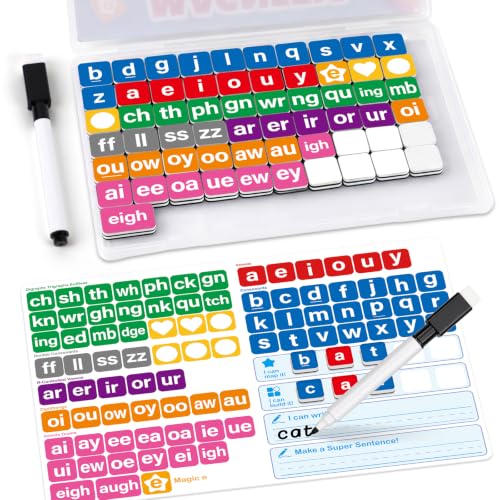
This 265-piece set is a strong all-in-one option among phonics learning kits with letter tiles. It combines color-coded phonics tiles, blank tiles, a reusable dry-erase board, markers, and a storage case for word building, spelling, and sentence practice.
Best For: Homeschooling, preschool, and classroom activities that need flexible word and sentence practice.
Pros:
- Includes 249 phonics tiles plus 16 blank tiles for varied word-building activities.
- Reusable dry-erase board supports both tile work and writing practice.
- Color coding helps distinguish vowels, consonants, and special sounds.
- Storage case and magnetic backing help keep the set organized and tiles in place.
Cons:
- The 265-piece collection may require more storage space than a smaller starter set.
- The supplied notes do not specify the included marker count or board dimensions.
Choose this kit if you want one organized package that can support phonics, spelling, and sentence-building practice across home or classroom settings.
Best for Group Practice – Gamenote Magnetic Letters Kit
The Gamenote kit is a practical choice among phonics learning kits with letter tiles for common words, CVC patterns, and CCVC practice. Its foam letters, double-sided magnetic board, markers, and coded storage box make it suitable for guided activities at home or in small groups.
Best For: Children ages 4–12, small-group lessons, and portable home or classroom practice with adult guidance for younger children.
Pros:
- Includes 234 letters with 182 lowercase and 52 uppercase pieces.
- Double-sided board works for both magnetic tiles and reusable writing or drawing.
- Red vowels and blue consonants provide a simple visual distinction.
- Soft EVA foam pieces have full-cover magnets and are washable.
Cons:
- The listing details vary between 238 pieces in the title and 235 pieces in the product details.
- Younger toddlers should use the set with parents.
This is a well-rounded option when you value uppercase and lowercase coverage, a writing surface, and easy handling for structured phonics lessons.
Best Game-Based Option – Snap It Up! Phonics Word Families
Unlike tile-focused phonics learning kits with letter tiles, Snap It Up! uses fast-paced card play to reinforce word families, vowel sounds, spelling, and decoding. It gives children a game-based way to practice reading skills in classrooms, homeschool settings, or family activities.
Best For: Children ages 6–10 who benefit from interactive word-family and phonics practice.
Pros:
- Turns phonics practice into an engaging card game.
- Reinforces word families, vowel sounds, spelling, and decoding.
- Can be adapted for different ages and reading levels.
- Designed for classroom, homeschool, and family game-night use.
Cons:
- It is a card game rather than a magnetic letter-tile or word-building board set.
- The manufacturer recommends ages 6–10, so it may be less suitable for preschool beginners.
Consider this set when motivation and repeated game play matter more than having physical tiles for hands-on sentence construction.
Best Compact Manipulatives – Phonics Magnetic Letter Tiles
This compact set is a focused option among phonics learning kits with letter tiles, offering grapheme tiles, blanks, discs, storage bags, and color coding for phonics exploration. The EVA foam pieces are designed for word building, blending, segmenting, and sentence work with magnetic surfaces.
Best For: Children ages 4–8, individual practice, small-group activities, and organized home or kindergarten lessons.
Pros:
- Includes 108 grapheme tiles, six blank tiles, and eight discs for flexible activities.
- Color coding covers consonants, vowels, digraphs, and trigraphs.
- High-density EVA foam with rounded edges is easy for small hands to grip.
- Four storage bags help separate and organize the pieces.
Cons:
- The set has fewer pieces than larger 200-plus-piece letter collections.
- The supplied notes do not mention an included writing board or markers.
This kit makes sense for buyers who want targeted grapheme practice, flexible blank tiles, and straightforward storage without the bulk of a larger classroom collection.
Best All-in-One Kit – Rainbow Phonics Tiles
For shoppers comparing phonics learning kits with letter tiles, this Junior Learning set combines color-coded tiles, phoneme frames, and a built-in magnetic whiteboard in one compact kit. It is designed for hands-on practice with blending, segmenting, spelling, consonants, vowels, digraphs, and split digraphs.
Best For: Children ages 5 and up who benefit from visual, guided phonics practice at home or in early-learning settings.
Pros:
- Includes 90 color-coded tiles and 16 phoneme frames.
- Built-in write-and-wipe magnetic board supports real-time word building.
- Color-coded phoneme groups support visual learning and structured instruction.
- Compatible with additional Junior Learning phonics resources.
Cons:
- Recommended for ages 5 and up, so it may not suit younger learners.
- Its 106-piece format is smaller than the larger classroom multipacks.
The built-in board makes this a particularly practical choice when you want one organized set for modeling lessons and independent word work. Its expandable system is useful if you plan to add related Junior Learning resources later.
Best for Classroom Multipacks – Word-Building Magnetic Tiles
This hand2mind set stands out among phonics learning kits with letter tiles because it supplies six complete sets for small groups, literacy centers, or repeated practice. The foam tiles cover consonants, vowels, digraphs, variant vowels, high-frequency words, and sound isolation activities.
Best For: Teachers, tutors, and families who need multiple organized tile sets for group instruction or shared word work.
Pros:
- Includes six sets of 97 tiles, for 582 pieces total.
- Foam tiles are sized for easy gripping and classroom use.
- Dot and heart tiles support high-frequency word instruction.
- Reusable vinyl pouches simplify storage and cleanup.
Cons:
- The six-set format may be more than a single learner needs.
- Foam construction may feel less substantial than rigid tile materials.
With six pouches and a broad mix of phonics manipulatives, this is a strong value for classrooms and learning centers. Choose it when parallel activities and easy organization matter more than having a single compact kit.
Best for Small-Group Word Work – Magnetic Phonics Set
For flexible phonics learning kits with letter tiles, this Advancing Phonics set is built around six individual magnetic trays, 672 magnets, and reusable dry-erase activity mats. The setup supports collaborative or independent word building, from beginning sounds and digraphs to word families and spelling practice.
Best For: Small-group instruction, tutoring, literacy centers, and homes that want structured activities for several learners.
Pros:
- Includes six magnetic boards, 672 alphabet magnets, and 30 double-sided mats.
- Raised tray edges help keep letters in place during activities.
- Includes 83 grapheme tiles and 29 blank tiles per set for open-ended word work.
- Activity guide supports phonemic-awareness and decoding practice.
Cons:
- The large number of pieces may require careful sorting and storage.
- Its small-group design may be unnecessary for one learner using the kit alone.
The combination of individual trays, activity mats, and blank tiles gives this kit unusually broad flexibility for guided lessons and independent exploration. It is a practical pick when several learners need their own workspace at the same time.
Classroom Multipack – JoyCat 3-Set Magnetic Letter Tile Kit
For classrooms, literacy centers, or families teaching several children, this three-pack is a practical choice among phonics learning kits with letter tiles. Each set combines magnetic tiles, a folder, marker, and storage case for shared or individual word-building practice.
Best For: Preschool and pre-K classrooms, small groups, homeschool settings, and multiple children learning at once.
Pros:
- Includes three complete sets with 339 phonics tiles and 75 blank tiles overall.
- Folders support sound mapping, blending, and word building.
- Color-coded tiles and erasable markers enable repeat practice.
- Storage cases help keep the sets organized between activities.
Cons:
- The three-set format may be more than a single learner needs.
- The complete package weighs about 3 pounds, so it is less compact than a single kit.
Choose this JoyCat set when quantity and classroom organization matter most. Its reusable folders and multiple storage cases make it well suited to recurring group instruction.
All-in-One Practice Kit – Magnetic Phonics Word-Building Game Set
This all-in-one option stands out among phonics learning kits with letter tiles by combining 108 magnetic pieces with activity mats, built-in boards, and organized storage. It supports building, matching, writing, and sentence-making in one reusable setup.
Best For: Preschool through kindergarten learners who benefit from guided phonics, spelling, and word-family activities.
Pros:
- Includes double-sided mats for word building, writing, and sound matching.
- Color coding distinguishes consonants, vowels, blends, and blank tiles.
- Built-in magnetic dry-erase boards support repeatable practice.
- All-in-one storage box and bag make the kit portable and tidy.
Cons:
- With 108 pieces, it has fewer tiles than some larger kits.
- Only one dry-erase marker is included.
This kit is a strong fit for learners who need more structure than loose tiles provide. The matching mats and boards turn phonics practice into a guided, repeatable activity while keeping materials together.
Focused Literacy Practice – Phonics Magnetic Letter Tiles with Folder
Designed for individual or small-group instruction, this compact kit is a straightforward pick among phonics learning kits with letter tiles. Its 132-piece assortment covers consonants, vowels, and diphthongs, while the dry-erase folder guides learners from sound mapping to written words.
Best For: Children ages 4–7, homeschool practice, classroom lessons, speech therapy, and special education activities.
Pros:
- Includes 132 tiles covering several phonics patterns and letter combinations.
- Dry-erase folder supports mapping sounds, building words, and writing them down.
- Hands-on rearranging reinforces letter recognition and spelling practice.
- Compact format suits home, classroom, and targeted literacy work.
Cons:
- Includes one folder and one marker, so it is geared toward one learner at a time.
- The supplied details list cards as an included component but do not specify a storage case.
This is a focused option for buyers who want a simple folder-based routine rather than a larger multi-board system. It offers broad phonics coverage in a compact format for repeated early-reading practice.
How We Picked the Best Phonics Learning Kits with Letter Tiles
We focused on what makes a phonics kit useful during repeated practice: a practical mix of letters, clear tile design, strong magnets, and enough pieces to build short words and word families. We also considered whether each set includes helpful extras such as a magnetic board, dry-erase surface, trays, folders, markers, storage cases, or activity materials.
Because children use these kits in different ways, the selection includes compact sets for home practice, larger collections for classrooms, and structured word-building products for guided instruction. Age guidance and ease of resetting the activity were also important considerations.
Quick Comparison
- Best for a complete home setup: Choose a kit that combines magnetic tiles, a board, writing tools, and storage.
- Best for classrooms: Look for multiple tile sets, trays, or enough pieces for partner and small-group activities.
- Best for structured phonics: Word-family and progressive word-building materials can make lessons easier to organize.
- Best for portability: Folder-style kits and compact cases are convenient for travel, tutoring, or take-home practice.
Key Buying Factors for Phonics Learning Kits with Letter Tiles
Tile Quantity and Letter Mix
A larger piece count is useful only if it includes enough common vowels and consonants to build several words at once. Check whether the kit includes duplicates, uppercase and lowercase letters, vowel color coding, or blank tiles for customization.
Board and Activity Format
A magnetic board provides a defined workspace, while a dry-erase surface adds spelling and sentence-writing practice. Trays and folders can help children keep letters organized and make activities easier to reset between lessons.
Durability and Safety
Prioritize thick, easy-to-grip tiles with secure magnets and smooth edges. Always follow the stated age range, especially when kits contain small pieces that may pose a choking hazard.
Storage and Cleanup
A case, folder, or divided container saves time and helps prevent missing letters. This matters particularly for large sets used by multiple children.
Who Should Buy Which Phonics Learning Kits with Letter Tiles?
Parents supporting early readers should look for an all-in-one kit with a board, varied letters, and clear visual cues. Teachers and tutors may benefit from multi-set or small-group options with trays and duplicate tiles. Children who need focused word-family practice are likely to do best with a structured phonics game rather than an unorganized tile collection. For travel or occasional practice, a folder-based kit offers a compact alternative.
Whichever set you choose, use it for short, frequent activities: build a word, say each sound, blend the sounds, then change one tile to create a new word. That routine helps turn magnetic play into purposeful reading and spelling practice.